Two-wheel vs four-wheel lateral move, which is better?
If you manage rectangular fields and you're weighing a two-wheel lateral move against a four-wheel system, the short answer is: it depends on your terrain, field size, and crop type. Two-wheel linear irrigation systems travel in a straight line across level ground, delivering over 98% field coverage on rectangular plots with a length-to-width ratio greater than 2:1. Four-wheel systems carry heavier structural loads and perform better on uneven or soft-soil terrain. Neither is universally superior — but for most flat, rectangular cash crop fields, the two-wheel configuration offers a lower-cost, highly efficient solution.
Understanding Two-Wheel and Four-Wheel Lateral Move Irrigation Systems


What Is a Two-Wheel Lateral Move System?
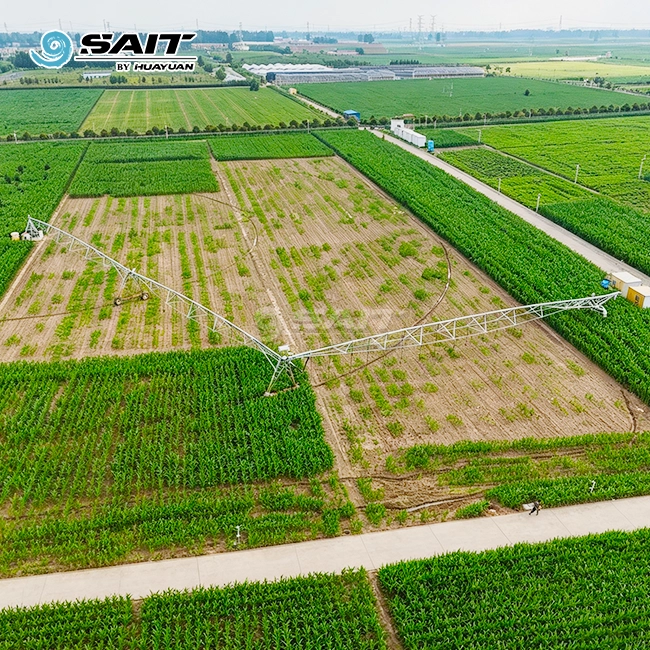
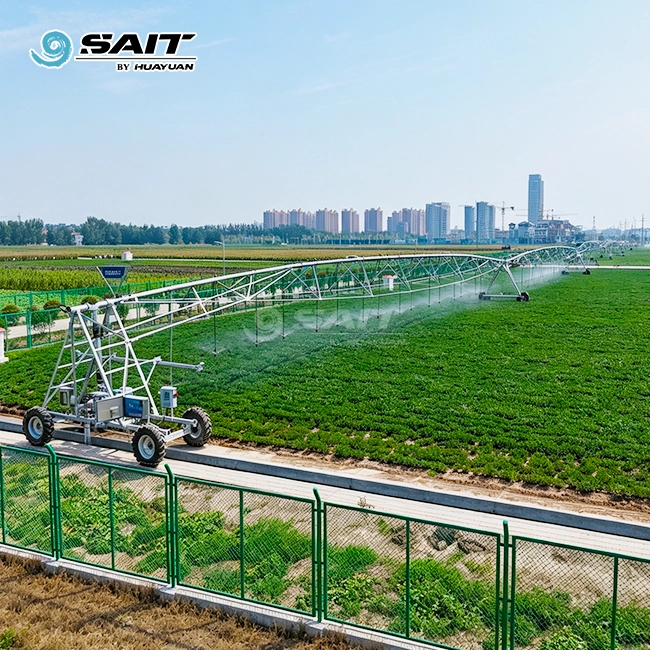
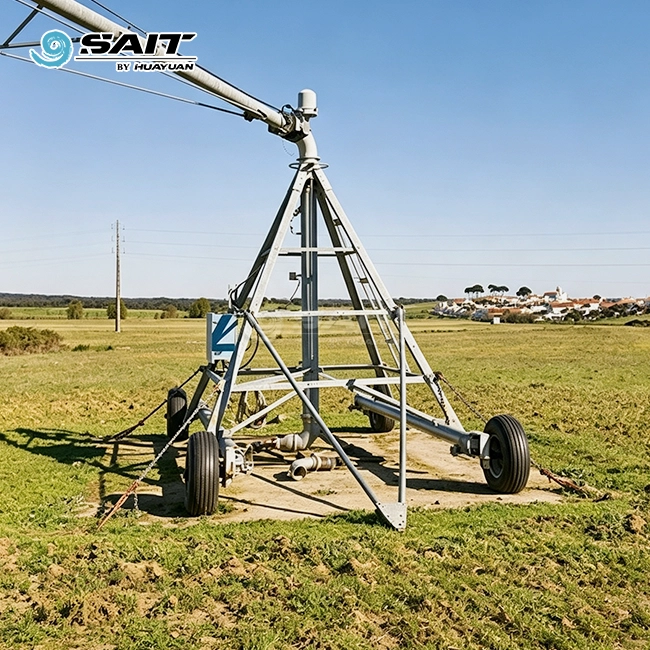
A two-wheel lateral move system uses a single-axle drive cart to move and hold the core pipe so that it is straight across the field. It goes straight ahead and is driven by either an electric cable being pulled behind it or a generator on board. This arrangement works best on flat ground that can hold the same amount of weight. HUAYUAN SAIT's two-wheel linear irrigation system can water up to 240 hectares of land and has a maximum machine length of 973 meters and a maximum journey distance of 3,000 meters.
What Is a Four-Wheel Lateral Move System?
A two-axle cart is used under each span tower in a four-wheel lateral move method. This spreads the load across a larger area. This setup is better than a two-wheel setup for heavy spans, softer ground, and mild slopes. It is usually chosen for fields with uneven soil, heavier truss configurations, or crops that need a lot of space to grow. The extra wheel contact area lowers the ground pressure per tire, which protects the structure of the soil in growing areas that are sensitive to it.
Key Mechanical Differences at a Glance
The two systems, our two-wheel lateral move and its four-wheel variant, use the same lateral-move concept, but the designs of their drive units are different. Two-wheeled carts are easier to keep up, lighter, and faster to move. Four-wheeled carts can carry more weight up and down hills and are better at keeping their balance on cross-slopes. Both systems at HUAYUAN SAIT can handle span lengths of 37.5m, 43.3m, 49.1m, and 54.9m, as well as overhangs from 2.7m to 25m. They can also be guided in a number of ways, such as by furrow, cable, or BDS/GPS dual-mode satellite.
Performance and Efficiency Comparison
Water Distribution Uniformity
When set up correctly, both configurations can get a Christiansen Uniformity Coefficient (CUC) above 90%. The HUAYUAN SAIT system uses both BeiDou tracking and IoT-based alignment control to keep the rate of missed watering below 5%, which is lower than the average for lateral move equipment in the industry. There are different ways to get water, such as through a canal or a drag hose. This gives owners choices for how to set up their fields' infrastructure.
Energy Consumption and Operating Cost
Two-wheel drive units use less energy per hectare because the smaller cart needs less power to keep going at the same speed. In remote areas where grid power isn't available, the generator power supply choice keeps things going without the need for extra infrastructure. Two-wheel carts have fewer moving parts because their mechanics aren't as complicated. This means that they will last longer and cost less to maintain over 20 years or more.
System Longevity and Structural Protection
HUAYUAN SAIT hot-dip galvanizes all steel buildings over 80μm thick, which is a coating thickness that works better than normal galvanized finishes and stays stable from -20°C to 60°C. The self-made virgin PE lines are thicker than industry standards and don't contain any recycled materials. They don't crack or break down in the sun over several growing seasons. These choices of materials directly increase the life of equipment and lower the total cost of ownership for people who run continuous irrigation systems.
Decision-Making Based on Farming Needs and Conditions
Matching System Type to Field Conditions
Two-wheel systems work best on areas that are flat, rectangular, and have hard, even ground. They work great for potato, sugar beet, carrot, veggie row crops, sugarcane, orchards, nurseries, and any other crop where more fertile land is needed and fertigation is important. Four-wheel systems work better when the soil can't hold as much weight, when the spans have to carry extra fertigation gear, or when the field has gentle cross-slopes that make horizontal drift a risk.
Crop-Specific and Agronomic Considerations
Two-wheel linear irrigation systems are a useful platform for growing cash crops where Variable Rate Irrigation (VRI) is going to be used. The straight path makes it possible to precisely apply water zone by zone, which lowers the risk of leaching on different types of soil. When linear movement is combined with low-energy precision application (LEPA) nozzles, wind drift and evaporative loss are greatly reduced compared to traditional overhead sprinklers. This results in better water use per hectare.
Cost-Benefit Analysis for Procurement Planning
Because the drive cart only needs a few parts, two-wheel systems usually have a cheaper initial unit cost than four-wheel systems. This difference in price is important when ordering 3–10 units per project by agricultural cooperatives or government irrigation authorities. When site engineering needs a certain amount of load-bearing capacity that a two-wheel cart can't safely provide, four-wheel systems are worth the extra cost. Before making a purchase, operators should ask for a field shape efficiency study that compares straight coverage to center pivot options.
Procurement and Supplier Insights for Two-Wheel and Four-Wheel Systems
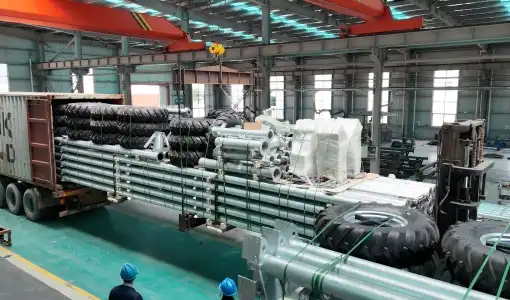
Evaluating Supplier Qualifications
When buying lateral move irrigation equipment from outside of the country, buyers should make sure that the equipment is galvanized, meets ISO standards (ISO 11545), and has safety paperwork (ISO 12100). HUAYUAN SAIT has more than 130 patents, including 35 invention patents and 15 foreign patents. These patents were created with the help of China Agricultural University and local engineering research centers. This R&D machinery helps make sure that the quality of the products is the same in both regular and custom designs.
OEM, ODM, and Custom Configuration Options
Full OEM and ODM services are available from HUAYUAN SAIT. Drive units, control panels, and guidance systems can all have private-label branding added to them. Buyers can choose the type of drive unit (two-wheel or four-wheel), the way the machine moves (furrow, cable, or GPS), the power source, the water supply, and the special span lengths needed for fields with uneven edges. First-order pilot units can be bought in quantities of one to two units, and custom drive unit designs can be made in thirty to forty-five days.
Warranty, After-Sales Support, and Parts Availability
After the sale, there is free assembly, a full guarantee for one year, low-cost upkeep and parts replacement for three years, and spare parts for life at the price the maker set them. For buyers from other countries, HUAYUAN SAIT offers on-site installation supervision and training for operators in the language of the buyer. Because the company is close to Xuzhou, it has direct access to transportation hubs, which lets it send orders quickly, both in China and abroad.
Comprehensive Installation and Operation Guide
Site Preparation and Pressure Requirements
Before installation, workers should do a topographic survey to check the slope of the field and the soil's ability to support weight. For best straight-line tracking, two-wheel lateral move devices need flat or nearly flat ground. There are two main pipe diameters, 168mm and 219mm, which can handle different flow rates. The guidance system (furrow, cable, or satellite) should be chosen based on the field's infrastructure and the technical skills of the operator.
Operational Best Practices for Seasonal Efficiency
Wheel sizes from 11.2-24 to 16.9-24, with either flat or tubed tires, should be chosen based on the conditions of the ground to avoid packing it down too much. Options with a high clearance span can handle bigger crops without damaging the canopy. The electronic system with a remote control lets workers check on and change the travel speed and water application rates from afar. This cuts down on the need for human field checks and makes sure that the same amount of water is applied over long distances.
Maintenance Protocols to Reduce Downtime
Checking the oil seals in the gearbox, making sure the flow is correct in the nozzle package, and calibrating the alignment system should all be part of regular maintenance. The HUAYUAN SAIT water turbine's 4-speed gearbox has carefully made gears that don't wear out easily and keep the speed stable even when the power load changes. The corrosion protection built into the system from the start is extended by checking the galvanized structure for coating integrity on a regular basis.
Conclusion
Two-wheel lateral move irrigation works best on flat, rectangular fields where getting the most out of the land and keeping the weight of the tools low are important. Four-wheel setups are better for situations with soft ground and heavy loads. Two-wheel linear irrigation covers more ground for less money per unit and is better for most sugar beet, potato, and vegetable row crop operations that are on level ground. The best choice is always based on the specifics of your field, like the type of soil, the slope of the land, the height of the crops, and the power source that is available. If you look at those four factors first, it will be easy to choose the right system.
FAQ
Q1: How does a two-wheel lateral move compare to a center pivot for rectangular fields?
A center pivot leaves approximately 20% of a square field unirrigated in the corners. A two-wheel linear irrigation system moves in a straight line across the full field width, achieving over 98% coverage on rectangular plots — eliminating that land waste entirely.
Q2: Can a two-wheel system handle sloped terrain?
Two-wheel lateral move systems perform best on level ground. They can manage gradients up to approximately 5–8% depending on span length and tire configuration, but steeper or uneven terrain is better served by a four-wheel drive unit with higher lateral stability.
Q3: What guidance systems are most reliable for lateral move equipment?
Furrow and cable guidance are proven, low-maintenance options. Satellite guidance (BDS/GPS dual-mode) is increasingly preferred for precision applications and fields where physical guide infrastructure is impractical to maintain.
Q4: What is the expected service life of these systems?
With hot-dip galvanized steel structures and routine gearbox lubrication, HUAYUAN SAIT lateral move systems regularly exceed 20–25 years of service life, supported by lifelong spare parts availability at factory cost price.
Get a Custom Quote From HUAYUAN SAIT — Two-Wheel Linear Irrigation Manufacturer
It has been 20 years since HUAYUAN SAIT started making lateral move and linear irrigation systems for rectangular fields all over the world. This is true whether you need a normal two-wheel linear irrigation supplier setup or a fully engineered OEM solution. Our expert team can use your field data to find the right system for you. You can email us at kevin@showyirrigation.com to get a field coverage study and project price.
References
1. Irrigation Association. Landscape and Agricultural Irrigation Performance Standards. Irrigation Association, 2021.
2. Evans, R.G., & Sadler, E.J. "Methods and Technologies to Improve Efficiency of Water Use." Water Resources Research, 2008.
3. Food and Agriculture Organization of the United Nations. Crop Evapotranspiration: Guidelines for Computing Crop Water Requirements. FAO Irrigation and Drainage Paper No. 56, 1998.
4. Howell, T.A. "Irrigation Efficiency." Encyclopedia of Water Science, Marcel Dekker, 2003.
5. International Organization for Standardization. ISO 11545: Agricultural Irrigation Equipment — Centre-Pivot and Moving Lateral Irrigation Machines with Sprayer or Sprinkler Nozzles — Determination of Uniformity of Water Distribution. ISO, 2009.
6. Smajstrla, A.G., & Zazueta, F.S. "Lateral-Move Irrigation Systems." University of Florida IFAS Extension Bulletin, 2000.
Get a tailored irrigation solution for your project — our engineering team is ready to support you from design to installation.