How to program sector control for irregular field boundaries?
Programming sector control for irregular field boundaries means configuring your center pivot or linear irrigation system to irrigate only within defined angular or geographic zones — stopping, reversing, or adjusting application rates as the machine approaches non-irrigable areas such as roads, property lines, or oddly shaped field edges. Effective sector control eliminates water waste on non-crop zones, protects infrastructure, and maximizes yield across every workable hectare. When field boundaries deviate from a clean circle, the programming logic must account for multiple stop-and-start positions, variable arc lengths, and terrain-driven clearance requirements.
Why Irregular Field Boundaries Create Real Programming Challenges
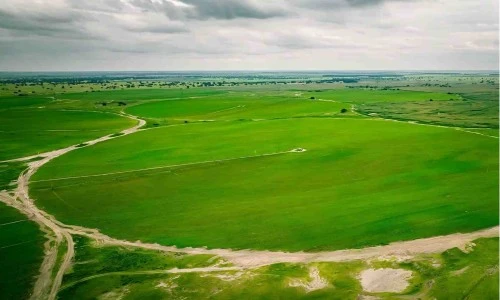
Most center pivot devices are set up to rotate in either a full circle or a simple half circle at the factory. Standard angle presets don't work when there are diagonal fence lines, road gaps, drainage ditches, or property lines that come together. If an operator only uses one stop-angle setting, they might water too much in buffer zones or leave productive crop rows dry near the edge of the field.
The Core Problem With Conventional Angular Presets
Most standard pivot control screens can store one or two stop settings. In a square or L-shaped field, the way it is set up means that workers have to do things by hand, sometimes more than once during a watering cycle. Those manual resets add up to measurable labor costs and uneven water application in a 500-hectare operation with multiple machines running at the same time. The USDA Agricultural Research Service published research that backs up the idea that uncontrolled boundary over-spray can waste 8–14% of all the water applied in a season on fields with odd shapes.
How Field Geometry Amplifies the Difficulty
Within seconds of machine movement, diagonal lines make loops where the pivot arm can swing between ground that can be irrigated and ground that can't be irrigated. In partial circle irrigation, in river valley farming and land-reform plots, narrow wedge-shaped fields mean that the machine has to do more than one start-stop process in a single revolution. If GPS-referenced border data isn't built into the control logic, timing these steps with mechanical limit switches alone leads to positional errors of ±3 to 5°, which is far enough to miss full crop rows close to the field edge.
Principles and Best Practices for Programming Sector Control in Irregular Fields
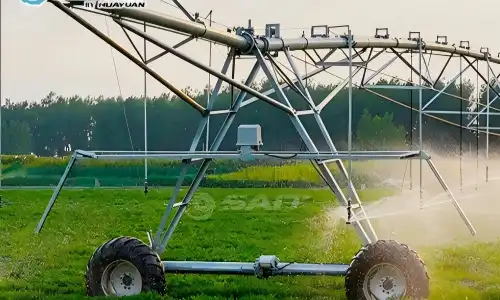
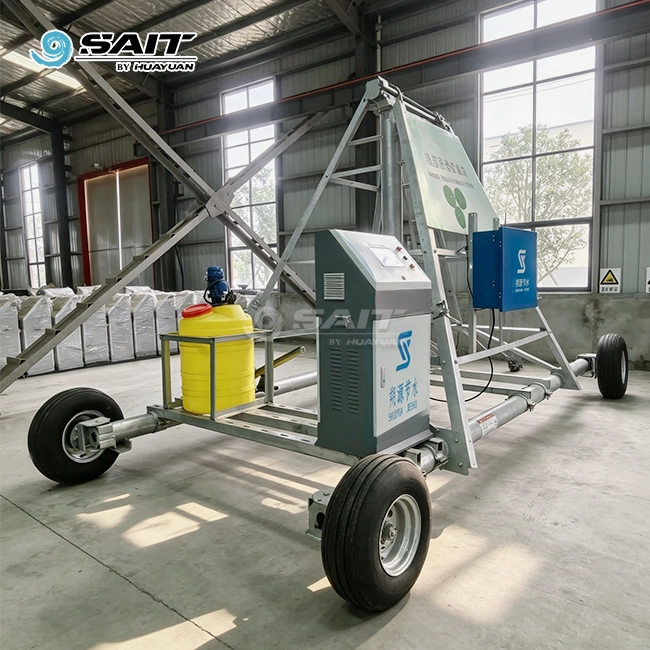
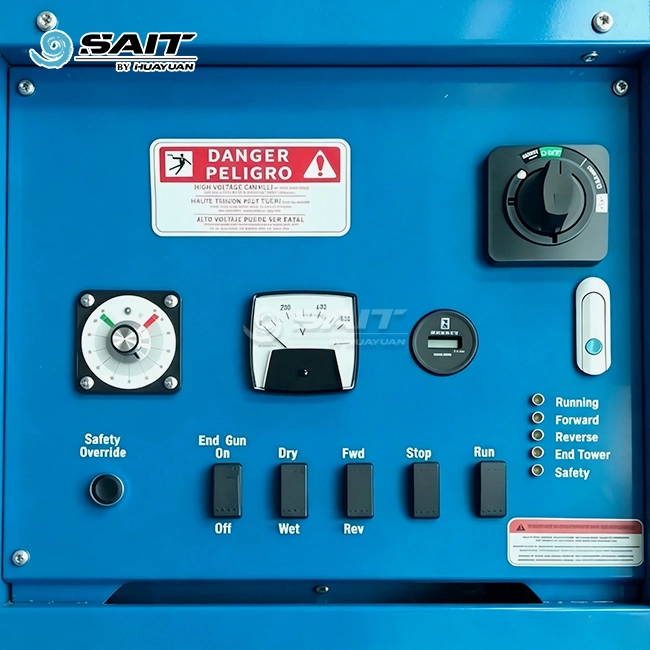
To get accurate zone irrigation on fields with non-standard forms, you need to move beyond mechanical angle switches and use software to control the field's edges. The SAIT Smart Control System, which is built into HUAYUAN SAIT center pivot machines, directly addresses this issue by combining GPS positioning with programmable multi-zone arc logic. This lets operators set up several separate irrigation sectors within a single pivot rotation.
Define Boundaries Using GPS Coordinates, Not Just Angles
Stops that are built on angles lead to the machine's own pivot point. GPS coordinate-based stops are based on real places. When there is a boundary that is diagonal to the pivot radius, a GPS-anchored stop position stays accurate no matter how the ground changes or how much the cable stretches. These are two things that make mechanical limit switches less reliable over time. Before putting any control parameters into the panel, operators should use RTK-grade GPS data to map out the edges of the fields.
Program Multiple Stop-and-Restart Sequences
Most of the time, irregular fields don't need just one specific section. A field with three sides that can't be watered and one distance for a road might need four separate arc zones programmed as a series of machine actions. The SAIT control platform allows multi-sector scheduling, which means that the pivot can complete a full boundary-compliant turn by itself, without any help from an operator at any time.
Match Application Rate to Arc Length Variation
Narrow sectors finish their arc faster than wide sectors when the timer setting is kept at 100%. The narrow area gets a lot less water per unit area if the machine goes through a 40° arc at the same speed as a 180° arc. The SAIT Smart Control System has a feature called variable-rate irrigation (VRI) that changes the travel speed or nozzle output for each defined zone. This keeps the soil evenly moist even when the arc lengths are different.
Types of Sector Control Methods Applicable to Irregular Boundaries
Which control method to use relies on how complicated the field is, what infrastructure is available, and how automated your process needs to be. The market for precise irrigation is dominated by three designs at the moment.
On older pivot systems, mechanical limit switches are still popular. They don't cost much up front, but they need to be moved every season because crop rotation or lease limits change. As the cables wear out and the towers bend under load, their location precision decreases.
Digital control with GPS integration is now the standard for large-scale commercial operations. Real-time positioning data is used by systems like the SAIT platform to start zone changes at exact field coordinates. The number of missed irrigation runs drops below 5%, which is a goal that HUAYUAN SAIT meets by combining intelligent algorithms with BeiDou navigation.
The main problem with circular pivots on square or rectangular fields can be fixed with corner arm attachments. The HUAYUAN SAIT Corner Arm System moves the outer span into field corners during the relevant circle and then pulls it back when the machine gets out of the corner zone. Field tests show that this design effectively irrigates 15% more land than standard pivot layouts on square plots, which directly lowers the cost of water and inputs per hectare.
All three of these ways can be used at the same time. To get full boundary compliance across complicated shapes, high-performing processes use GPS-referenced multi-sector programming and sector control, corner arm hardware, and VRI speed control.
Optimization Strategies for Sector Control Programming
After the initial setup, ongoing optimization tells the difference between operations that just avoid over-spray and those that actively try to get the most out of every dollar that goes in. The following methods are designed to work in situations with uneven boundaries.
Here are the main things that always make border performance better after the initial setup:
- Run a calibration rotation before the season opens. Program all sector transitions, then observe the full pivot rotation in dry-run mode. Document any positional discrepancy between the intended boundary and the actual machine stop point. Adjust GPS waypoints by the measured offset before the first live irrigation event.
- Log per-sector application data across three to five irrigation cycles. The SAIT platform exports cycle-level application records. Comparing expected versus actual water volume per sector identifies speed-timer miscalibrations that standard visual inspection cannot detect.
- Schedule maintenance checks on gearmotor and wheel gearbox units at midseason. HUAYUAN SAIT machines use 25.5:1 gearmotors (1.5 hp) and 50:1 or 52:1 wheel gearboxes. Drivetrain inconsistencies shift the machine's travel speed, which alters application depth in each sector. Catching this at midseason prevents under-irrigation during peak crop demand periods.
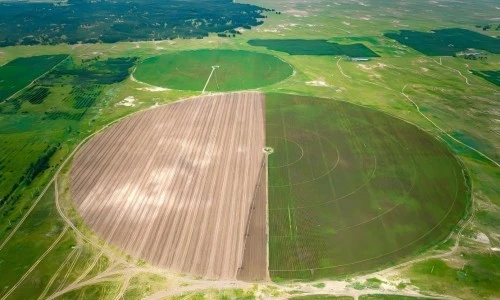
For partial circle irrigation, running a tuning shift before the season starts is a good idea. Set up all the sector changes, and then watch the center turn all the way around in dry-run mode. Write down any differences in position between the planned limit and the real machine stop point. Before the first live watering event, change the GPS markers by the amount of offset that was recorded.
Procurement and Implementation Guidance for Sector Control Systems
When looking for a center pivot provider for projects with irregular boundaries, design freedom is just as important as unit price. If you build a machine with fixed span configurations, it won't be able to adapt to the unique arc geometry that non-standard fields need.
You can get span lengths from 37.5 m to 66.5 m from HUAYUAN SAIT. The main pipeline sizes are 5" (127 mm), 6-5/8" (168 mm), and 8-5/8" (219 mm). The profile heights range from 2.1 m to 4.5 m, which includes row crops, high-clearance sugarcane farms, and biofuel plants. The hot-dip galvanized steel structure has a zinc coating that is at least 80 μm thick, which is more than the corrosion-resistance level needed for use in deserts, along the coast, and in humid tropical areas. It is designed so that the system will work for more than 20 years.
Before committing to multi-unit project orders, engineering firms and regional wholesalers can test how well SAIT controls work on a certain irregular field plan by buying one unit at a time as a pilot. With every delivery, there is on-site installation help and technical advice.
Conclusion
It is no longer necessary to do a hand calibration practice to program sector control for irregular field borders. Working together, GPS-referenced multi-sector logic, corner arm hardware, and variable-rate application make it possible for large-scale operations to water fields evenly more than 90% of the time, which was impossible for automatic coverage before. The engineering base is important: a system with precise drive components, strong structural geometry, and an open control architecture will always follow the boundaries, season after season. The most important thing to remember when designing a precision watering system is to match the right sector control setup to the shape of your field.
FAQ
Q1: What is the minimum order quantity for a custom sector control pivot configuration?
HUAYUAN SAIT will take trial orders from one unit for unique setups. This lets the people working on the project and the engineering companies test how well it works on a specific, uneven field plan before ordering more.
Q2: Can the SAIT system integrate with third-party farm management platforms?
The SAIT Smart Control System can work with SCADA and farm management systems made by other companies. For OEM clients, we offer a custom API and customized control panel language settings.
Q3: How accurate is GPS-based sector boundary positioning?
The SAIT system uses BeiDou navigation and smart positioning algorithms to achieve a missed irrigation rate of less than 5% and an irrigation uniformity of more than 90%. This makes it much better than mechanical limit switch options on fields with irregular shapes.
Q4: What pipeline specifications are available?
The main sizes of pipelines are 5" (127 mm), 6-5/8" (168 mm), and 8-5/8" (219 mm). The span lengths are between 37.5 m and 66.5 m, and the overhangs can be set up to 25 m long to cover more of the border.
Connect With HUAYUAN SAIT — Trusted Sector Control Supplier for Irregular Field Projects
Engineer HUAYUAN SAIT creates precise irrigation systems that are made to work in all kinds of field shapes, not just the perfect circle, incorporating sector control for tailored watering. Our team is ready to make a solution that fits your specific needs. We have over 130 patents, 20 years of experience making things, and a Corner Arm System that increases the effective irrigated area by 15%. To get a site-specific setup plan, email our technical team at kevin@showyirrigation.com or go to shuoyuanjieshui.aixdb.cn.
References
1. USDA Agricultural Research Service — Center Pivot Irrigation Management on Irregular-Shaped Fields, 2019.
2. American Society of Agricultural and Biological Engineers (ASABE) — ASABE Standard S436.1: Test Procedure for Center Pivot and Lateral Move Irrigation Machines, 2021.
3. Evans, R.G. & King, B.A. — Site-Specific Sprinkler Irrigation in a Water-Limited Future, Transactions of the ASABE, 2012.
4. Camp, C.R., Sadler, E.J., & Bauer, P.J. — Variable Rate Irrigation for Humid Region Precision Agriculture, Applied Engineering in Agriculture, 2010.
5. Food and Agriculture Organization of the United Nations (FAO) — Irrigation Water Management: Irrigation Methods, FAO Irrigation and Drainage Paper No. 45, 2015.
6. International Commission on Irrigation and Drainage (ICID) — Modernization of Irrigation Systems: Indicators and Assessment Frameworks, ICID Technical Report, 2018.
Get a tailored irrigation solution for your project — our engineering team is ready to support you from design to installation.