What Is a Linear Move Irrigation System?
A linear move Irrigation system is a mechanized, self-propelled irrigation solution engineered to travel in a straight line across rectangular or elongated agricultural fields. Unlike center pivot systems that rotate around a fixed anchor point, this lateral move system advances perpendicular to its structural span, delivering water uniformly from one end of the field to the other. With field utilization rates exceeding 98%, it eliminates the unirrigated corners that cost center pivot operators up to 20% of harvestable land — making it the preferred choice for large-scale rectangular field operations worldwide.
Understanding the Linear Move Irrigation System
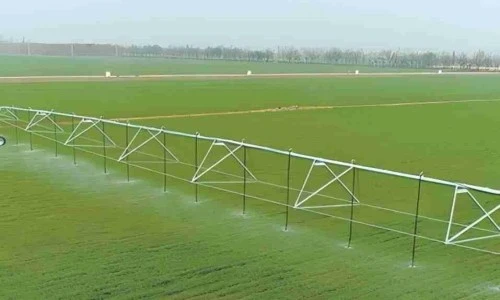
How It Moves and Why That Matters
The lateral move system moves along the length of the field on wheeled drive units, staying on a straight path that is kept accurate by furrow tracking, buried cable, or satellite navigation (BDS/GPS dual-mode). The water comes in through a canal pump entry or a drag hose that is hooked up to a pipeline hydrant that is under pressure. Mainline pipes on board, which come in 168mm and 219mm sizes, pressurize the flow to precise nozzles that are placed across spans from 37.5m to 54.9m. The built-in electronic control system, which can be set up with a standard keypad or a remote control, coordinates the speed of the tower's movement to keep the structure aligned over up to 3,000 meters of travel.
Key Components That Drive Performance
In a lateral move system, each part carries a certain amount of weight. Here are the structural parts that affect how well a field works:
- Galvanized steel spans — Hot-dip galvanized steel spans over 80μm offer rust protection that is much higher than the average for the industry. They can be used in tropical, arid, and sub-zero conditions ranging from -20°C to 60°C.
- Drive units — You can get drive units with two or four wheels and wheel sizes of 11.2-24, 14.9-24, or 16.9-24 (tubed or tubeless). You can choose the right size based on the field grade and the soil's ability to hold weight.
- Guidance systems — Guidance systems include trench guidance for low-cost tasks, cable guidance for accurate results every time, and BDS/GPS satellite guidance for sub-inch accuracy on big or rough terrain.
- Water supply modes — There are different ways to get water to facilities. A canal supply works for open-channel operations, which are popular in North Africa and Central Asia. A drag hose supply works for pressure mainline setups in North America and Australia.
- Span height options — Options for span height: standard height and high-clearance spans can handle tall cash crops like corn, sugarcane, and vegetable canopies.
Together, these parts work together to make a flexible platform that procurement engineers can set up in a way that works best for their land, crops, and infrastructure.
Benefits and Efficiency of Lateral Move Systems
Because Pivot Irrigations aren't very efficient geometrically, rectangular field operators lose a lot of harvestable land. This is fixed structurally by a side move method. A study from the American Society of Agricultural and Biological Engineers says that center pivot systems only water 78 to 80% of the total area on identical parcels, while lateral move systems consistently water over 98% of fields with a length-to-width ratio greater than 2:1.
Gains from saving water are just as important. Lateral move systems use less energy per acre than moving gun systems because they work at lower working pressures. They also keep a Coefficient of Uniformity of more than 90%. The USDA Agricultural Research Service has confirmed that using precision nozzle packages on mechanized lateral systems lowers the total amount of water applied by 30–40% compared to surface flood irrigation on the same amount of land.
Integration of fertigation is also part of operational efficiency. HUAYUAN SAIT's platform allows for the direct injection of fertilizers and crop protection agents into the irrigation stream. This cuts down on work needs and ensures that nutrients are evenly distributed along the entire trip path. This feature is especially useful for high-value crops like veggies, potatoes, and sugar beets, where the quality of the output depends on when the nutrients are added.
Comparing Linear Move Irrigation with Other Irrigation Methods
When purchasing managers look at different types of automated irrigation, they often compare lateral move systems to center pivots, drip lines, and moving gun systems. There are different pros and cons to each method.
On square or circular fields, Pivot Irrigation systems are easier to set up at first, but they can't water the corners, which is a structural loss that lateral move systems completely eliminate. A lateral move system can make up for lost space in fields with irregular edges or long rectangular shapes without the need for extra corner arm infrastructure. The HUAYUAN SAIT platform can make the machine as long as 973 meters, which is more than 240 hectares per unit. No other center pivot can do that on a single rectangular block.
For high-value specialty crops, drip irrigation is the most efficient way to use water, but it's expensive to set up and hard to keep up on more than 50–100 hectares. Lateral move systems are a good compromise because they have lower working pressure than traveling guns, a wider area than drip, and a much higher field usage than pivots.
In places where infrastructure investment is limited, traveling gun systems are still common. However, their high operating pressure and uneven water distribution (usually less than 75% CU) make them inefficient on a large scale. Every measure of agronomic efficiency that is important for commercial grain, vegetable, and sugarcane production shows that a properly set-up lateral move system works better than traveling gun equipment.
Design, Maintenance, and Automation of Linear Move Systems


Configuring the System for Your Field
For field distribution to work, you need accurate topographic survey data to start. The engineering team at HUAYUAN SAIT works directly with project managers to choose extension lengths (from 2.7m to 25m), center cart position (end-part or center-mounted), and span configuration based on the shape of the field boundaries and the slope profile. Three types of machines are available to meet different operating needs: Two-Wheel Linear Irrigation is most cost-effective, Four-Wheel Lateral Irrigation is best for heavy loads or soft soil, and Swing-Around Linear Irrigation is best for fields that need to be reoriented at the end of the field.
Automation and Remote Monitoring Capabilities
The remote control system lets operators change the speed of travel, the amount of water applied, and the parameters for guidance from a mobile device or a central control station. IoT integration lets you do diagnostics and get problem reports in real time, which cuts down on unplanned downtime. The BeiDou-integrated guidance algorithm used by HUAYUAN SAIT keeps the rate of missed watering below 5%, which is better than the average performance of similar automated systems in the industry.
Routine maintenance focuses on gearbox lubrication (every 1,000 hours of use is suggested), tire pressure management, and nozzle wear check are the main parts of routine maintenance. HUAYUAN SAIT sells spare parts at the factory cost for as long as the equipment is in use. Each unit comes with a full warranty for one year and a low-cost maintenance program for three years.
Procurement Considerations for Linear Move Irrigation Systems
When buying lateral move irrigation equipment from a business-to-business (B2B) supplier, the total cost of the system has to be weighed against the performance needs of the field. As a direct-factory linear move irrigation system manufacturer with 20 years of experience, HUAYUAN SAIT doesn't charge markups to distributors and has a one-week delivery lead time from its facility in the Xuzhou area.
The business has more than 130 patents, including 35 idea patents and 15 foreign patents. These were created through joint research with China Agricultural University and with help from state engineering research centers. Self-produced virgin PE pipes that are thicker than industry standard and don't contain any recycled materials, and a water turbine 4-speed gearbox with a wear-resistant gear formulation make service times much longer than market-standard parts.
Full private-label integration is supported by OEM and ODM services. This includes branded control panels, drive units, and custom SAIT software interfaces. Pilot orders of one to two units with custom configurations can be delivered in 30 to 45 days, which lets distributors and project developers check the performance before committing to full-scale procurement.
Conclusion
There are real economic and agricultural benefits to using a lateral move irrigation system on rectangular fields where a center pivot system can't reach the whole productive area. Field coverage of more than 98%, support for fertigation, modular configuration across guidance modes and power sources, and a maximum machine length of 973 meters are some of the main inefficiencies that cost large-scale operators money in terms of yield, water, and operating margin. For this type of purchase, you need a provider with proven engineering depth, clear component sourcing, and a reliable after-sales infrastructure. HUAYUAN SAIT meets all of these requirements thanks to its 20 years of manufacturing experience and well-documented R&D base.
FAQ
1. How much water does a lateral move system save compared to flood irrigation?
The USDA Agricultural Research Service found that mechanized lateral move systems use 30–40% less water than surface flood irrigation on the same amount of land. This is mostly because they have lower operating pressure and a more even distribution of water.
2. Can these systems operate on sloped terrain?
Yes. Depending on the length of the span and the tires chosen, flexible joint spans can work on slopes of up to about 15%. The engineering team at HUAYUAN SAIT looks over topographic survey data before deciding on the final drive unit and span design for sloped fields.
3. What guidance system is most reliable for large rectangular fields?
The most accurate tracking over long distances is achieved with BDS/GPS dual-mode satellite guidance. The missed irrigation rate for HUAYUAN SAIT's BeiDou-integrated system stays below 5%, which is the standard for big business deployments.
4. How long does the equipment last?
The main structural parts should last 20 to 25 years with normal care and a hot-dip galvanized covering that is over 80μm thick. HUAYUAN SAIT offers spare parts for life at the price of the factory.
5. Is OEM customization available for first-time buyers?
Yes, pilot orders for one to two units are welcome. Custom configurations with branded control panels and guidance system integration can be made in 30 to 45 days.
Partner with HUAYUAN SAIT — Trusted Linear Move Irrigation System Supplier
HUAYUAN SAIT offers direct-factory pricing, 20 years of experience making things, and more than 130 patents for linear move irrigation systems that are made to work well on a commercial scale. Every unit comes with on-site fitting help, a full guarantee for one year, and parts for life. If you need a standard lateral move platform or an OEM solution that is fully designed for your field, our engineering team is ready to set it up. To get a technical consultation and project quote, email us at kevin@showyirrigation.com right now.
References
1. American Society of Agricultural and Biological Engineers. (2017). Design and Performance of Mechanized Irrigation Systems for Rectangular Fields.
2. USDA Agricultural Research Service. (2020). Water Use Efficiency in Mechanized Irrigation: Lateral Move vs. Surface Flood Systems.
3. Food and Agriculture Organization of the United Nations. (2016). Irrigation Water Management: Irrigation Methods. FAO Irrigation and Drainage Paper No. 45.
4. China Agricultural University, Water-Saving Irrigation Research Center. (2021). BeiDou Navigation Integration in Precision Irrigation Equipment: Field Performance Assessment.
5. International Commission on Irrigation and Drainage. (2019). Mechanized Irrigation Systems: Procurement Guidelines for Large-Scale Agricultural Projects.
6. Howell, T. A. (2003). Irrigation Efficiency. Encyclopedia of Water Science. Taylor & Francis.
Get a tailored irrigation solution for your project — our engineering team is ready to support you from design to installation.