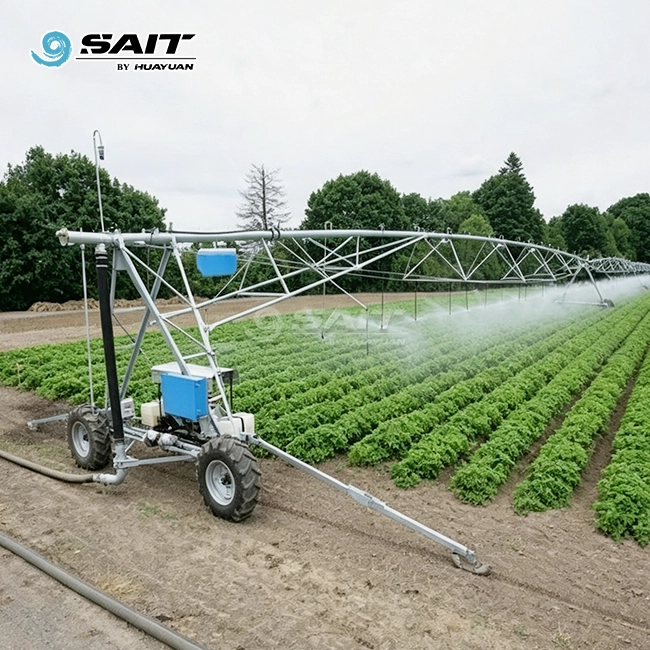
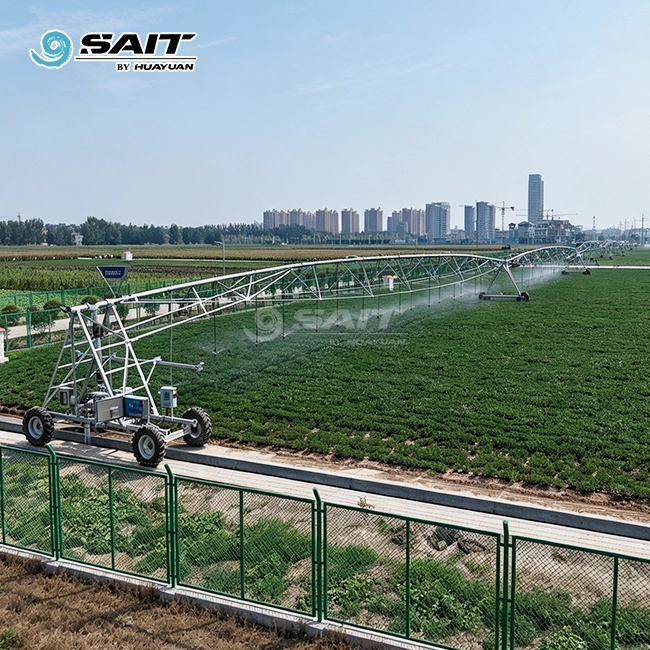
How much land can a single-span small-field irrigation cover?
A single span small fields irrigation system can cover approximately 4 to 15 hectares per irrigation cycle, depending on span length, field geometry, and sprinkler configuration. With span lengths ranging from 37.5m to 66.5m and optional overhang extensions, one unit delivers precise water distribution across compact plots where full-scale center pivots are impractical. HUAYUAN SAIT systems support coverage scaling from small demonstration plots to configurations reaching 200 hectares when multiple spans are combined, making them a practical choice for fragmented farmland, seed research plots, and high-value crop production across diverse terrain types.
Understanding Single-Span Small-Field Irrigation Systems


What Defines a Single-Span Irrigation Unit
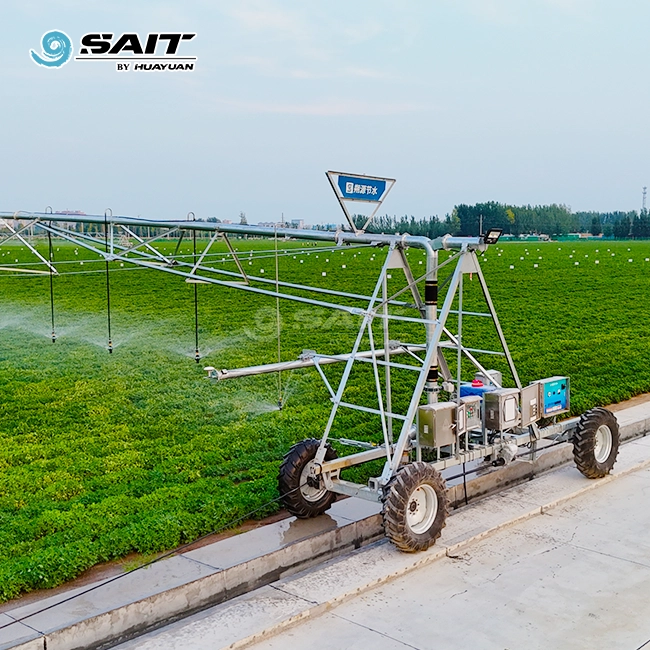
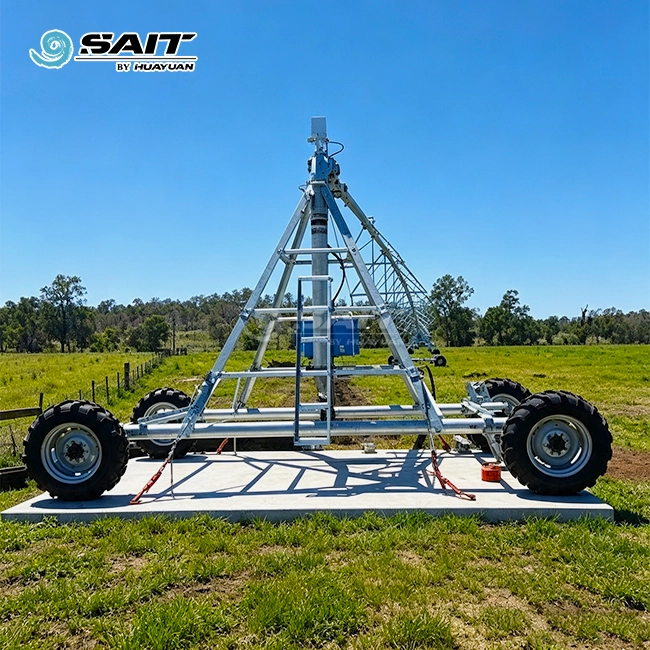
A single-span irrigation unit has one structural boom that is held up by a pivot point and a drive tower. The boom carries a line of pressurized water that has sprinkler outlets spaced out. Multi-span center pivots are made for fields that are 50 hectares or more, but this configuration is made for small areas where installation is easy and costs are low. The whole unit moves in a circle or a straight line, releasing water at set rates that are based on how well the soil can absorb it.
Core Components and Their Functions
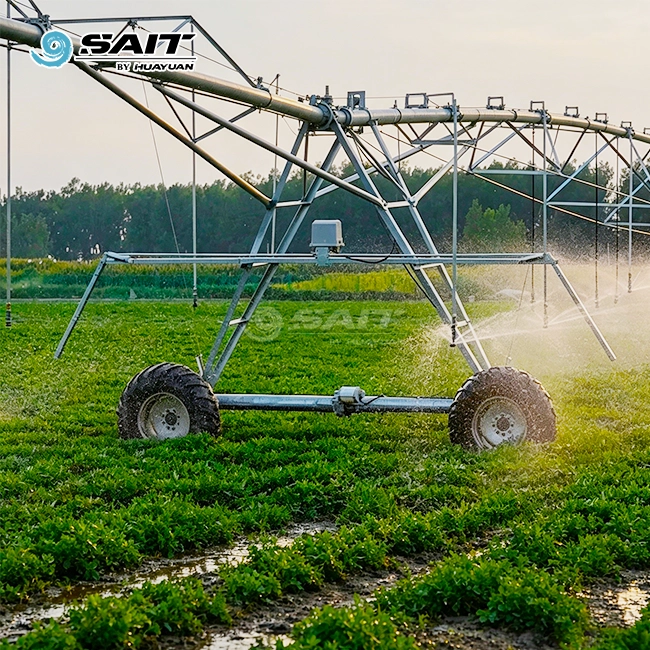
There are three normal sizes for the main pipeline: 5" (127mm), 6-5/8" (168mm), and 8-5/8" (219mm). Truss bars with sizes of 20 mm or 22 mm keep the structure straight even when the load changes. Drive towers have gearmotors with 25.5:1 (1.5hp) or 40:1 (0.75hp) ratios and wheel gears with 50:1 or 52:1 reductions. This lets the controlled motion speed work on a variety of ground conditions. UL-listed cables with armor protect electrical connections from damage in the field.
Profile Options and Structural Design
The small field pivot is available from HUAYUAN SAIT in four profile heights: normal at 2.1 m, low-clearance at 2.9 m, high at 3.8 m, and ultrahigh at 4.5 m. This range works for crops ranging from soybeans that grow low to corn and sugar cane that grow high, without affecting the regularity of the sprinklers. The angle geometry and truss rods make sure that the span loads are spread out evenly. This keeps the structure from bowing during the whole rotation cycle and keeps the outlet spacing at 1.9m or 2.9m along the boom.
How Much Land Can a Single-Span Irrigation System Effectively Cover?
This is the first question most procurement workers ask, and the answer rests on a number of factors that work together.
Coverage by Span Length
The irrigated radius and, by extension, the wetted area are directly related to the span length. Based on HUAYUAN SAIT's common setups, here is a useful guide:
- 37.5m span: Covers approximately 0.4–0.5 hectares per full rotation cycle, suitable for demonstration plots and seed research parcels.
- 49.1m span: Covers approximately 0.7–0.8 hectares, fitting most high-value vegetable or hybrid seed production fields.
- 66.5m span: Covers approximately 1.3–1.5 hectares, representing the upper range for compact mechanized irrigation without transitioning to multi-span configurations.
These numbers are based on a full circle sweep. Depending on the design, overhang additions from 2.7m to 25m can add more land without the need for a full new span.
Field Shape and Its Impact on Actual Coverage
When compared to ideal circle sweeps, square and irregular field shapes don't cover as much ground. This is directly dealt with by HUAYUAN SAIT's corner arm system. By extending a flexible arm during corner passes, the device can water more of a square parcel's surface area. For uneven ground with 15% grade, high-flotation tire choices (14.8-24 and 16.9-24) keep their grip without wearing down the structure, so cova erage stays the same around the whole field.
Comparing Coverage Against Alternative Systems
In terms of technology, single-span mechanized irrigation is in a certain place. Drip irrigation is very good at using water efficiently, but it needs a lot of infrastructure to be set up and a lot of work to keep up over the same 4–15 hectare range. Stationary sprinkler grids are better at covering odd forms, but they can't be automated and don't produce as even of a spread (usually 70–80% vs. 90%+ uniformity coefficient; shape a standardized single-span unit). For areas smaller than 4 hectares, hand or drip methods are still usually cheaper. When used on more than 15 hectares, multi-span center pivots have better cost-per-hectare rates.
Comparing Single-Span Irrigation with Other Irrigation Solutions for Small Fields
Knowing how this technology fits into the market as a whole helps buyers make choices that they can stand behind.
Initial Investment and Total Cost of Ownership
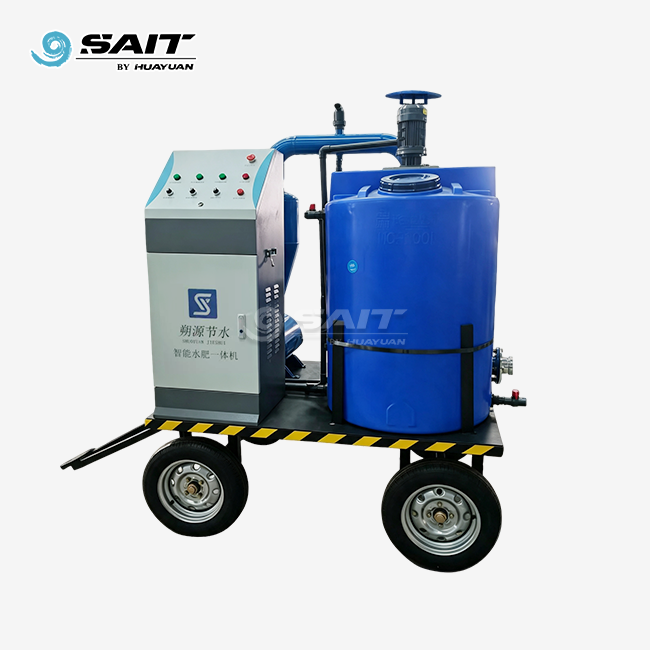
For single span small fields irrigation, a HUAYUAN SAIT single-span unit costs less up front than a multi-span pivot of the same size and offers levels of automation that human systems can't match. Hot-dip galvanizing with a zinc coating that is at least 80μm deep makes structures last longer than 20 years, which lowers the cost of repair and the number of times they need to be done. Because the water and fertilizer functions work together, you don't need to buy separate fertigation equipment. This saves money on capital costs because you only need to buy one system for two functions.
Water Use Efficiency Compared to Flood Irrigation
The Food and Agriculture Organization of the United Nations (FAO) says that 40–60% of the time, river irrigation is more efficient than other methods of applying water to fields. HUAYUAN SAIT's single-span systems save over 70% more water than traditional flood methods because they send water directly to the root zone through spray packages that are set to match the rate at which water soaks into the soil. This efficiency benefit is directly good for the economy in places where water is scarce or where the cost of water is going up.
Automation Depth vs. Stationary Sprinkler Systems
Stationary sprinkler grids need to be moved and valves need to be operated by hand. The HUAYUAN SAIT pivot units come with the SAIT Smart Control System, which le,ts you operate them from afar and use big data agronomic models to schedule irrigation and set different rates for different zones. When BeiDou navigation is added, missed irrigation zones drop to less than 5%, which is a technical goal that stationary systems can't physically reach. For business farms that take care of multiple plots, this level of technology directly means less work and more consistent yields.
Key Considerations for Selecting a Single-Span Irrigation System
To choose the right setup, you need to make sure that the technical specs match up with what's happening in the field and what the long-term operating needs are.
Matching Span Length to Field Dimensions
The most common mistake in buying is choosing span length based only on field area, without taking into account field shape, entry places, and clearance for obstacles. The engineering team at HUAYUAN SAIT helps with site-specific span design, taking into account things like uneven edges, slopes, and crop clearance needs. To keep the boom from touching the ground during late-season passes, the span height should be chosen based on the tallest crop in rotation.
Evaluating Durability Requirements for Your Operating Environment
Irrigation systems are more likely to rust in tropical, arid, or high-humidity areas than in other areas. HUAYUAN SAIT's hot-dip galvanized layer at 80μm+ is much better at resisting salt spray than normal electro-galvanized parts. From -20°C to 60°C, the system works steadily, which covers most farming conditions from the continental zones of North America to sub-Saharan Africa. Long-term failure risk from material degradation is lower for self-produced virgin PE pipes that don't contain any recycled material.
After-Sales Support and Spare Parts Availability
For small field pivot users, long-term operational reliability depends as much on supplier support as on the quality of the initial product. HUAYUAN SAIT offers monitoring of the installation on-site, a full guarantee for one year, and low-cost upkeep and part replacement for three years. Lifelong supply of spare parts at the factory cost price takes away the risk that buyers often face when working with suppliers that aren't well-known. With the ability to make 1,800 pivot and linear systems every year, extra parts will always be available for the entire duration of a product.
Where and How to Procure Single-Span Irrigation Systems for Small Fields?
When buyers go into buying for the first time, they often focus on unit price and not give enough weight to delivery speed and customization options.
Evaluating Suppliers Beyond Price
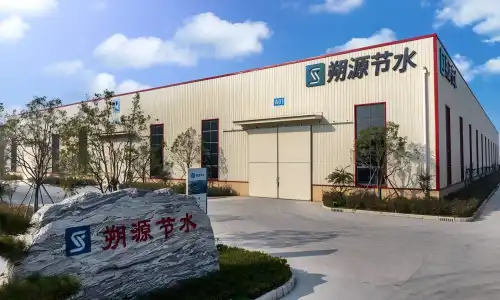
HUAYUAN SAIT is located next to Xuzhou in the Huaihai Economic Zone, which is in a hub-level transportation network. This area allows for faster export dispatch, lower freight costs, and more reliable delivery schedules than suppliers in manufacturing zones that are farther away. The company has been making things for 20 years and has over 130 patents, including 35 invention patents and 15 international patents. This shows that they have strong technical credentials that go beyond their catalog-level products.
Customization Options Available for OEM and Project Buyers
Original Equipment Manufacturers (OEMs) can ask for their logo to be placed anywhere on tower boxes and truss assemblies, colors to be matched to RAL or Pantone, and SAIT control panel interfaces to be localized in the language they need. For pilot orders, the MOQ is one unit for unique setups, and it takes 30 to 45 days to make a quick prototype of attachments like corner arms and end guns. Full OEM paperwork packages come with video installation guides set up for dealer training and exploded parts diagrams with private-label part numbers.
How to Request a Quotation
Visit the product information page at shuoyuanjieshui.aixdb.cn for technical specifications and configuration options. Send your field dimensions, crop type, power supply details, and required span configuration to kevin@showyirrigation.com for a direct factory quotation. Including a field map or GPS boundary coordinates speeds the engineering review process.
Conclusion
For single span small fields irrigation, standard span setups allow single-span mechanized irrigation to cover 4 to 15 hectares per cycle. This makes it a useful and inexpensive option for small business plots, seed research fields, and irrigation projects where full center pivots are too big. The span lengths in HUAYUAN SAIT's product line range from 37.5m to 66.5m, and there are four profile height options. The design is ISO 11545-compliant, and the uniformity coefficient is 90% or higher. This system is a good buy for buying teams working in commercial agriculture, government programs, and regional distribution because it saves over 70% of water compared to flood irrigation, has a structure lifespan of 20 years or more, and can be fully customized by the OEM.
FAQ
Q1: What is the minimum field size for a single-span pivot system?
For plots as small as 4 hectares, these systems give the best return on investment. Below that point, the cost of capital per plot goes up compared to hand or drip methods that are easier to use. For plots that are between 1 and 4 hectares, a towable design might be a better way to get started.
Q2: How does distribution uniformity compare to drip irrigation?
As per ISO 11545 testing standards, a single-span unit that has been properly calibrated has a uniformity coefficient of more than 90%. Drip systems can reach this number in perfect conditions, but they break down faster in places with hard water or a lot of sediment if the filters aren't maintained regularly.
Q3: Can these systems operate in off-grid locations?
Yes. A 0.75kW tower motor doesn't use much power, and a small diesel engine on-site can power the whole setup. HUAYUAN SAIT can also link to 3-phase grids, but this depends on the facilities in the area.
Q4: What maintenance does the system require annually?
Gearbox oil levels, tire pressure, nozzle regulator cleaning, and the function of the alignment switch should all be checked once a year. Under normal field conditions for the first ten years of service, the 80µm hot-dip galvanized structure doesn't need any surface retreatment.
Start Your Project with HUAYUAN SAIT — Single Span Small Fields Irrigation Supplier
With every single span small fields irrigation for sale inquiry we receive, HUAYUAN SAIT brings 20 years of manufacturing experience and more than 130 patents. With our factory-direct prices, 80εm hot-dip galvanizing construction, and SAIT Smart Control integration, you can get a solution that is both technically sound and long-lasting without having to pay a broker. To get started, email our team at kevin@showyirrigation.com ask for your field-specific setup.
References
1. Food and Agriculture Organization of the United Nations. Crop Evapotranspiration: Guidelines for Computing Crop Water Requirements (FAO Irrigation and Drainage Paper No. 56). FAO, 1998.
2. International Organization for Standardization. ISO 11545: Agricultural Irrigation Equipment — Centre-Pivot and Moving Lateral Irrigation Machines with Sprinkler or Spray Nozzles — Determination of the Distribution of Water . ISO, 2009.
3. American Society of Agricultural and Biological Engineers. ASABE Standards: Design and Installation of Microirrigation Systems (EP405.1). ASABE, 2012.
4. Keller, J., & Bliesner, R. D. Sprinkle and Trickle Irrigation. Van Nostrand Reinhold, 1990.
5. Howell, T. A. "Enhancing Water Use Efficiency in Irrigated Agriculture." Agronomy Journal, Vol. 93, No. 2, 2001.
6. Evans, R. G., & Sadler, E. J. "Methods and Technologies to Improve Efficiency of Water Use." Water Resources Research, Vol. 44, No. 7, 2008.
Get a tailored irrigation solution for your project — our engineering team is ready to support you from design to installation.