How does universal linear work in farmland?
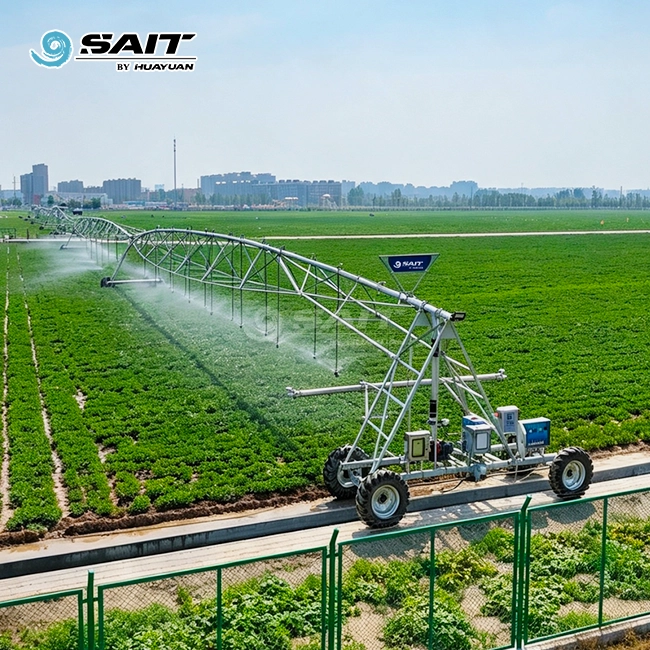
Universal linear irrigation is a lateral-move irrigation method where a long, self-propelled boom travels in a straight line across rectangular or irregularly shaped fields, applying water uniformly as it moves. Unlike a center pivot that rotates in a circle, a universal linear irrigation system travels forward and backward across the full field width, achieving up to 98% field coverage. This makes it particularly well-suited for sugar beet, potato, and vegetable row crop operations where square or rectangular plots cannot be efficiently served by circular systems.
What Is Universal Linear Irrigation? System Overview and Technology Explained


Core Structural Components
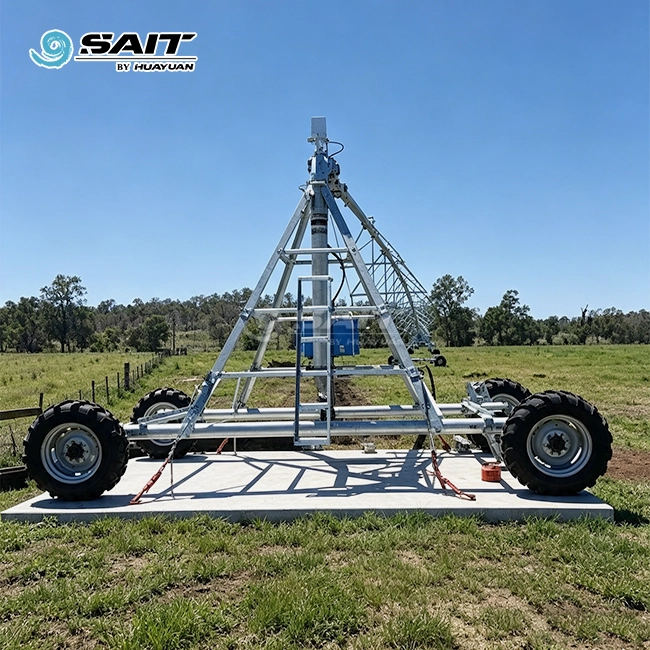
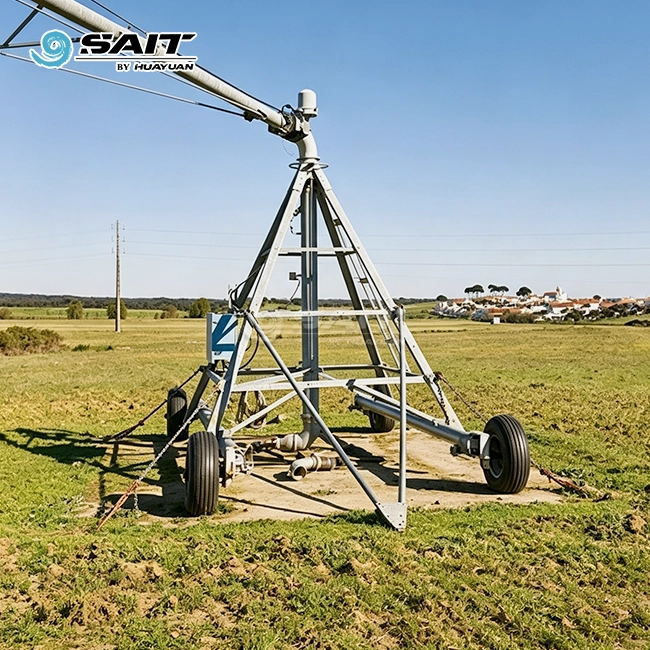
The equipment is made up of several spans that are linked and held up by self-moving drive towers. Each span section has a trunk pipe with a width of either 168 mm or 219 mm that sends water to sprinkler heads or drop nozzles that are above. The HUAYUAN SAIT universal linear move system can handle span lengths of 37.5m, 43.3m, 49.1m, and 54.9m, and the machine can be as long as 973m in total.
Movement and Guidance Technology
There are three types of guidance modes that the system can use to follow a set path: furrow guidance (physical trench tracking), cable guidance (hidden wire signal), or BDS/GPS dual-mode satellite guidance. Satellite guidance keeps horizontal drift to less than 10 cm over a 1 km run. This is very important for row crops, where the placement of the wheel tracks affects how far apart the plants are and how much food is produced.
Water and Power Supply Configuration
This convertible irrigation system uses either a canal entry with suction filtering or a drag hose from a hydrant to bring water to the boom. A trailing cable connects to either the power grid or a diesel generator on board. This means that it is possible to use in remote fields without permanent electrical infrastructure. Because it is flexible, the system is different from fixed irrigation options that need ongoing infrastructure work.
Benefits and Efficiency of Universal Linear Irrigation in Farmland
Field Coverage and Water Uniformity
A well-calibrated lateral move system has a uniformity coefficient (CU) of more than 90%, which can be proven by catch-can tests that follow ASAE S398 guidelines. This level of uniformity lowers both overwatering in some areas and plant stress caused by dry spots, which have a direct effect on business growth goals in high-value crops.
Dual-Mode Operation Cuts Equipment Costs
The ability to turn 180 degrees around the central drive cart is one of the most useful and cost-effective benefits. This means that the same machine can work in both straight travel mode and center pivot mode, which means that it can water twice as much land with the same investment. HUAYUAN SAIT's product data says that this dual-mode design lowers the overall cost of equipment by about half compared to setting up different systems for each field block.
Terrain Adaptability and All-Weather Operation
The better wheel system, which comes in sizes 11.2-24, 14.9-24, and 16.9-24 with or without tubes, handles rough ground well. The hot-dip galvanized steel layer is more than 80µm thick and covers all structural parts from -20°C to 60°C. The flexible span joints allow for up to 15% changes in the terrain. This means that the method can be used for both temperate grain belts and dry desert recovery projects.
Universal Linear Irrigation vs. Other Irrigation Methods
Comparison with Center Pivot Systems
A center pivot covers an area that is round, leaving the corners of the field dry, which is usually 21% of a square plot. The universal linear irrigation lateral move system goes all the way across the field, reaching corners and edges that a pivot can't. This difference in effective coverage can be measured in terms of how much money is made each season on rectangular industrial fields that are at least 200 hectares in size.
Comparison with Drip Irrigation
Drip systems send water precisely to the root zone, but they need a lot of filtration, regular upkeep on the emitters, and a big investment of money per hectare. A lateral move system covers the same area but requires much less work to maintain and is cheaper to install. For permanent crops and orchards, drip is still the better option. But for annual row crops that are rotated every season, the lateral move system's ability to be moved gives it a clear operational advantage.
Addressing Installation Complexity
Preparing the site for a horizontal move system is more precise than preparing the site for a center pivot. Skilled technicians are needed to dig the guidance channel, set the distance between the hydrants, and calibrate the initial alignment. This is directly addressed by HUAYUAN SAIT, which offers on-site installation supervision, operator training in the buyer's language, and remote diagnostics through the SAIT platform. This lowers the learning curve that has historically kept people from adopting.
How to Maintain and Optimize Universal Linear Irrigation Systems?
Routine Inspection Schedule
Maintenance should be done once a year to include changing the oil in the gearbox, checking the tire pressure, and checking all the electrical connections for water damage. Gearboxes are checked to make sure that the seals are still good so that they don't crack in cold places where winter temperatures drop below -10°C. Every 500 hours of operation, a nozzle wear check keeps the application consistency above the 90% CU level.
Guidance System Calibration
At the start of each growing season, satellite tracking devices should be set up again. For cable and furrow guide systems, mid-season changes can be avoided by checking the trench profile or making sure the underground cables are still connected. Keeping lateral accuracy below 10 cm protects the space between rows of crops and keeps the wheels of the drive tower from touching the rows of plants.
Long-Term Component Reliability
The convertible irrigation systems from HUAYUAN SAIT use self-made virgin PE pipes that are thicker than similar products on the market and don't contain any recycled material. This has a direct effect on the service life of pipes in deserts with a lot of UV light. When you add the 80µm-plus galvanized coating to all the steel structure parts, the system is built to last more than 20 years with normal upkeep.

Procurement Guide for Universal Linear Irrigation Systems
If you want to buy a lateral move irrigator, you need to think about a lot of things, like the shape of your field, where you can get water, and when you can get parts in the future. Before placing an order, procurement teams with a lot of experience look at these main things:
- Field shape and guidance mode selection: Rectangular fields over 200ha are the economic sweet spot for linear systems. GNSS guidance commands a 20–35% premium but eliminates the need for trench maintenance and suits fields with variable boundary geometry.
- Water supply infrastructure: Canal-fed systems allow unlimited travel distance but require integrated filtration. Drag hose systems are cleaner and faster to commission but are practically limited to 200–400m travel runs per hose connection point.
- Power supply logistics: Generator-powered configurations suit remote fields in Central Asia or Sub-Saharan Africa where grid connection is not available. Trailing cable setups reduce fuel costs for fields near grid infrastructure.
- Spare parts and after-sales terms: HUAYUAN SAIT offers a 1-year full warranty, 3-year low-cost maintenance and parts replacement, and lifelong supply of spare parts at factory cost price. With 20 years of manufacturing experience and 1,800 units of annual production capacity, supply continuity is a verifiable commitment rather than a marketing statement.
When you add these things up, they give you a much truer picture of the total cost of ownership than the unit purchase price alone. When procurement teams buy directly from a maker like HUAYUAN SAIT, they don't have to pay the markups that distributors charge, and they can get full OEM and ODM customization, such as private-label control panels, custom span lengths, and dual-beam drive unit configurations for heavy-load uses.
Conclusion
A universal linear irrigation system can water rectangular fields that center pivots can't reach well, uses water with uniformity coefficients above 90%, and works with different power and water supply setups that are good for areas that are rural or don't have a lot of infrastructure. One machine can cover twice as much ground as a single-directional horizontal move because it can rotate 180 degrees. This greatly lowers the capital cost per irrigated acre. These systems can last 20 years or more if they are calibrated correctly, have regular mechanical upkeep, and have a stable parts supply chain. This makes them a good long-term investment for big rectangular field operators, cooperatives, and government irrigation programs.
FAQ
Q1: Can the system handle sloped terrain?
Yes. The span joints have a hook-and-receiver flexible connection that can handle changes in terrain of up to 15%. Structural load tests make sure that the structure works on uneven ground, which is common in Central Asia and North Africa.
Q2: What is the difference between canal-fed and hose-fed water supply?
Canal-fed systems use suction screens to pull water from open waterways, which lets the machine move for kilometers without stopping. Drag hoses connect hose-fed systems to pressurized hydrants. This limits movement to about 200–400m per link but provides cleaner water that needs less nozzle filtering.
Q3: How does the 180-degree swing-around function work?
When the machine is still, the central drive cart can turn 90 to 180 degrees, which moves the whole thing to cover an adjacent field block. This movement is controlled by PLC logic, so the system doesn't need to be taken apart or moved by car.
Q4: What certifications do the machines meet?
There are more than 130 patents that HUAYUAN SAIT has. There are 35 new patents and 15 foreign patents. As required by ISO 1461, the hot-dip galvanized coating has a minimum zinc thickness. All span sections are tested under hydrostatic pressure at 1.5 times the maximum operating pressure.
Request a Quote from HUAYUAN SAIT — Universal Linear Irrigation Supplier
HUAYUAN SAIT has spent 20 years making systems that work in rectangular fields, areas that turn deserts into farms, and cooperative farm networks all over the world. Our universal linear irrigation machines can work in both pivot and linear modes, have full OEM branding, and can be configured in the field. They also come with a real after-sales program that provides parts for life. To get a field coverage analysis, product list, or price for a particular project, email our technology team at kevin@showyirrigation.com.
References
1. Keller, J., & Bliesner, R. D. Sprinkle and Trickle Irrigation. Van Nostrand Reinhold, 1990.
2. American Society of Agricultural and Biological Engineers. ASAE S398: Procedure for Sprinkler Distribution Testing for Research Purposes. ASABE, 2007.
3. Howell, T. A. "Irrigation Efficiency." Encyclopedia of Water Science, Marcel Dekker, 2003.
4. Food and Agriculture Organization of the United Nations. Crop Evapotranspiration: Guidelines for Computing Crop Water Requirements. FAO Irrigation and Drainage Paper No. 56, 1998.
5. Hanson, B., Schwankl, L., & Fulton, A. Scheduling Irrigations: When and How Much Water to Apply. University of California Division of Agriculture and Natural Resources, Publication 3396, 1999.
6. Payero, J. O., Tarkalson, D. D., Irmak, S., Davison, D., & Petersen, J. L. "Effect of irrigation amounts applied with subsurface drip irrigation on corn evapotranspiration, yield, water use efficiency, and dry matter production." Agricultural Water Management, Vol. 95, Issue 8, Elsevier, 2008.
Get a tailored irrigation solution for your project — our engineering team is ready to support you from design to installation.