How Does Sector Control Improve Precision Center Pivot Irrigation?
Sector control transforms center pivot irrigation by dividing the full circular field into independently managed arc segments. Rather than applying uniform water across the entire rotation, the system activates or modulates irrigation only within designated zones. This approach aligns water delivery with actual crop demand, soil type variation, and field topology. The result is measurably higher application efficiency, reduced energy draw per cycle, and better yield consistency across the field. For large-scale commercial operations managing 500 hectares or more, this level of zonal precision directly reduces input costs while protecting long-term soil health.
Understanding Sector Control in Precision Center Pivot Irrigation
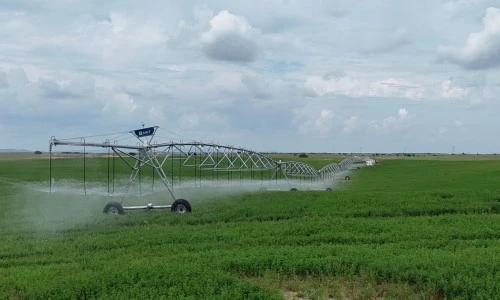
Center pivot systems aren't just simple water lines that spin around. Today's precise irrigation means that each part of a field needs to get water that is just right for it, not all of it at once based on the worst-case zone.
When a center pivot has sector control, its rotation arc is split into segments that can be programmed. Each part can have a different application rate, run time, or even be skipped. The HUAYUAN SAIT Smart Control System allows for remote scheduling and variable rate irrigation (VRI) through big data soil models. This means that the pivot reacts to real field data instead of the operator's best guess. There is more than 90% uniformity in the irrigation, and the system is designed to match the infiltration characteristics of the soil. This stops both surface runoff and deep percolation losses.
A lot of the water used in traditional river irrigation is lost to evaporation and flow. A properly set up center pivot with sector control, on the other hand, saves over 70% more water than flood methods. This number is supported by research from the USDA NRCS on the efficiency of mechanized irrigation. One HUAYUAN SAIT unit can water anywhere from 4 to 200 hectares per cycle, and it can reach a radius of up to 800 meters.
The system comes in standard, low, high, and ultra-high profile options with span heights of 2.1m, 2.9m, 3.8m, and 4.5m. It can handle a wide range of crops, from low-clearance wheat to high-canopy sugar cane and biofuels. There are different sprinkler sets to meet the needs of sector watering across different fields. The outlet spacing can be 1.9m or 2.9m, and it can be customized to make sure that the application is equal across span lengths ranging from 37.5m to 66.5m.


Challenges in Implementing Sector Control Systems and How to Overcome Them
It's not easy to switch to sector control. Problems that procurement teams and project engineers often face fall into three groups: hardware compatibility, environmental durability, and system integration complexity.
Compatibility and Durability Barriers
Older pivots often use analog signals that digital sector controls can't understand. This is taken care of by HUAYUAN SAIT's armored UL-listed cable infrastructure and gearmotors rated at either 25.5:1 (1.5hp) or 40:1 (0.75hp). These are made to work reliably in a range of electrical environments, from 3-phase grid power to diesel-driven setups that are common in off-grid African and Middle Eastern deployments.
The ability to last in difficult environments is also a big problem. Sand getting into systems, UV damage, and changes in humidity all speed up the failure of parts in systems that aren't built well. The framework of HUAYUAN SAIT is made of hot-dip galvanized steel that has a zinc covering that is at least 80μm thick. This is a higher standard than regular galvanizing and ensures that the structure will last longer than 20 years. Using 20mm or 22mm truss rods, based on the layout, the truss rod and angle structure design spreads the load evenly across each span.
This building standard can be used in operational conditions ranging from -20°C to 60°C without any problems. When procurement teams compare the total cost of ownership of this product to well-known names like Valley or Lindsay, this galvanizing standard, along with a design life of 20 years or more, gives them a big lifetime cost edge.
Early-stage soil mapping, span configuration planning, and integration testing with third-party SCADA or farm management platforms should all be part of a structured implementation roadmap. HUAYUAN SAIT offers expert support and on-site installation supervision, which lowers the risk of deployment for first-time users and EPC companies in charge of projects with multiple units.
Comparing Sector Control to Other Irrigation Control Technologies
With centralized irrigation controls, one order tells the whole system what to do. That model works well for fields that are all the same, but it doesn't work well when the soil, slope, or crop type changes across the field border.
IoT-Enabled Zone Management vs. Conventional Approaches
IoT-connected sector control systems, like the SAIT platform, link smart algorithms, BeiDou navigation, and real-time sensor data to provide sub-field accuracy that can't be matched by centralized controllers. The BeiDou integration fixes a problem that standard pivots have had for a long time: corner irrigation. The HUAYUAN SAIT corner arm system effectively irrigates up to 15% more land than traditional center pivots. This directly solves the problem of missed coverage in square or uneven field plans.
The rate of missed irrigation with this method is less than 5%, while the average in the business is often more than 10–15% in corner zones. For government agriculture offices and state farm owners in charge of food security programs, that 15% area recovery means a lot more crop output for every dollar spent on infrastructure.
The SAIT system can be expanded to fit main pipelines that are 5" (127mm), 6-5/8" (168mm), or 8-5/8" (219mm) in diameter. It can also handle wheels that are 11.2-24, 14.8-24, or 16.9-24 in either tube or tubeless setups. One procurement standard can be used for pilot installations with one to three units and commercial deployments with five to twenty units per project.
Real-World Examples and Case Studies of Sector Control in Action
The usefulness of sector control has been proven by methods that have been put into use. After replacing centralized pivots with sector control timing, a state farm in Kazakhstan that manages more than 1,000 hectares of wheat blocks saw a clear drop in peak water demand. Different application rates for different types of soil decreased the total amount of water used during the growing season without lowering crop yield, which is in line with what the International Water Management Institute found about the return on investment (ROI) of precision irrigation.
Performance Outcomes Across Agricultural Regions
The 4.5m ultra-high profile design from HUAYUAN SAIT keeps the ground clear while incorporating fertigation straight into the irrigation cycle. This is useful for sugar cane operations that need pivots with high clearance. This combined system for delivering water and fertilizer cuts down on both nutrient loss and the cost of work needed to apply the fertilizer. Researchers in the field of agronomy have found that combining fertigation with sector control can increase the amount of nitrogen used by 20–35% compared to using separate application methods.
For one year, HUAYUAN SAIT guarantees the performance of the sector watering system with a full warranty. For three years, they offer a low-cost maintenance and parts replacement program, and they will supply spare parts at the factory cost price for life. With the ability to make 1,800 pivot and linear systems every year, supply promises are kept for multi-unit project orders.
How to Choose and Procure the Right Sector Control System for Your Business?
To choose the right system, you need to match technical specs to what's needed in the field and then check how reliable the provider is by looking at their production capacity, infrastructure for after-sales support, and the quality of their paperwork.
When buying teams, look at a sector control source; these are the main things they should look at:
- Technical specification alignment: Make sure that the span lengths (37.5m–66.5m), overhang lengths (2.7m–25m), and profile heights (2.1m–4.5m) fit your operation's field geometry and crop clearance needs.
- Certification and standards compliance: If you are buying something in the US, make sure that it meets ISO 9001 standards, aligns with ASABE standards, and meets UL-listed cable specs. HUAYUAN SAIT has more than 130 patents, including 35 invention patents and 15 foreign patents. He got these patents by working with China Agricultural University on joint projects through local engineering research platforms.
- OEM and customization capability: HUAYUAN SAIT offers a full OEM service that includes custom branding on tower boxes, control panels, and truss assemblies, as well as localized control panel language and user interface for markets from North America to Southeast Asia. This service is useful for regional irrigation brands and government contractors with technical specifications.
- After-sales network and lead time: HUAYUAN SAIT is located in the Huaihai Economic Zone, next to Xuzhou. This gives them access to hub-level logistics and the ability to deliver standard configurations within one week, which eases the concerns about lead time that many trading companies have when they buy from Chinese manufacturers.
All of these things together show if a purchasing choice brings value throughout the entire span of an item, not just when it is bought. Direct factory supply cuts out the middleman, and the full export paperwork package meets international standards for buying in all major importing areas.
Conclusion
What a center pivot can do changes when sector control is used. Precision sector control systems lower operating costs per hectare across the whole rotation by applying water based on actual field conditions instead of having regular cycles. This cuts down on waste, improves yield distribution, and lowers operating costs per hectare. The HUAYUAN SAIT-equipped center pivot has this feature, as well as an 80μm hot-dip galvanized frame, smart control that works with BeiDou, and a range of configurations that can be used for operations from 4 to 200 hectares. The system is built to last for a long time in the field, thanks to 20 years of manufacturing experience and a full after-sales commitment.
FAQ
Q1: What field shapes work with a sector-controlled center pivot?
Full-arc sector control is good for standard circle fields, but it's best for odd and square fields. The HUAYUAN SAIT corner arm system covers areas that aren't round, which means that it can recover up to 15% more irrigated land that regular pivots leave dry.
Q2: What is the minimum order for a custom-configured system?
HUAYUAN SAIT will take trial orders from a single unit for custom setups that include different span lengths, profile heights, private-label branding, and control panel interfaces that are tailored to the local market.
Q3: How does the SAIT control system compare to established brands?
BeiDou tracking, IoT devices, and big data VRI models are all built into the SAIT Smart Control System. It gets an irrigation uniformity rate of more than 90% and a missed irrigation rate of less than 5%, which are performance levels that meet or beat those set by well-known North American names.
Q4: What certifications apply to the US market?
The system uses armored wire that is listed by UL, manufacturing methods that are in line with ISO 9001, and technical standards that are in line with ASABE. Full export paperwork is included to make sure US import rules are followed.
Partner with HUAYUAN SAIT for Your Next Precision Irrigation Project
HUAYUAN SAIT has been making pivots for 20 years and has more than 130 patents and co-developed technology with China Agricultural University. Our engineering team can help you find the right sector control supplier for your 500-hectare industrial farm or a special OEM solution for a government food security program. They can make configurations that fit your field, your crop, and your budget. You can email Kevin at kevin@showyirrigation.com to talk about technical details, OEM options, or wholesale prices.
References
1. Evett, S. R., & Tolk, J. A. (2009). "Water Use and Crop Production in Center Pivot Irrigation Systems." Agricultural Water Management, Elsevier.
2. Camp, C. R., Sadler, E. J., & Yoder, R. E. (1996). Evapotranspiration and Irrigation Scheduling. American Society of Agricultural Engineers.
3. Evans, R. G., & Sadler, E. J. (2008). "Methods and Technologies to Improve Efficiency of Water Use." Water Resources Research, American Geophysical Union.
4. Postel, S., Polak, P., Gonzales, F., & Keller, J. (2001). "Drip Irrigation for Small Farmers: A New Initiative to End Hunger and Poverty." Water International, International Water Resources Association.
5. USDA Natural Resources Conservation Service. (2013). Irrigation Water Management—National Engineering Handbook, Part 652. US Department of Agriculture.
6. Klocke, N. L., Currie, R. S., & Aiken, R. M. (2009). "Soil Water Depletion and Recharge Under Limited Irrigation." Agronomy Journal, American Society of Agronomy.
Get a tailored irrigation solution for your project — our engineering team is ready to support you from design to installation.