How Does a Linear Move Irrigation System Work?
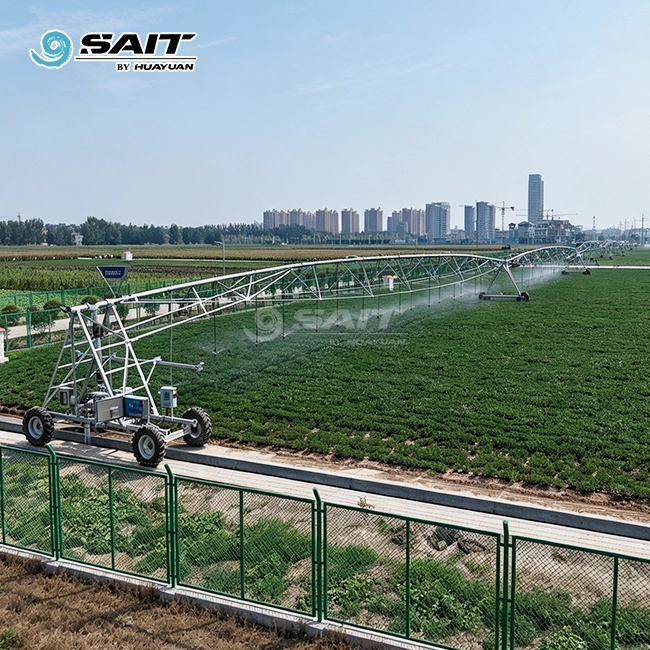
A linear move irrigation system traverses rectangular fields in a straight line, moving perpendicular to its structural span while delivering water uniformly across the entire plot. Unlike center pivot systems that rotate around a fixed point and leave dry corners, a lateral move system travels the full length of the field — covering up to 98% of the irrigated area. Powered by electric motors or diesel generators, guided by furrow, cable, or satellite signals, and supplied by canal or drag hose, the system automates large-scale water delivery with precision, minimal labor, and measurable efficiency gains.
What Is a Linear Move Irrigation System?
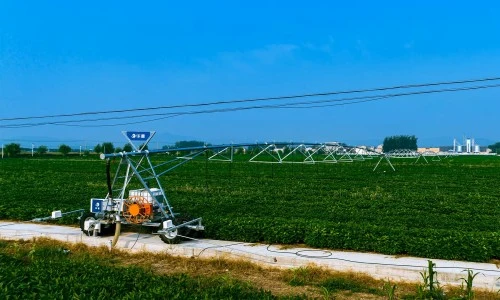
Circular irrigation technology has always had trouble covering rectangular fields. Even though center pivot systems are very popular, they don't water up to 21% of square fields, which is a big loss of output. That gap was taken care of by the linear move irrigation system.
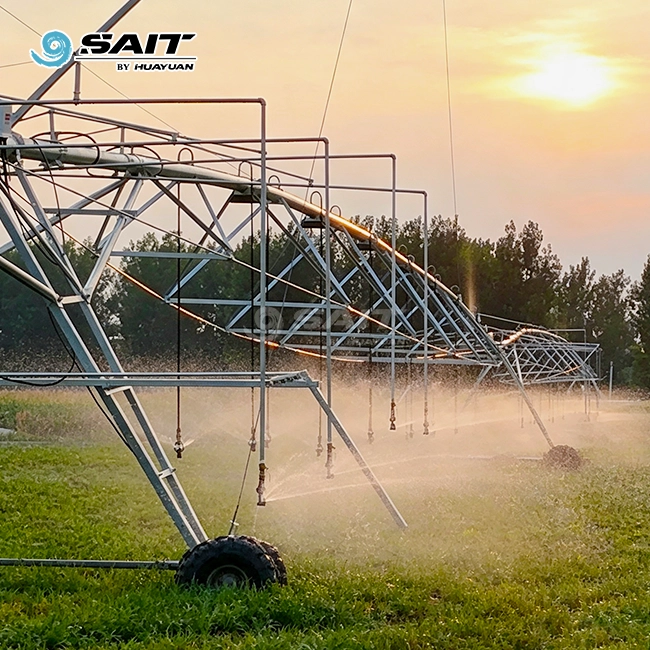
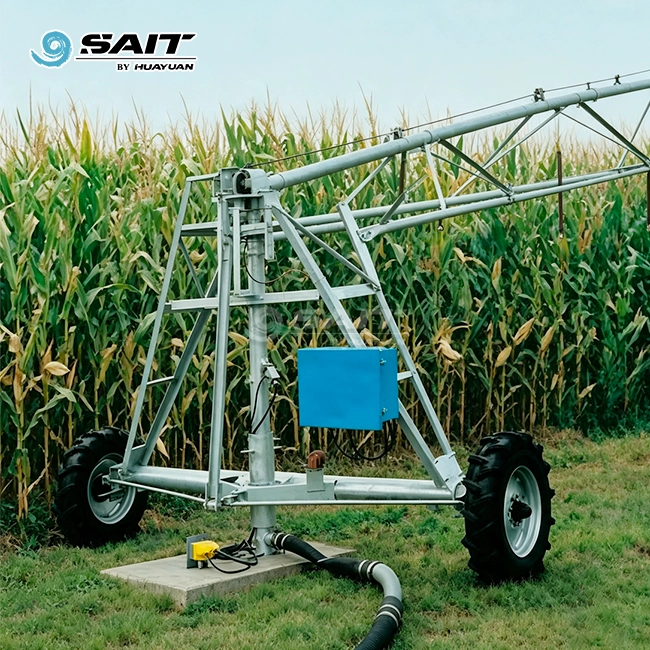
At its core, this system is made up of a group of spans that are attached to self-moving drive poles and move across the field in a straight line. Water comes in through a central mainline pipe, either from a canal using an onboard pump or from a drag hose linked to a pressurized spigot. It then spreads along the length of the boom by overhead sprinklers or drop nozzles.
HUAYUAN SAIT's lateral move platform can be set up in three different ways:
- Swing-Around Linear Irrigation — the machine makes one pass and then swings around 90° to adjust for the return. This is great for fields that need to cover the whole edge.
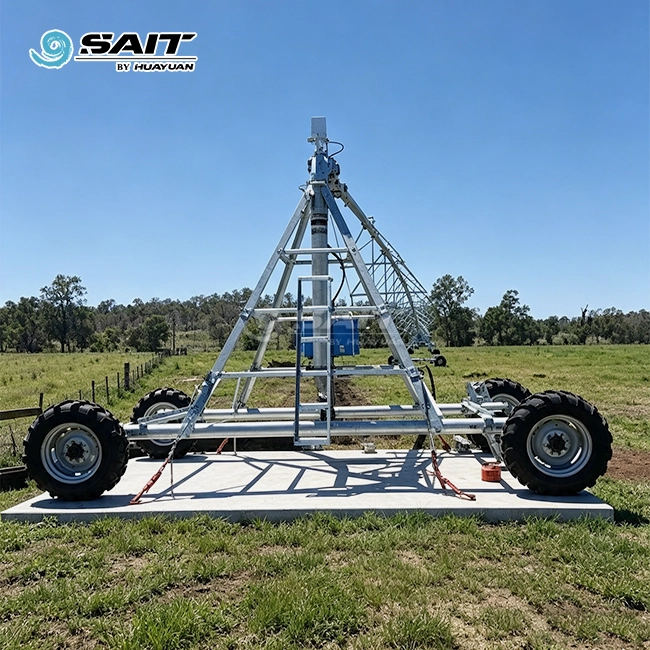
- Four-Wheel Lateral Irrigation — four-wheel drive tower units make the equipment more stable on soft or sloped ground, and they can handle slopes of up to 15%.
- Two-Wheel Linear Irrigation — a cheaper, smaller option that works best on flat, hard ground and standard rectangular plots.
Each configuration uses the same modular platform, which means that power supply, water supply, and guidance parts can be switched out without having to rebuild the structural frame. This saves money on purchases and lowers long-term capital exposure.
How Does a Linear Move Irrigation System Work?
Movement and Guidance
At each tower, synchronized electric motors or hydraulic actuators move the machine across the field at a steady pace. The hardest thing about linear move irrigation system operations is keeping the travel line exactly straight. This is something that HUAYUAN SAIT takes into account with three types of guidance: furrow guidance, underground cable guidance, and BDS/GPS dual-mode satellite guidance with tracking accuracy of less than an inch. When a tower drifts past a set limit, sensors on board cause an automatic speed correction or emergency stop, which keeps the structure from being stressed on the sides.
Water Supply and Distribution
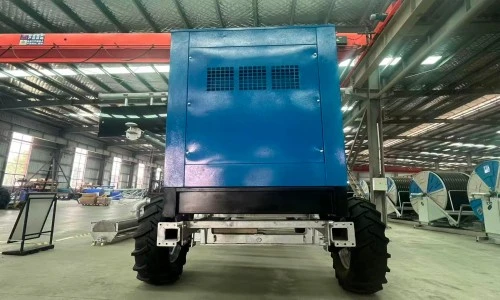
There are two ways for water to get to the moving boom. The water source for the canal comes from an onboard pump that takes water directly from an open channel that runs parallel to the field. This makes it useful for big desert reclamation projects and state farm operations. A flexible hose called a drag hose connects the machine to a pressurized underground mainline. The hose moves behind the machine as it moves. With 168 mm and 219 mm main pipe diameters, friction loss is kept to a minimum across boom lengths of up to 973 meters, keeping the working pressure constant from the first pass to the last.
Automation and Smart Control
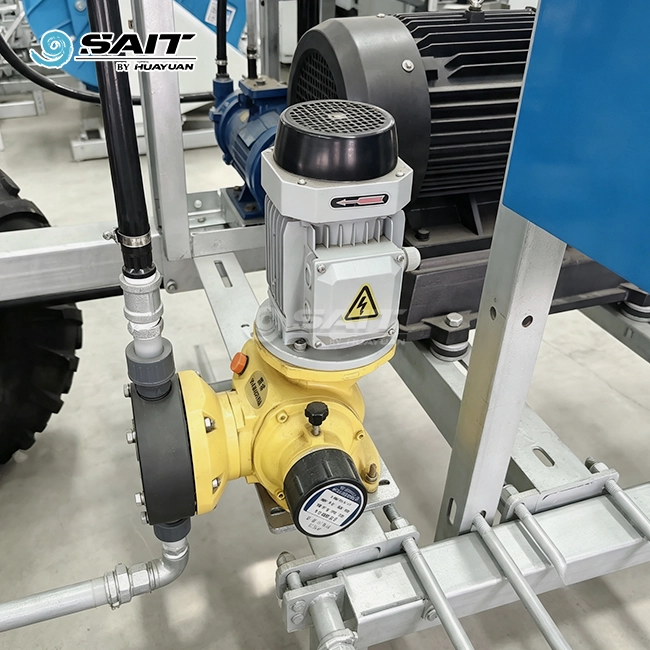
HUAYUAN SAIT builds in BeiDou tracking, IoT sensors, and its own smart algorithms into the control system. The electronic control system can be set up in both standard and remote ways, and operators can use a mobile device to check on the system's status, travel position, and the rate at which water is applied. Fertigation injection can be timed to match the speed of movement, providing nutrients at exact rates that are based on how the soil changes across the field.
Comparing Linear Move Irrigation With Other Systems
It is important to know when the linear move irrigation system works better than other options and when it doesn't before making a purchase decision.
On circular fields, center pivot systems cost less per hectare and are easier to guide. A lateral move system, on the other hand, uses over 98% of the field on rectangular plots with a length-to-width ratio greater than 2:1, while a pivot only uses about 79% of the field. This difference directly affects the amount of land that can be used for farming.
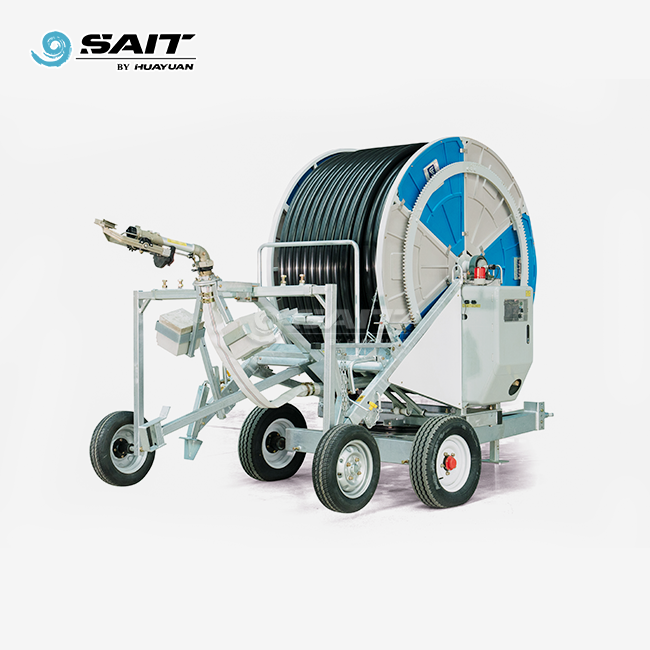
It is most efficient to use water at the roots with drip irrigation, but it costs a lot more to set up and can't be used with deep-till crops like sugar beet and potato because the tape infrastructure is hidden. While traveling gun systems don't need any infrastructure for direction, the water they spread out isn't be as evenly distributed.
One lateral move system can service multiple fields in turn, which is something that fixed drip networks can't do for big groups that take care of neighboring rectangular parcels.
Benefits and Maintenance
When it comes to technology and operations, the linear move irrigation system is the best choice for large rectangular areas because:
- 98%+ field coverage — designed for fields with a length-to-width ratio greater than 2:1, getting an irrigation coverage rate that doesn't lose water in the corners like pivot systems.
- Irrigation uniformity exceeding 90% CU — HUAYUAN SAIT's precise nozzle packages and BeiDou-guided travel control keep the application depth the same along the 973-meter boom.
- Extreme environment durability — a hot-dip galvanized steel coating that is thicker than 80μm (above the standard ASTM A123 limits) covers structural parts from -20°C to 60°C, which means it can be used in both mild continental climates and warm arid zones.
- Flexible span configurations — span lengths of 37.5m, 43.3m, 49.1m, and 54.9m, along with overhang choices ranging from 2.7m to 25m, make it possible to precisely fit the border to an uneven field edge.
- Multi-crop compatibility — works well with grains, vegetables, sugarcane, orchards, nurseries, and high-value cash crops; options with a high clearance span can also be used with tall canopy crops.
Because of these benefits, the equipment's yield will be protected, and its running costs will go down over its whole life. To keep up that level of performance, you need to do regular maintenance, like checking the gearbox lubricant every season and changing the oil every 1,000 hours of use. You should also check the tire pressure to make sure the travel speed stays the same, and the guidance sensor calibration should be checked once a year. HUAYUAN SAIT backs this up with a full guarantee for one year, a low-cost parts replacement program for three years, and the ability to get spare parts at the original cost price for life.
Procurement Considerations
When procurement teams look at linear move irrigation systems, they should think about four things: the shape of the field, the type of water source, the availability of power, and the complexity of the guidance.
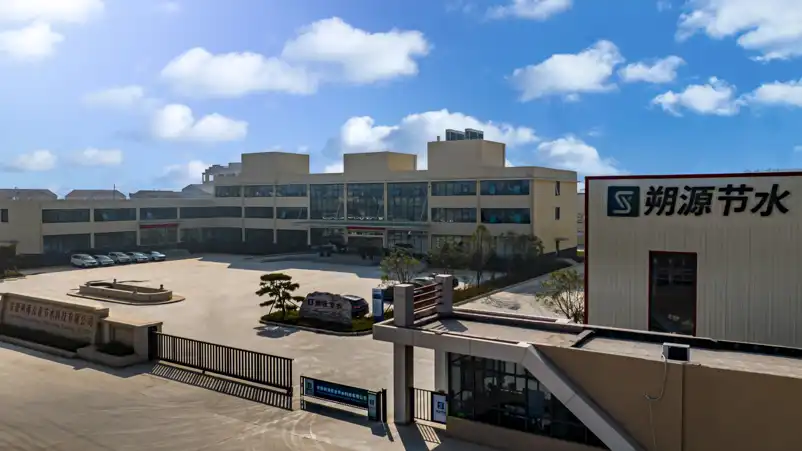
HUAYUAN SAIT provides direct factory prices with no markup for distributors, OEM and ODM customization for unique project needs, and full export paperwork for buying goods from other countries. Standard delivery from the factory near Xuzhou takes about a week for orders that are set up correctly. This is made possible by hub-level logistics infrastructure in the Huaihai Economic Zone, which lowers the cost of freight and the time it takes to get export shipments.
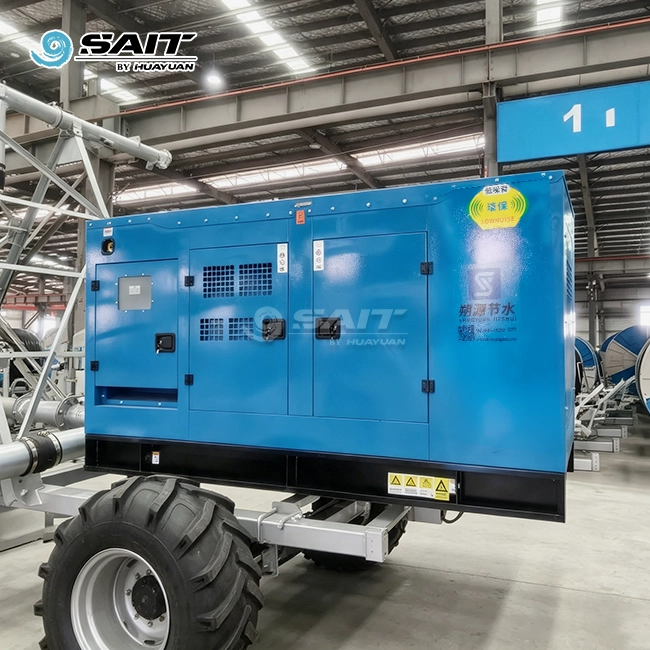
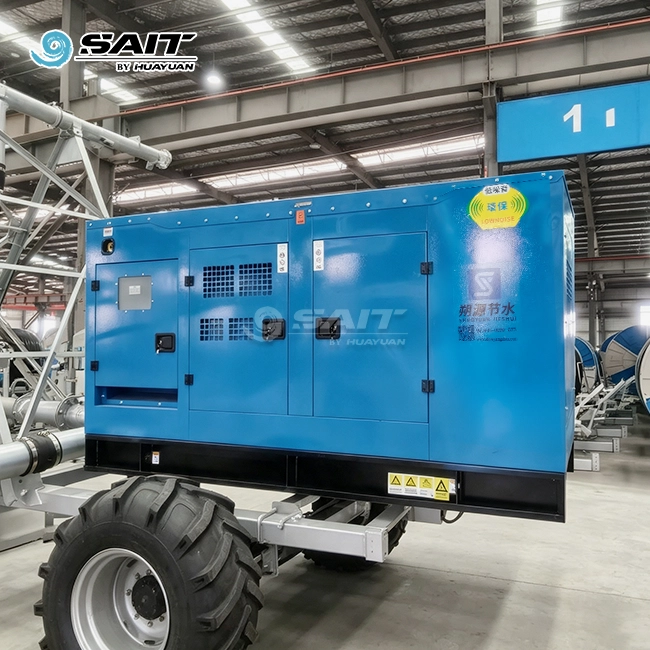
HUAYUAN SAIT can produce 1,800 units per year, which means that orders from government irrigation officials, desert reclamation developers, and farm cooperatives of 3 to 10 units will always be met. Custom designs, such as GNSS-guided dual-direction systems, diesel generator power packs, and private-label control screens, cost 20–35% more to build and take 30–45 days to make prototypes.
The project package includes on-site installation guidance and operator training in the buyer's language. This takes care of the complicated alignment issue that is still the biggest problem for first-time lateral move operators.
Conclusion
When it comes to rectangular land, center pivot and drip systems can't match the field utilization rate, automation level, and crop compatibility profile of the linear move irrigation system. HUAYUAN SAIT has been making lateral move systems for 20 years and has over 130 patents and a modular platform that can be set up to work with almost any power source, water supply, or guidance need. These systems are designed to work in large-scale commercial farming. The basics of engineering are the same whether you are in charge of 200 hectares of sugar beet in the Midwest or a government-funded project to clean up a desert: coverage in a straight line, high uniformity, and effective machinery.
FAQ
1. What field shape works best for a lateral move system?
The best shape is a rectangle with a length-to-width ratio greater than 2:1. For fields that are less than 200 meters wide or have very uneven edges, you might need special overhang configurations or corner arm attachments to get full coverage.
2. How does the machine stay straight over long distances?
The linear move irrigation systems made by HUAYUAN SAIT have three ways to find their way: physical furrow guidance, buried cable guidance, and BDS/GPS dual-mode satellite guidance. Each method constantly checks the position of the tower and changes the speeds of each drive to keep them in line.
3. Can the system operate on sloped terrain?
Four-wheel drive tower designs can work on slopes of up to 15% as long as the span engineering takes into account the field gradient and the soil's ability to hold weight. Before deciding on the width and drive unit, it is a good idea to do a topographic study.
4. What is the expected equipment lifespan?
The main structure usually lasts 20 to 25 years with regular maintenance and 80µm+ hot-dip galvanized structural steel. HUAYUAN SAIT promises to always provide extra parts at the price of the plant.
5. Is fertigation compatible with this system?
Yes. The automatic control system syncs the fertigation injection with the trip speed, providing nutrients at different rates based on data about the soil's moisture level. This is especially useful for high-value veggie and cash crop farms.
Partner With HUAYUAN SAIT for Your Next Irrigation Project
HUAYUAN SAIT has been making linear move irrigation systems for 20 years, has more than 130 patents, and offers direct factory pricing. With a one-week delivery lead time and full after-sales support, our modular platform can meet all of your field configuration, power source, and guidance needs. Get in touch with our team right away for a proposal tailored to your field or a technical consultation. You can email us at kevin@showyirrigation.com.
References
1. Evans, R. G., & King, B. A. (2012). Site-specific sprinkler irrigation in a water-limited future. Transactions of the ASABE, 55(2), 493–504.
2. Camp, C. R., Sadler, E. J., & Busscher, W. J. (1997). A comparison of uniformity measures for drip and linear move irrigation systems.
3. Kincaid, D. C. (1996). Spraydrop kinetic energy from irrigation sprinklers. Transactions of the ASAE, 39(3), 847–853.
4. Food and Agriculture Organization of the United Nations. (2014). Water-Efficient Irrigation: FAO Irrigation and Drainage Paper No. 67. FAO.
5. USDA Natural Resources Conservation Service. (2016). Irrigation Water Management: National Engineering Handbook Part 652. USDA NRCS.
6. Irrigation Association. (2023). Landscape and Agricultural Irrigation Best Management Practices. Irrigation Association.
Get a tailored irrigation solution for your project — our engineering team is ready to support you from design to installation.