How can I improve water intake at the ditch feed?
Improving water intake at the ditch feed starts with selecting the right lateral move irrigation system for your field layout. A ditch feed linear system draws water directly from an open canal running parallel to the field, eliminating hose drag limitations and pressure loss over long distances. By matching intake assembly design, pump capacity, and guidance precision to your specific field conditions, operators on rectangular plots of 100 hectares or more can achieve irrigation uniformity above 90% while reducing labor dependency significantly.
Understanding the Challenge of Water Intake at the Ditch Feed
Trouble getting water to the ditch feed happens more often than most workers think, and it's not always due to a single fault.
Uneven Water Distribution Across the Field
During times of high demand, when canal water levels change by as little as 0.3 to 0.5 meters, fixed entry units lose prime, leaving dry spots across the span. It only takes 48 to 72 hours for crop stress to be visible on fields longer than 400 meters when the intake consistency drops by 10%.
Contamination Risks at the Canal Intake
All year long, open ditch systems gather silt, algae, and organic matter. Without a self-cleaning suction screen with a mesh size of 30 mesh or less, that debris gets into the high-pressure nozzles and makes the application less even and wears down internal parts faster. One of the main reasons why nozzles fail early in lateral move systems around the world is contamination.
Structural Mismatch Between Field Shape and System Type
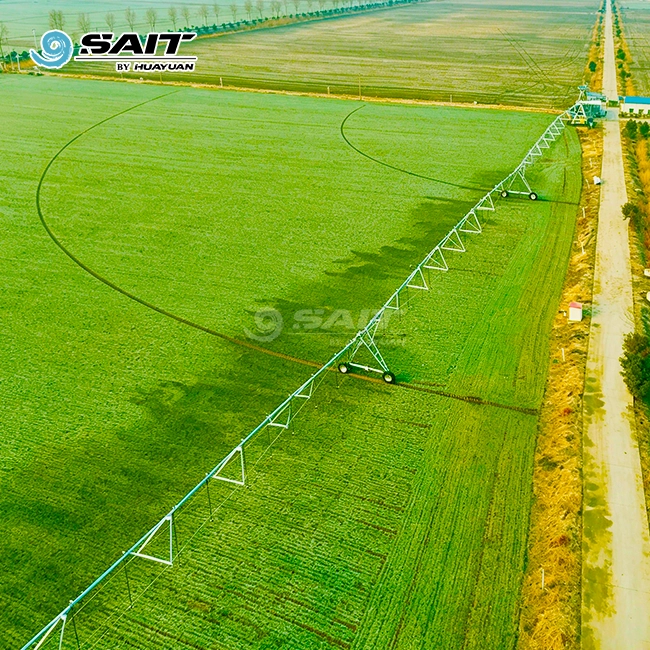
Many operators try to use circle pivot equipment on rectangular plots, knowing that they will lose 15–20% of the crop in the corners that aren't watered. That assumption is not true. Ditch feed linear systems always get field covering rates above 98% when they are used on rectangular fields with a length-to-width ratio greater than 2:1.
Optimizing Ditch Feed Linear Design to Enhance Water Intake


Once the root causes are known, they need to be fixed by making smart engineering choices during the planning phase.
Floating Intake Structures for Variable Canal Levels
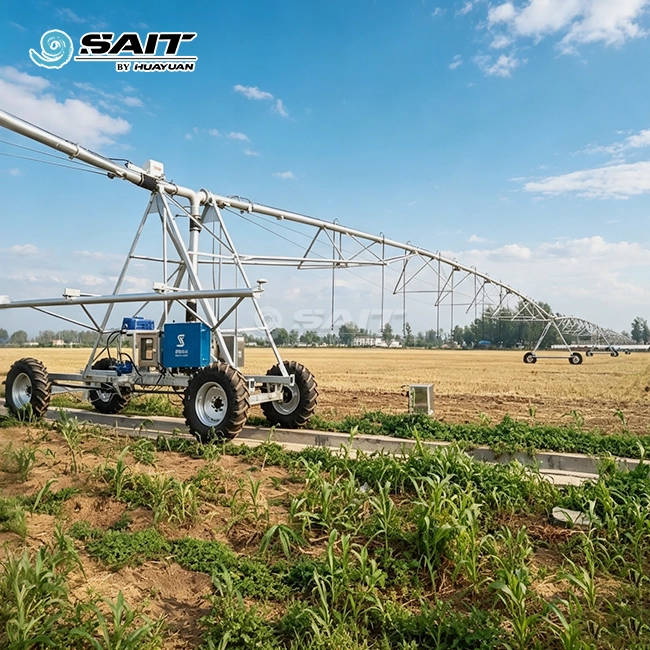
A moving entry platform on the center cart lets the suction pipe automatically follow the height of the water surface. This keeps the prime level stable even if the ditch level changes during irrigation cycles. This gets rid of the most common single-point failure in canal-fed lateral systems. When working on a large scale, telescopic suction pipe designs make this error even bigger.
Span Configuration and Machine Length
The HUAYUAN SAIT ditch-feed lateral move system can handle span lengths of 37.5m, 43.3m, 49.1m, and 54.9m, and it can also handle overhangs of 2.7m to 25m. The longest part of the machine is 973 meters long, and it can move up to 3,000 meters, which is equal to covering up to 240 hectares per unit. Choosing the right span design for your field's soil-bearing capacity has a direct effect on how stable the intake is during transport.
Guidance Mode Selection and Its Effect on Water Delivery Consistency
Over- and under-irrigated strips are caused by alignment drift over long travel lengths. This happens because passes meet unevenly. The HUAYUAN SAIT has three types of guidance modes: furrow guidance, cable guidance, and BDS/GPS dual-mode satellite guidance. It can keep the line within ±10 cm over distances of more than 800 meters. Precision tracking isn't just a nice-to-have; it's necessary for distributing water.
Installation and Maintenance Best Practices to Maximize Water Access
A system that works well at commissioning is different from one that works well in year five. The difference is proper installation and regular maintenance.
Pre-Installation Site Assessment
Before installing, workers should make a detailed map of the ditch line in relation to the edges of the field. Standard drive units can handle a grade tolerance of up to 5–6%. For grades greater than that, high-torque motors and special universal joints are needed to keep the span from moving out of alignment while it's moving. With every unit they sell, HUAYUAN SAIT offers expert support and on-site fitting help.
Daily and Seasonal Maintenance Protocols
For ditch feed linear systems, in peak season, the self-cleaning intake screen should be checked every day the machine is running. The main pipe on HUAYUAN SAIT systems comes in two diameters, 168mm and 219mm. It should be flushed at the beginning and end of each irrigation cycle to get rid of any sediment that has built up inside it. The state of wheels in sizes 11.2-24, 14.9-24, and 16.9-24 (tubed or tubeless) has a direct effect on how ground pressure is distributed, which in turn has an effect on the stability of the intake system on soft soils.
Electronic Control System Monitoring
With HUAYUAN SAIT's remote control system choice, workers can see at a glance the flow rates, travel speeds, and deviations from the planned path. If intake problems are found early, like a 15% drop in measured flow, they can be fixed before crop stress shows up. To keep the accuracy of the fertigation application, the system's electromagnetic flow meters should be adjusted once a year.
Comparing Ditch Feed Linear Systems to Traditional Water Supply Methods
When buying, teams know where canal-feed lateral move systems work better than other options, they can use clear data to support the investment.
Here are the main ways that the three most common types of water supply differ in how well they work:
- Canal water supply (ditch feed): No hose length restriction, no friction loss accumulation, continuous flow as the machine travels. Best suited for fields adjacent to established irrigation channels. Operating pressure at the source is lower than hose-feed units, which reduces energy draw per hectare.
- Drag hose water supply: Suitable for fields without canal access, but hose drag creates soil compaction in wheel paths and limits effective travel distance. Maintenance intervals are shorter due to hose wear and coupling stress.
- Fixed sprinkler infrastructure: High upfront civil cost, no relocatability, and poor adaptability to changing crop rotation patterns. Contract farming operations on leased land cannot recover this investment at lease end.
These are not small changes. On rectangular fields bigger than 80 hectares, canal-fed lateral move systems always have a lower total cost per watered hectare than hose-drag systems, especially when the equipment for the canals is already there.
Procurement Considerations: Selecting the Right Ditch Feed Linear System

Choosing the right ditch feed linear system for your business involves more than just comparing prices per unit. Long-term return on investment is based on a number of technical and business factors.
Power Supply Configuration for Remote Fields
The HUAYUAN SAIT can be powered by either a towed cable (electrical) or an onboard generator. For rural rectangular fields in dry areas that don't have access to the grid, the generator choice gets rid of all infrastructure needs. For operations that want to lower their per-cycle energy costs, cable-fed power uses less fuel and needs less maintenance than diesel alternatives.
OEM and Customization Depth
As an OEM and ODM company, HUAYUAN SAIT can make custom span lengths for fields with uneven edges, choose the right drive unit based on the type of soil, and name the control panel with your own logo. The company has more than 130 patents, including 35 idea patents and 15 foreign patents. These were created through joint research with China Agricultural University and with help from local engineering research centers.
After-Sales Support and Parts Availability
HUAYUAN SAIT provides a full warranty for one year, low-cost maintenance and part replacement for three years, and spare parts at factory cost for life. The company is close to Xuzhou, which is one of China's main transportation hubs for farm machinery. They can deliver normal setups within a week, and their export paperwork meets international standards for buying things.
Conclusion
For a well-designed ditch feed linear system, getting more water into the ditch feed is not a problem that can be solved by a single fix. It needs to match the design of the intake assembly to the conditions of the canal, choose the right span setup for the field geometry, use exact guidance to keep the spread equal, and keep the system running on a regular schedule. On a rectangular field, a well-designed ditch-feed lateral move system achieves coverage above 98%, irrigation uniformity above 90%, and a missed irrigation rate below 5%. These are results that fixed or circular pivot systems just can't match on non-circular plots. Making these choices at the right time during the buying process protects the potential yield for the whole time the equipment is being used.
FAQ
Q1: How does a ditch feed linear system handle variable canal water levels?
Floating input platforms and telescopic suction lines keep the prime even when ditch levels change by up to 0.5 meters. This keeps the flow going during normal watering cycles.
Q2: What is the most important daily maintenance task for the canal intake?
Every day, check and clear the self-cleaning suction screen (30-mesh or finer) to keep debris from getting to the nozzles, which is the main reason why lateral move systems fail to achieve uniformity.
Q3: Can a ditch feed lateral move system operate on sloped terrain?
Yes, normal drive units can handle slopes of up to 5–6%. In fields with steeper slopes, high-torque motors and special universal joints are needed to keep the span aligned while it moves.
Q4: What guidance options are available for long-span configurations?
The HUAYUAN SAIT can guide you with furrows, cables, or both BDS and GPS satellites. Using RTK-GPS, the whole length of the machine stays aligned within ±10 cm, and any steering drift is fixed right away.
Contact HUAYUAN SAIT — Ditch Feed Linear Supplier for Rectangular Field Operations
Every lateral move irrigation project that HUAYUAN SAIT works on is backed by 20 years of experience making things. You can buy as few as one trial unit or as many as three to ten systems per project through our ditch feed linear manufacturer platform. This platform allows for full OEM customization, BDS/GPS guidance, and canal or hose water supply options from a single product line. You can email our technical team at kevin@showyirrigation.com to get a field coverage study and a quote that is tailored to your project.
References
1. Keller, J., & Bliesner, R. D. Sprinkle and Trickle Irrigation. Van Nostrand Reinhold, 1990.
2. Allen, R. G., Pereira, L. S., Raes, D., & Smith, M. Crop Evapotranspiration: Guidelines for Computing Crop Water Requirements. FAO Irrigation and Drainage Paper No. 56, Food and Agriculture Organization of the United Nations, 1998.
3. Evans, R. G., & Sadler, E. J. "Methods and technologies to improve efficiency of water use." Water Resources Research, 2008.
4. Hanson, B., Schwankl, L., & Fulton, A. Scheduling Irrigations: When and How Much Water to Apply. University of California Division of Agriculture and Natural Resources Publication 3396, 1999.
5. ISO 11545:2009. Agricultural Irrigation Equipment — Centre-Pivot and Moving Lateral Irrigation Machines with Sprayer or Sprinkler Nozzles — Determination of Uniformity of Water Distribution. International Organization for Standardization, 2009.
6. Phocaides, A. Handbook on Pressurized Irrigation Techniques. Food and Agriculture Organization of the United Nations, 2007.
Get a tailored irrigation solution for your project — our engineering team is ready to support you from design to installation.