What cable length is suitable for a linear irrigation cable reel power supply?
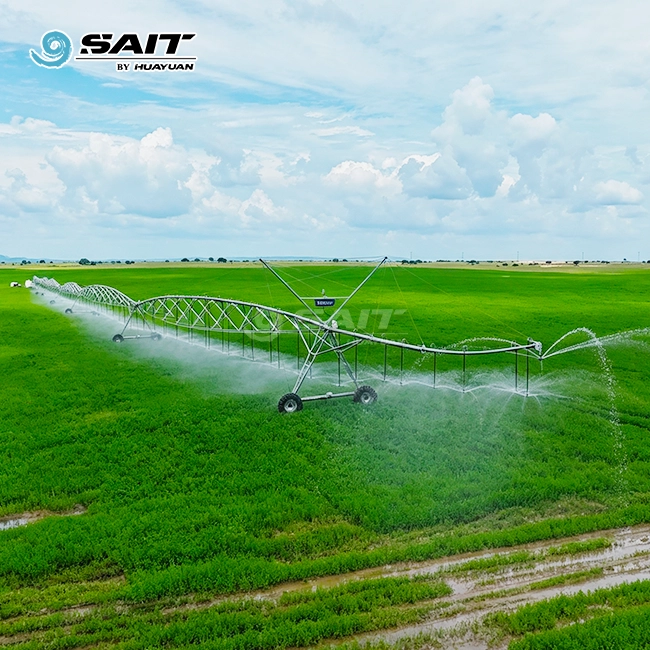
For a linear irrigation system using a towed cable reel power supply, the appropriate cable length typically ranges from 400 to 3,000 meters, depending on field dimensions and power source placement. A cable reel power supply feeds electricity to the moving lateral as it travels across the field. Since HUAYUAN SAIT's linear systems support a maximum travel distance of 3,000 meters per run, the cable must match that travel path without exceeding safe voltage drop thresholds—generally kept below 5% to maintain consistent motor performance across all drive units.
Understanding Linear Irrigation Cable Reel Power Supply
What Is a Cable Reel Power Supply in Irrigation?

An electromechanical device called a cable reel power supply moves an electrical conductor around as the irrigation lateral moves across the field. In contrast to fixed conduit wiring, it keeps power going to the moving machine without the cables getting tangled up. Linear irrigation uses this design when grid electricity is chosen as the power source, instead of diesel generators in places with reliable electrical infrastructure.
Key Electrical Specifications to Know
Linear irrigation cable reels usually work at 380V to 480V (three-phase AC), and the size of the conductor cross-section depends on the length of the field and the load on the motor. For systems that cover 240 hectares per unit, like HUAYUAN SAIT's move laterally, the cable needs to be able to send steady power over long distances. Conductor cross-sections are usually chosen based on the total cable run and the highest amperage that will be used. They range from 10mm² to 70mm².
Power Supply Mode Options on HUAYUAN SAIT Systems
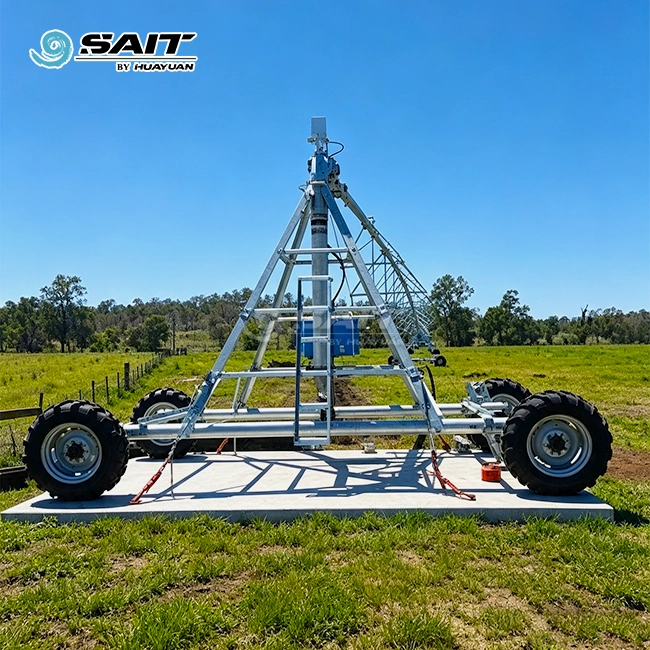
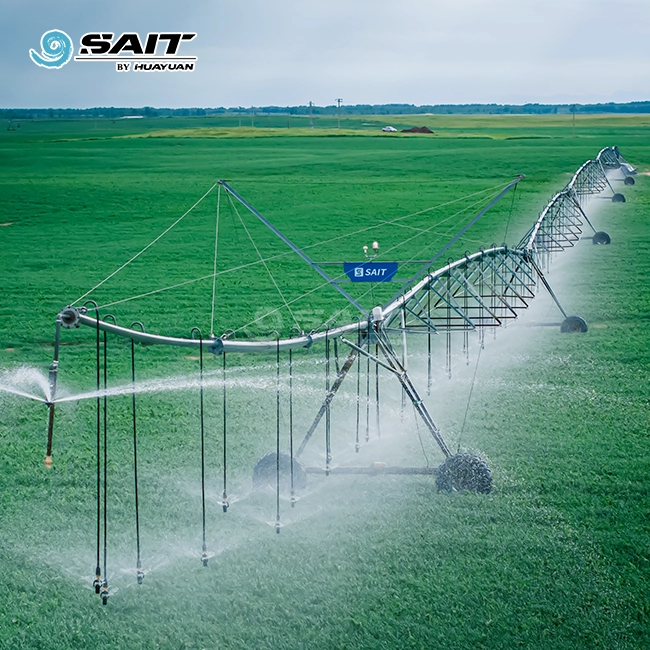
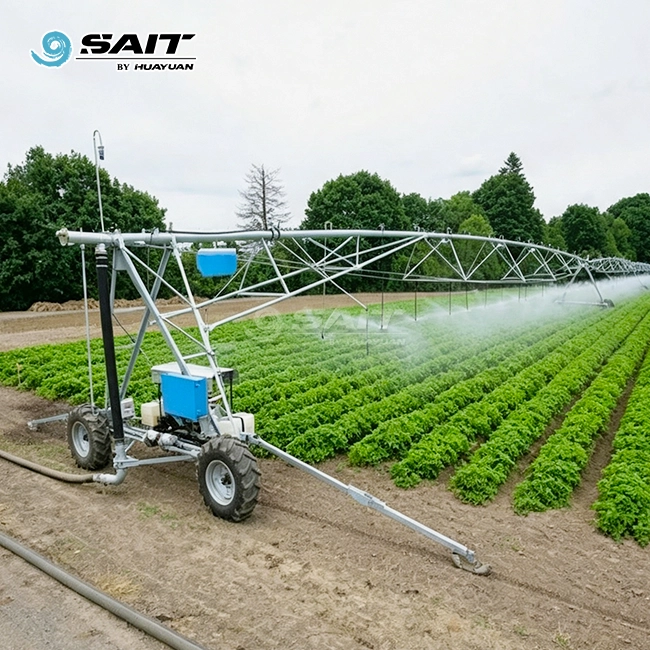
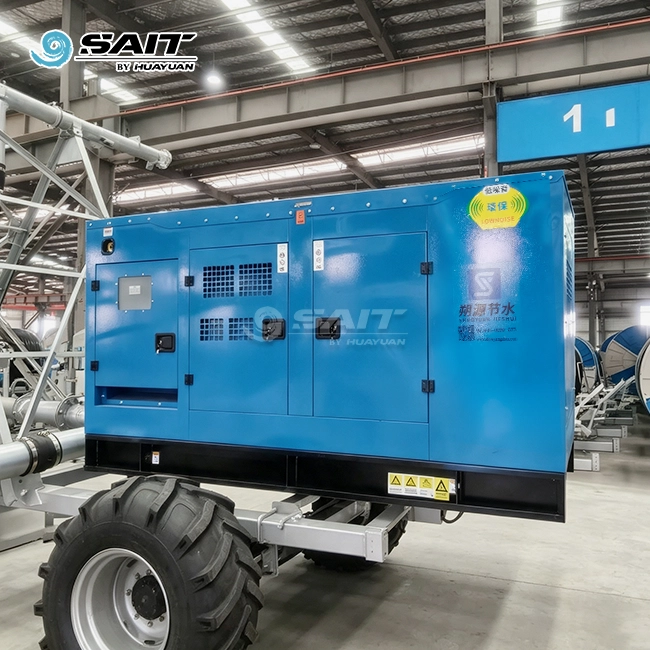
Linear irrigation tools made by HUAYUAN SAIT can get power from either a cable reel power supply or a generator. In the pulled cable mode, a cable reel is attached to either the center cart or the end cart, and as the machine moves forward, the cable is paid out. In rural areas that can't connect to the grid, the generator mode is best. You can choose from both choices for Swing-Around Linear, Four-Wheel Lateral, and Two-Wheel Linear irrigation.
Factors Influencing the Suitable Cable Length for Linear Irrigation
Field Length and Travel Distance
Only field length makes a difference. The longest distance that HUAYUAN SAIT's lateral move systems can go is 3,000 meters. The cable reel needs to have enough conductor to go all the way from where the power is connected to where the cable rolls out. For example, on a field that is 1,500 meters long, the wire reel needs at least 1,500 meters of useful conductor, plus an extra 5–10% just in case.
Voltage Drop Over Long Runs
Loss of voltage is the main electricity limit. IEC 60364-5-52 says that the voltage drop across a power supply cable shouldn't be more than 5% of the nominal voltage when the cable is fully loaded. An undersized conductor will make drive motors run slower than their stated speed on a 3,000-meter run at 380V three-phase with a 30-amp draw. This will make the watering less even. The two possible fixes are to increase the cross-section of the conductor or shorten the line.
Environmental Conditions and Regulatory Constraints
Agricultural cables that are used outside must have security grades of IP65 or IP66 to keep water out and protect the wires from soil wear. In places with high temperatures, like the Middle East or Sub-Saharan Africa, it's best to use wire insulation that can handle continued use up to 90°C. Electrical codes in agricultural areas, like NEC Article 547 in the US, also say how cables should be routed and protected.
Comparing Cable Reel Power Supply Types and Their Cable Length Capacities

Fixed vs. Portable Cable Reels
Fixed cable reels are attached to the center cart of the irrigation system. They pay out a conductor as the lateral moves in one direction and pick it up again on the return pass. Moving portable reels from one field to another is easy for contract farmers who are in charge of leased land that is spread out over several parcels. Up to 3,000 meters of cable can usually fit on a fixed reel, while shorter runs of less than 800 meters are better served by portable units.
Motorized vs. Spring-Driven Reels
For lengths up to 30–50 meters, spring-driven reels work well because they use mechanical tension to pull the wire back. For irrigation laterals that go 500 to 3,000 meters in length, a cable reel power supply utilizing motorized cable reels is the best choice. They use a frequency-controlled drive to make sure that the cable pay-out and recovery speed is in line with the travel speed of the lateral. This keeps the cable from getting too loose or too tight, which could damage the wires or trip the safety circuits.
High-Amperage and Extended-Length Configurations
Agricultural groups that are in charge of several rectangular parcels next to each other often ask for high-amperage cable reels to power longer machine setups, up to HUAYUAN SAIT's 973-meter maximum machine length. For these setups, you need wires with cross-sections of 50 mm² or more and drums that can hold more than 2,000 meters of wire. The material of the reel drum, the bearing load rating, and the design of the cable management guide all have a direct effect on how long it will last in the field.
These differences are important because picking the wrong reel type for a certain field length or power load can cause problems in the middle of the season. Matching the reel's capacity to the field's real conditions from the start cuts down on both downtime and the cost of replacements.
Best Practices for Selecting and Maintaining Cable Length in Linear Irrigation Systems
How to Accurately Measure Your Cable Requirement
First, make a topographic map of the field and find the point where the power connects in relation to where the lateral starts. Add the whole trip distance plus 8–10% to account for changes in elevation, cable routing curves, and links between terminals. To power a 2,400-meter field from the middle, the cable reel on each half needs about 1,320 meters of conductor. Note the type of dirt and the slope of the field; slopes above 8% raise the motor's draw and change the size of the conductors.
Preventive Maintenance to Extend Cable Reel Lifespan
Here are the basic maintenance steps that will keep your cable reel working well all year:
- Inspect cable insulation for abrasion or cracking at the drum entry point every 200 operating hours; soil and crop residue concentrate wear at this point.
- Check drum bearing lubrication at the start of each irrigation season; inadequate lubrication under field vibration leads to bearing failure and misalignment.
- Verify cable tension settings after each directional reversal; incorrect tension causes conductor fatigue at the connection terminals over time.
- Clean cable entry seals after heavy rain or sand exposure to maintain the IP65/IP66 rating of the reel housing.
If you regularly follow these steps, the service life of a cable reel will be well over five seasons in normal field circumstances.
Safety Features and Overload Protection
Linear irrigation cable reels should have thermal overload safety on the motor, ground fault interruption on the wire circuit, and automatic pay-out stop switches that go off if the tension of the cable drops suddenly, which could mean there is a problem with the cable. The electronic control system from HUAYUAN SAIT comes in both normal and remote-control versions. These safety features are built into the main control panel of the system so that faults can be viewed centrally.
Procurement Guide: Buying the Right Cable Reel Power Supply for Linear Irrigation

Essential Criteria for B2B Procurement
When buying a cable reel power supply for a lateral move irrigation project, procurement teams should look at four main factors: the rated cable length capacity (which should match the travel distance in the field), the conductor cross-section (which is calculated from the motor load and run length), the protection class (at least IP65 for outdoor agricultural use), and how well it works with the control architecture of the irrigation system. HUAYUAN SAIT's systems can be set up with either standard electrical control or remote control, which gives distributors options when choosing power supply parts.
Evaluating Suppliers: Warranty and After-Sales Support
A good company that makes cable reel power supplies should offer a guarantee on the reel assembly for at least one year, and replacement parts should be easy to get for at least 10–15 years. HUAYUAN SAIT provides a full warranty for one year, low-cost maintenance and part replacement for three years, and a lifelong supply of spare parts at factory cost price. These terms make the total ownership cost for large-scale irrigation projects much lower.
When Custom Cable Reel Solutions Are Necessary
Most rectangular field uses can be met by standard wire reel arrangements. When the field travel distance is more than 2,500 meters, when the power input voltage is not 380V three-phase, or when the irrigation system includes fertigation control signals along with the power conductor, custom solutions are needed. HUAYUAN SAIT offers OEM and ODM setups, which let project managers and irrigation equipment brands choose unique cable lengths, conductor sizes, and control interfaces that fit the needs of the site.
Conclusion
The field travel distance, conductor size based on voltage drop calculations, and environmental protection needs all play a role in choosing the right cable length for a linear irrigation cable reel power supply. For laterals going up to 3,000 meters, which is the range of HUAYUAN SAIT's systems, the cable reels need to be the right size, with automatic drum mechanisms and conductors chosen to keep the voltage within 5% of normal when the system is fully loaded. With the right choice and regular maintenance, the power source will work steadily through many growing seasons.
FAQ
Q1: What is the maximum cable length a linear irrigation reel can handle?
HUAYUAN SAIT's lateral move systems support a maximum travel distance of 3,000 meters. The cable reel must carry conductor length matching the full travel path, plus a safety margin. Motorized reels sized for this range are standard on systems covering up to 240 hectares per unit.
Q2: How do I calculate the correct conductor cross-section?
Use the formula: cross-section (mm²) = (2 × cable length × current) ÷ (conductivity × allowable voltage drop). For most linear irrigation applications at 380V three-phase, this produces cross-sections between 16 mm² and 70 mm² depending on run length and motor load.
Q3: Does cable length affect irrigation uniformity?
Yes. Excessive voltage drop from undersized or over-length cable reduces drive motor speed, causing uneven lateral travel and non-uniform water application. Maintaining voltage drop below 5% is the standard threshold for consistent irrigation performance.
Q4: What protection class should the cable reel meet?
IP65 is the minimum for outdoor agricultural use. In regions with heavy rainfall or sandy conditions—common in Middle East and Sub-Saharan Africa deployments—IP66-rated assemblies are the appropriate specification.
Contact HUAYUAN SAIT for Your Cable Reel Power Supply Needs
HUAYUAN SAIT has been making lateral move irrigation systems for 20 years and has over 130 patents to back it up. We are a direct cable reel power supply manufacturer, and we offer OEM/ODM configurations, delivery in one week, and full support after the sale. To get detailed advice, email Kevin@showyirrigation.com with the details of your field.
References
1. Food and Agriculture Organization of the United Nations. Irrigation Water Management: Irrigation Methods. FAO, 2020.
2. American Society of Agricultural and Biological Engineers. ASABE Standards: Design and Installation of Microirrigation Systems. ASABE, 2021.
3. International Electrotechnical Commission. IEC 60364-5-52: Electrical Installations of Buildings – Selection and Erection of Electrical Equipment. IEC, 2009.
4. Shock, C.C., and Welch, T. Drip and Subsurface Irrigation Management. Oregon State University Extension Service, 2019.
5. National Fire Protection Association. NFPA 70: National Electrical Code, Article 547 – Agricultural Buildings. NFPA, 2023.
6. Hanson, B., Orloff, S., and Peters, D. Monitoring Soil Moisture for Irrigation Water Management. University of California Agriculture and Natural Resources Publication, 2018.
Get a tailored irrigation solution for your project — our engineering team is ready to support you from design to installation.