Hose reel vs. center pivot: which should I choose?
If you manage irrigated farmland, a sports turf facility, or a multi-client contracting operation, this question probably comes up every budget cycle. The short answer: a hose reel traveler fits farms with irregular shapes, limited infrastructure budgets, or multi-field portability needs, while a center pivot suits large, uniform, permanently irrigated blocks. Read on for a full breakdown so you can match the right system to your actual field conditions — and avoid an expensive mismatch.
Understanding Hose Reel Travelers and Center Pivots
What Is a Hose Reel Traveler?
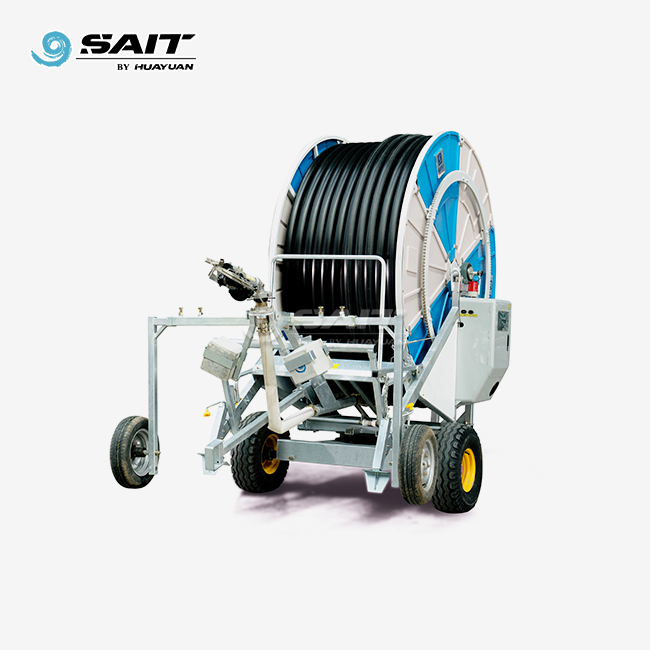
A hose reel traveler, which is also known as a traveling irrigator or hard-hose irrigator, is a machine that moves itself. A drum-wound PE pipe is pushed by pressurized water, which turns a water turbine. The water turbine pulls the pipe back and a spray cart across the field at a controlled speed. Different types in the HUAYUAN SAIT JP series can handle PE pipe lengths ranging from 300 m to 500 m, irrigation widths of 47–78 m, and travel speeds of 8–80 m/h. One unit can water more than 1.33 ha in one run, and the average machine lasts more than 10 years.
What Is a Center Pivot?
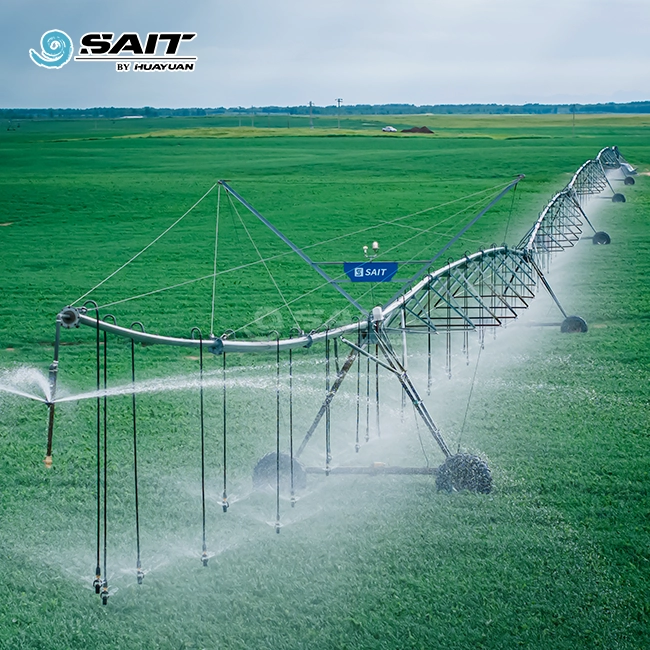
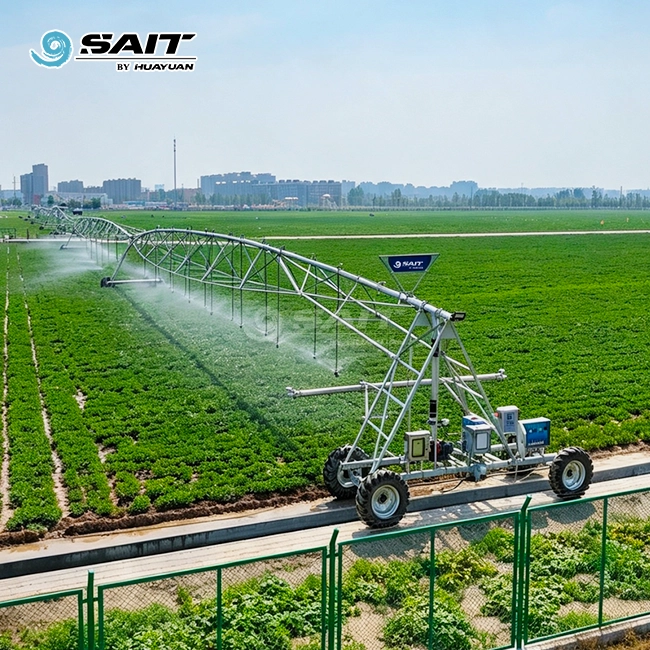
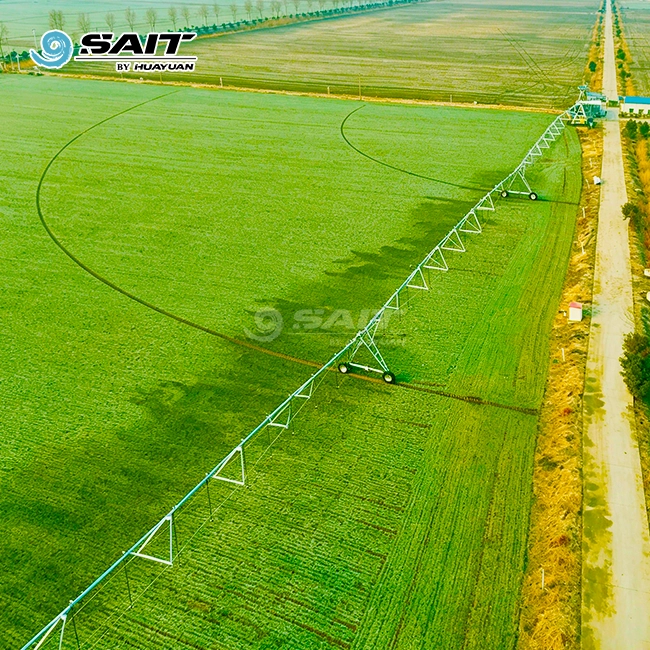
A center pivot is an irrigation device with a solid anchor that can turn. Several sections of metal pipe move around a central water supply point and cover an oval-shaped area. Most installations are between 50 ha and 130 ha per pivot. The method works best on flat, circular, obstacle-free fields with a steady flow of water because the infrastructure is fixed in place. The capital investment is much higher, usually between $50,000 and $200,000 USD per installation, plus the cost of getting the land ready.
Where Each System Is Typically Used
Row crops like corn, potatoes, and sugar beets are watered with hose reel travelers, a type of traveling irrigator designed for flexible field coverage. They are also used on vegetable fields, golf course fairways, sports fields, and anywhere else the irrigator needs to move between fields or go up and down slopes. In the U.S. Corn Belt, where fields are all the same shape, center pivots are used on most big grain farms. According to the USDA, sprinkler systems were used on about 46% of watered land in the U.S. in 2018. Center pivots were the most common type of system on fields larger than 100 ha.
Key Decision Criteria for Choosing Between Hose Reel Travelers and Center Pivots
Field Size, Shape, and Terrain
First, there is field geometry. Center pivots don't water the corners of 21–27% of square fields unless a corner arm system is added. Travelers for hose reels can handle hills, rectangles, and other odd forms without losing coverage. A traveling irrigator is the better option if your fields aren't round or are spread out in different places.
Infrastructure and Capital Budget
Center pivots need permanent investments like concrete anchor pads, buried mainlines, and electrical connections. These investments don't move with the machine if the owner of the land changes hands. A quick-connect fitting lets a hose reel traveler connect to a pump and pipeline that are already there. That freedom really pays off for medium-sized farmers (50–200 ha) who rent land or switch out fields. Entry-level turbine-drive traveler units are much cheaper than pivot installations, which means that they pay for themselves faster.
Water Source and Pressure Requirements
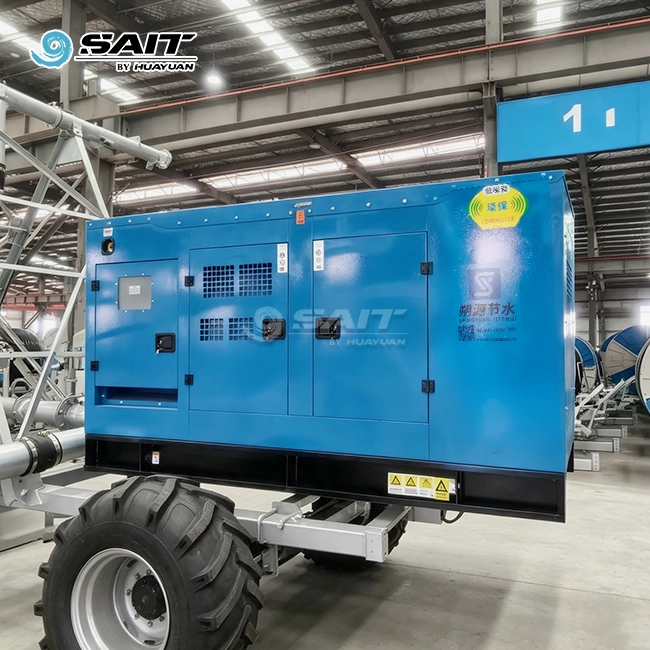
The JP-90/400 type works with an inlet pressure of 0.3 to 1.2 MPa, so it can be used with a lot of different pump setups. For off-grid farms, turbine-drive models are a good choice because they don't need power from the grid. Center pivots usually need stable electricity for the tower motors and a strong high-volume pump. This is a limitation that becomes important in places where grid access isn't always reliable.
Comparative Analysis: Hose Reel Traveler vs. Center Pivot


Water Use Efficiency and Uniformity
When set up correctly, HUAYUAN SAIT hose reel travelers save more than 50% of the water used by flood or standard gun irrigation, and they have a consistency coefficient (CU) of more than 90%. Wind drift losses are cut down by a boom-type carriage that breaks up small droplets into many smaller ones. It's also possible for center pivots to be very uniform on flat ground, but the outer spans cover more area per rotation and, without variable-rate technology, can apply too much or too little water compared to the inner spans.
Portability and Multi-Field Flexibility
This is where it's clear that the traveler wins. A hose reel traveler can be pulled behind a regular tractor by agricultural service workers who water many different clients' farms. It only takes less than an hour to set up, and the contractors can be on to the next spot the next day. A center pivot is set up forever. That cash stays in that field after you bolt it down. A single traveler irrigator can work on 4–6 different farms during the growing season, which is more than a fixed pivot can do and brings in more money for rental companies or contractors.
Maintenance and Operational Risk
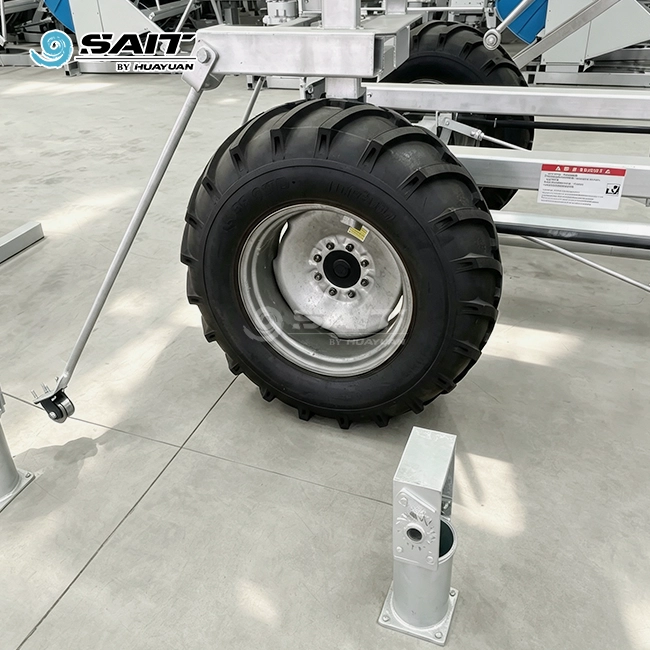
Center pivots have more failure points spread out over a larger area because they use electrical systems, tower drives, and alignment sensors that are spread out over more than 400 meters. The turbine, gearbox, and hose drum are all part of the hose reel traveler, which makes it easier to understand how it works. The four-speed gearbox made by HUAYUAN SAIT has carefully made gears that don't wear out easily, and the self-made raw PE pipe (PE80/PE100 grade) lasts more than 15 years. It's easy to take care of: just clean the turbine filter, check the mechanical seals, and drain the hose before it freezes.
Here is a quick list of the main ways that the two systems are different in terms of performance:
- Portability: Hose reel travelers are fully relocatable; center pivots are permanently anchored.
- Capital cost: Traveler units require significantly lower upfront investment than a full pivot installation.
- Field suitability: Travelers handle irregular, sloped, and multi-parcel fields; pivots need flat, circular, obstacle-free terrain.
- Off-grid operation: Turbine-drive travelers require only water pressure; pivots need grid electricity.
- Water efficiency: Both achieve high uniformity when properly set up; travelers offer broader adaptability across variable flow conditions.
For most B2B buyers, these differences make the decision easy: if your business needs to move around a lot, or if you don't have a lot of money to spend on infrastructure, a traveling irrigator is the better option.
Procurement Insights: Selecting the Best Hose Reel Traveler Supplier
What to Evaluate in a Manufacturer
When looking for a hose reel traveler maker, you should look at four things: the length of the PE pipe warranty, the turbine efficiency test data, the batch consistency paperwork, and the promise that parts will be available. The PE pipe made by HUAYUAN SAIT is guaranteed to last for 15 years. The company has over 130 patents, including 35 idea patents, and follows ISO 9001 quality management. For export markets, CE approval is also available.
OEM and Custom Configuration Options
From its 14,000-unit-per-year facility, HUAYUAN SAIT can support full OEM production with lead times of 30 to 45 days. You can choose the diameter and length of the PE pipe, the type of drive system (turbine, electric, or mechanical), the design of the boom spray, the language of the control panel, and branded instructions. First orders of 3–5 units with custom branding are welcome from buyers who want to test a new market.
After-Sales Support Structure
The company offers on-site installation help, a full warranty for one year, low-cost maintenance and part replacement for three years, and spare parts at factory cost for life. Because it is close to Xuzhou, which is a major transportation hub in the Huaihai Economic Zone, shipping to the port is quick and cheap.
Installation and Maintenance Guide for Hose Reel Travelers and Center Pivots
Site Preparation and Setup
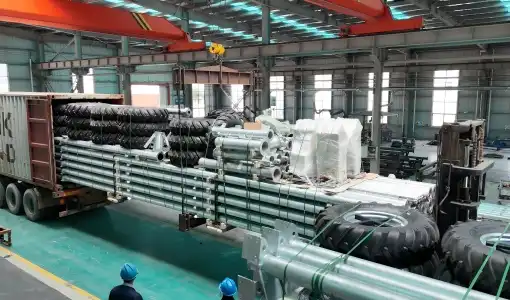
Setting up the site for a hose reel traveler means putting the machine at one end of the field, connecting the inlet to the mainline, and laying the PE pipe along the irrigation lane. At the very end is the watering cart. For an experienced user, the whole setup process usually takes 30 to 60 minutes. Surveying, building grounding pads, digging electrical trenches, and putting together spans are all parts of installing a center pivot. This process usually takes 3–7 days with a contractor team.
Preventive Maintenance Checklist
Check the turbine strainer every season. Every 500 hours of use, look at the PE hose for cracks on the outside or joint wear. Follow the manufacturer's instructions for how to grease the gearbox. Make sure that the automatic shut-off works right at the end of each run. Before putting the hose away for the winter, make sure it is completely drained to avoid damage from freezing. This will also protect the pipe's 15-year lifespan.
Troubleshooting Common Issues
When the retraction speed isn't stable, it's usually because the turbine strainer is partly stopped or the gearbox speed setting is wrong. A worn nozzle or a line that is kinked at the connection place can make the water flow unevenly. Both problems can be fixed in the field with common tools in less than 30 minutes. When fixing a center pivot, on the other hand, a technician usually has to walk or drive the whole span to find the broken tower.
Conclusion
There are three practical reasons to choose between a hose reel traveler and a center pivot: the shape of the field, the budget for infrastructure, and the ability to change how the system works. Center pivots work well for big, flat, circular fields that are always watered and have stable electricity. Hose reel riders are useful in a wider range of real-life situations, including uneven fields, operations that run in more than one place, farms that aren't connected to the power grid, and buyers on a budget who need steady performance without permanent infrastructure. The JP series from HUAYUAN SAIT saves more than 50% of water, has PE pipes that last more than 15 years, and machines that can be serviced for more than 10 years. They also offer full after-sales support.
FAQ
Q1: What is the minimum pressure needed to run a hose reel traveler?
Most turbine-drive models need between 3.5 and 5 bars (0.35 and 0.5 MPa) at the machine's entrance. The HUAYUAN SAIT JP-90/400 model can work with inlet pressures as low as 0.3 MPa, which is one of the wider ranges of pressures that this type of machine can handle.
Q2: How do I control irrigation depth?
The integrated gearbox lets you change the speed of the retractions to control the depth of the irrigation. When the trip speed is slower, more water is applied per meter. When the speed is faster, less water is applied per meter. With speeds ranging from 8 to 80 m/h, the JP series gives you precise control over a large area.
Q3: Can a travelling irrigator handle sloped or uneven fields?
Yes. Pro units are made with low-center-of-gravity bodies and wide-track wheels. Heavy hills might need more braking control, but normal field grades can be handled without any changes.
Q4: How long does the PE hose last?
With UV-stabilized material and the right way to store it for the winter, HUAYUAN SAIT's self-made virgin PE pipe lasts longer than 15 years, which is longer than many competitors who use recycled material blends.
Get a Custom Quote from HUAYUAN SAIT — Trusted Hose Reel Traveler Manufacturer
Every hose reel traveler that HUAYUAN SAIT makes is backed by our 20 years of experience and more than 130 patents. We can provide standard JP-series units for wholesale distribution or a fully branded OEM line for your local market. Our quality is always the same, and lead times are 30–45 days. You can email us at kevin@showyirrigation.com to get pricing information, technical specs, or a review of your unique setup. Within 24 hours of your first question, you'll get a personal answer.
References
1. United States Department of Agriculture (USDA). Farm and Ranch Irrigation Survey. 2018.
2. Keller, J., & Bliesner, R. D. Sprinkle and Trickle Irrigation. Van Nostrand Reinhold. 1990.
3. Food and Agriculture Organization of the United Nations (FAO). Irrigation Water Management: Irrigation Methods. FAO Irrigation and Drainage Paper No. 45. 1989.
4. Camp, C. R., Sadler, E. J., & Yoder, R. E. (Eds.). Evapotranspiration and Irrigation Scheduling. American Society of Agricultural Engineers. 1996.
5. International Commission on Irrigation and Drainage (ICID). Sprinkler Irrigation Systems: Design, Operation and Evaluation. ICID Technical Bulletin. 2001.
6. Hanson, B., Schwankl, L., & Fulton, A. Scheduling Irrigations: When and How Much Water to Apply. University of California Division of Agriculture and Natural Resources Publication 3396. 1999.
Get a tailored irrigation solution for your project — our engineering team is ready to support you from design to installation.