High-Profile Center Pivot: Key Benefits for Large-Scale Farms
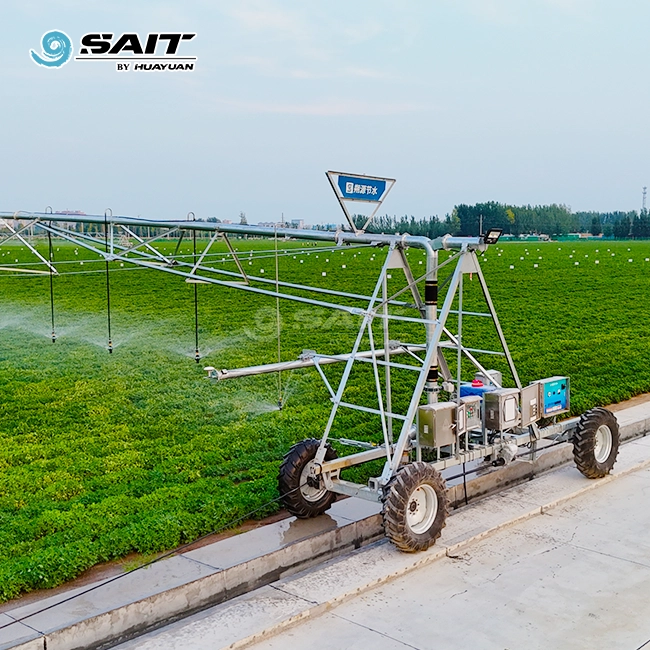
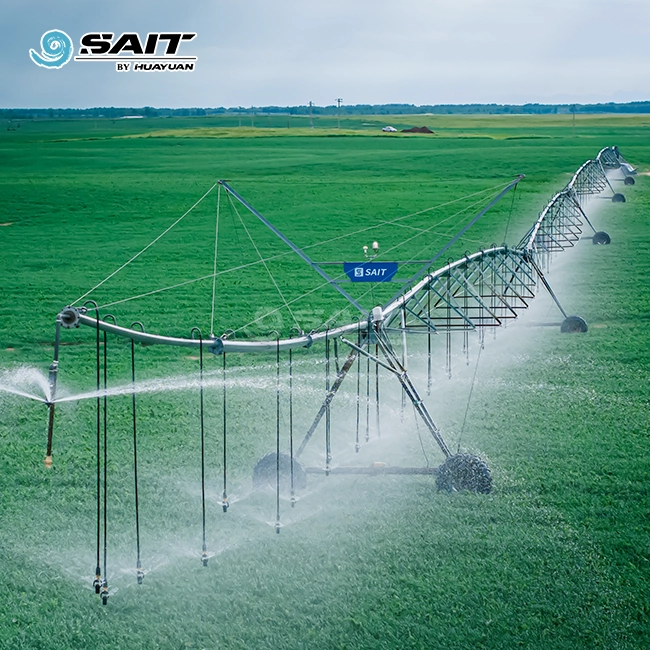
A high-profile center pivot is a mechanized irrigation system engineered with elevated tower clearance — typically ranging from 2.9 m to 4.5 m — specifically designed to irrigate tall-canopy crops such as sugarcane, mature corn, and sorghum without causing mechanical damage. Unlike standard configurations, these elevated pivot systems accommodate challenging topographies and diverse crop heights while delivering precise, uniform water application across fields up to 200 hectares per cycle. For large-scale commercial operations and agricultural project developers, understanding what this technology offers is the starting point for smarter infrastructure decisions.
What Sets High-Profile Center Pivots Apart from Standard Systems?
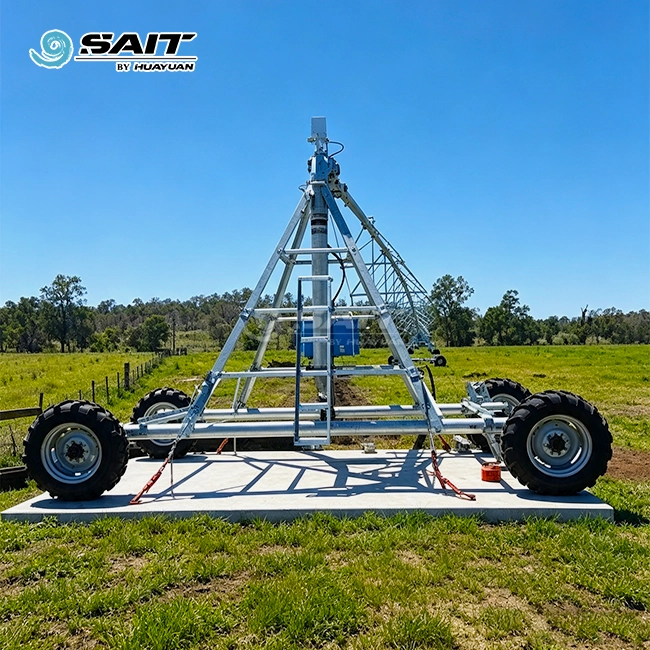
An elevated pivot is structurally different from a regular pivot in more ways than just the length of the tower legs. A high-clearance irrigation pivot has bigger wheelbases, reinforced truss sections, and recalibrated sprinkler packages to keep the same coverage even though the height is higher.


Engineering Architecture That Handles Real Farm Demands
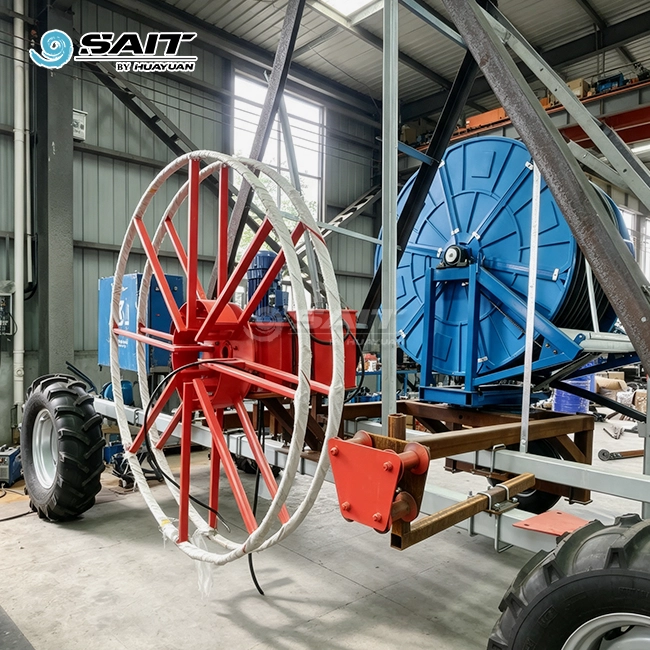
The high-profile center pivot from HUAYUAN SAIT is made of hot-dip galvanized steel that has a zinc covering of at least 80μm. This is thicker than regular galvanized parts and meets ASTM A123 standards for corrosion protection. There are different span heights (2.1 m, 2.9 m, 3.8 m, and 4.5 m), which give procurement engineers precise control over how much space is needed for different stages of food growth. This span can be anywhere from 37.5 m to 66.5 m long, and the main pipelines come in sizes of 5" (127 mm), 6-5/8" (168 mm), and 8-5/8" (219 mm).
The truss rod design, which comes in 20 mm and 22 mm diameters, evenly distributes span loading, which keeps the structure from bowing over long distances. You can choose wheels with 11.2-24, 14.8-24, or 16.9-24 tire sizes (tube or tubeless). The drivetrain has gearmotors with 1.5 hp (25.5:1 ratio) or 0.75 hp (40:1 ratio) and wheel gearboxes with 50:1 and 52:1 ratios. These are not catalog projections; they are exact production specs based on more than 20 years of experience making things.
Core Benefits for Large-Scale Commercial Farms
Large farms that grow corn, soybeans, wheat, cotton, sugarcane, or other crops need systems that can work across hundreds of hectares of land without constant human input. The HUAYUAN SAIT raised pivot system is a good choice for these tasks because of these main benefits.
- Water conservation at scale: It saves more than 70% more water with the SAIT method than with traditional flood irrigation. A single unit can water and fertilize between 4 and 200 hectares per irrigation cycle. The built-in function that applies both water and fertilizer at the same time cuts down on unnecessary field passes, which saves money on labor and keeps the soil from getting too compact.
- Precision controlled by intelligent technology: With BeiDou tracking, IoT devices, and big data models built into the SAIT Smart Control System, Variable Rate Irrigation can be done. The uniformity of the irrigation is more than 90%, and the missed-coverage rate stays below 5%. These are much better results than the standards for mechanized irrigation in the business.
- Structural longevity designed for ROI: After being hot-dip galvanized at 80µm or higher, a strong protective layer is created that works well in warm, dry temperatures, wet canopy microclimates, and mild continental conditions. The system works reliably from -20°C to 60°C and is meant to last more than 20 years.
- Adaptability to irregular field geometry: The corner arm system makes it possible to water both square and uneven fields, which adds about 15% to the area that can be used for irrigation. This solves one of the biggest problems that people keep having with center pivot rollout.
These advantages of the High clearance pivot translate into measurable production value. The American Society of Agricultural and Biological Engineers has published research that shows that precision irrigation systems with uniformity coefficients above 85% make crop yield stability improvements that are statistically significant when compared to surface irrigation methods.
Comparing Elevated Pivots with Alternative Irrigation Approaches
High-clearance pivots, standard-profile pivots, and linear move systems are usually the three types of mechanized irrigation that procurement managers compare.
Where the High-Clearance Configuration Wins
Standard pivots with a span height of 2.1 m work well for low-growing row crops, but they can get in the way of mature corn types that are over 2.5 m tall or sugarcane that is close to 4 m tall. That risk is completely eliminated with a high-clearance version that has a span height of 3.8 m or 4.5 m. The accurate application performance stays the same. Linear irrigation systems can be used in a variety of field shapes, but they need more complicated infrastructure for guiding and don't work as well in radial field plans.
Cost and ROI Considerations
Because the structural parts are stronger, raised pivot setups require a little more money up front than normal models. The 80µm zinc covering and 20+ year service life, on the other hand, make replacements much less common. HUAYUAN SAIT lets customers buy directly from the company or through OEM/ODM. They also accept pilot orders for as little as one unit, so buyers can test the performance before committing to bigger project numbers.


How to Select the Right System and Supplier?
To match system specs to operational needs, you have to look at things like field size, crop type, power availability, terrain gradient, and long-term service access. HUAYUAN SAIT helps with this process by planning the layout of the field, supervising the installation on-site, and writing up all the technical information in the buyer's language.
What to Verify Before Committing to a Purchase
Buyers of High clearance pivot should make sure that any pivot provider has valid certifications (ISO 9001, ASABE compliance for the U.S. market), offers armored UL-listed cable standards, and has a clear program for customer service after the sale. HUAYUAN SAIT offers a full warranty for one year, low-cost upkeep and part replacement for three years, and lifelong supply of spare parts at factory cost price. These terms lower the total cost of ownership by a large amount compared to buying parts from outside wholesalers.
Maintenance Practices That Protect Long-Term Performance
A well-kept raised pivot works for years without any major repairs. Instead of fixing things after they break, the key is to do regular preventative care.
High-Leverage Inspection Points for Elevated Configurations
It is important to check the integrity of the bolts at the structural joints during seasonal inspections because extended tower leg structures are subject to higher leverage forces than standard pivots. Non-destructive testing should be used to check the weld integrity on truss boots and tower leg extensions. Manufacturers' instructions should be followed for how often to lubricate the gearbox, balance the engine, and check the tire pressure. When drop-hose lengths or tip packages are changed to fit a new crop height, the outlet spacing must be recalibrated. The spacing can be changed from 1.9 m to 2.9 m, and it is important to make sure that the application stays even without any problems caused by wind drift.
Conclusion
Large farms that water tall crops or deal with uneven ground always benefit from the structural and technological benefits that come with a high-profile center pivot. With 80µm hot-dip galvanizing, SAIT precision control, BeiDou-guided alignment, and flexible span configurations, HUAYUAN SAIT's product is a technically sound and cost-effective choice. HUAYUAN SAIT is ready to serve large-scale commercial farms, government projects, and EPC companies. They have over 130 patents, 20 years of experience making things, and a transportation network that allows for fast export delivery.
FAQ
Q1: What maximum crop height can a high-profile center pivot accommodate?
The HUAYUAN SAIT pivot has a span height of 4.5 m, which is enough space for mature sugarcane and tall corn varieties. This stops damage to the tassels and stalks during late-season watering.
Q2: How does the elevated structure maintain stability in wind?
The bigger wheelbase and stronger truss design make up for the fact that the center of gravity is higher. The structural bolts and supports on the extended tower legs are made to handle high-strain loads, and the system is made to work steadily with a wide range of wind loads.
Q3: Can a standard pivot be converted to a high-clearance configuration?
Retrofitting tower legs with extensions is possible, but the whole structure needs to be checked for loads to make sure that the current spans, gearmotors, and wheel gears can handle the new weight distribution. It is usually cheaper to start with an elevated configuration that was built just for you.
Q4: Does the SAIT system support third-party farm management platform integration?
Yes. The SAIT Smart Control System can connect to external SCADA and smart agriculture platforms. OEM clients can get a customized user interface and language options for the system.
Request a Custom Quote from HUAYUAN SAIT — High-Profile Center Pivot Supplier
HUAYUAN SAIT offers engineered solutions for elevated pivots that are made to work well on a commercial scale. Our team can help you with full specification support, OEM customization, and detailed after-sales support for a high-profile center pivot, whether you need a trial unit or a project order for multiple systems. Get in touch with us right away to talk about your field needs and get a reasonable quote that fits your business. You can email our tech team at kevin@showyirrigation.com.
References
1. American Society of Agricultural and Biological Engineers (ASABE). ASABE Standards S436.1: Test Procedure for Determining the Uniformity of Water Distribution of Center Pivot Irrigation Systems. ASABE, 2017.
2. Evans, R. G., & King, B. A. Site-Specific Sprinkler Irrigation in a Water-Limited Future. Transactions of the ASABE, 2012.
3. Howell, T. A. Irrigation Efficiency. Encyclopedia of Water Science, Marcel Dekker, 2003.
4. National Agricultural Statistics Service (USDA NASS). Farm and Ranch Irrigation Survey. United States Department of Agriculture, 2018.
5. Sacks, W. J., et al. Crop Planting Dates: An Analysis of Global Patterns. Global Ecology and Biogeography, 2010.
6. Tolk, J. A., & Howell, T. A. Water Use Efficiencies of Grain Sorghum Grown in Three Usa Southern Great Plains Soils. Agricultural Water Management, 2003.
Get a tailored irrigation solution for your project — our engineering team is ready to support you from design to installation.