What is the coverage percentage of the center pivot?
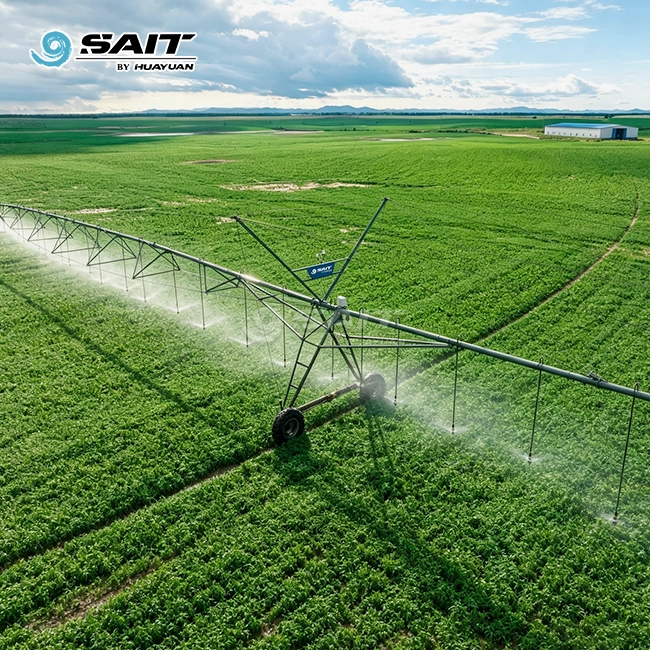
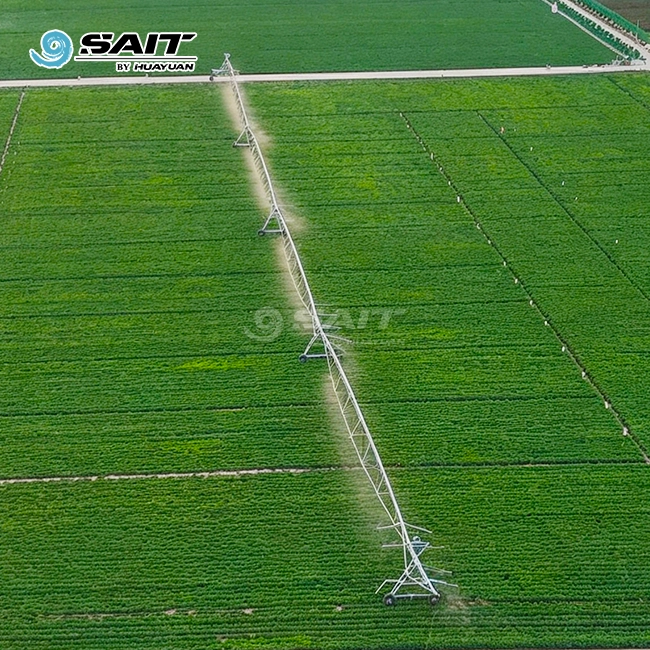
A center pivot typically irrigates between 70% and 80% of a square field under standard circular operation. When a 400-meter-radius pivot rotates across a 640-acre quarter section, the circular swept area covers roughly 78.5% of that square boundary. Add a corner arm system, and effective coverage climbs to 93–96%. For large-scale commercial operators procuring automated precision irrigation, this figure directly governs yield potential, water allocation budgets, and total cost of ownership. Understanding exactly what drives that percentage—and how to push it higher—is the first step toward a defensible procurement decision.
What Determines the Coverage Percentage of a Center Pivot?
Coverage is never a fixed number. It emerges from the interaction of structural design, field geometry, and operational settings. When engineers and procurement teams know which tools are most important, they can choose systems that perform well in real field conditions rather than catalog benchmarks.
Structural Parameters That Shape Coverage
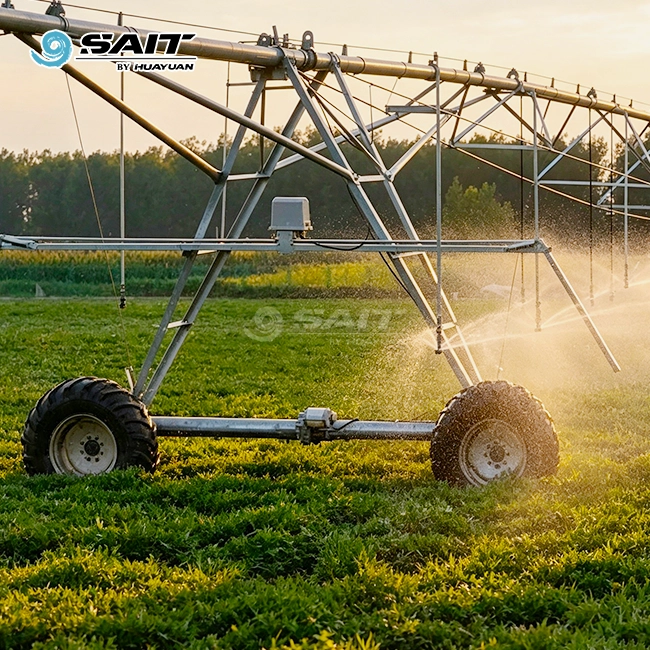
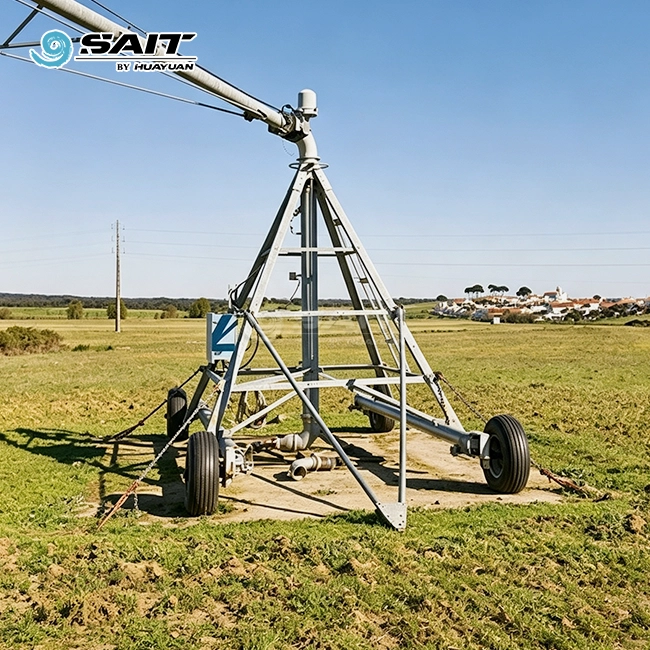
The pivot radius is the single most consequential variable. HUAYUAN SAIT systems support a maximum radius of 800 meters and span length options of 37.5 m, 43.3 m, 49.1 m, 54.9 m, 60.7 m, and 66.5 m. A longer total radius covers more gross area, but the ratio of the irrigated circle to the total field boundary depends on the field shape. Overhang lengths ranging from 2.7 m to 25 m extend water application beyond the last tower, squeezing additional coverage from each rotation without adding a full span.
Terrain, Nozzle Placement, and Rotation Speed
Undulating ground reduces effective uniformity even when the mechanical radius is correct. The SAIT Smart Control System addresses this by calibrating rotation speed to slope angle, keeping application depth consistent across elevation changes. Outlet spacing—1.9 m or 2.9 m, customizable—determines nozzle density, which directly affects the Coefficient of Uniformity (CU). Well-engineered center pivot systems routinely achieve CU values above 90%, and HUAYUAN SAIT's BeiDou-integrated control platform holds irrigation uniformity above 90% while keeping the missed-irrigation rate below 5%.
Common Coverage Percentages for Different Center Pivot Configurations


In circular irrigation, not every center pivot delivers the same proportion of irrigated area. The configuration chosen at procurement time locks in a coverage ceiling that no amount of field management can fully overcome.
Standard circular pivots operating on square quarter-section fields cover approximately 78.5% of the total land area. That leaves roughly 21.5% of corners unirrigated—a meaningful yield gap on high-value crops like corn or soybeans where every acre generates measurable revenue.
Here are the coverage ranges procurement teams should benchmark against:
- Standard circular pivot on a square field: 70–80% effective coverage. Suitable for round or near-round parcels where corner losses are acceptable.
- Corner arm (swing arm) system: Adds 13–15 percentage points, reaching 93–96% on square fields. HUAYUAN SAIT's corner arm design increases effective irrigation area by 15%, resolving the chronic pain point of corner missed irrigation on square and irregular parcels.
- Linear (lateral move) system: Approaches 95–99% coverage on rectangular fields, though infrastructure complexity and water supply logistics differ substantially from rotary pivots.
- Low-pressure versus high-pressure configurations: Low-pressure drop-nozzle packages apply water closer to the canopy, reducing wind drift losses by 15–25% compared to high-pressure impact sprinklers, effectively improving net coverage uniformity rather than gross swept area.
These distinctions carry real procurement weight. A 15-point coverage gap between a standard pivot and a corner-arm-equipped unit can represent hundreds of thousands of liters of water and dozens of irrigated hectares per season on a 500+ hectare operation.
How to Calculate and Optimize Coverage Percentage?
The standard formula for circular pivot coverage on a square field is:
Coverage (%) = (π × R²) ÷ (4 × R²) × 100 = 78.54%
Where R is the center pivot radius. This theoretical baseline assumes a perfectly square boundary with side length equal to the pivot diameter. GIS mapping software overlays this circle onto actual cadastral boundaries, revealing true coverage gaps and guiding span configuration choices before a single component ships.
Optimization moves beyond geometry. Adjusting the SAIT platform's variable rate irrigation (VRI) zones allows different application depths across soil types within a single rotation, improving agronomic coverage even where mechanical reach is constrained. Pairing span height options—2.1 m, 2.9 m, 3.8 m, or 4.5 m—with crop canopy height keeps nozzles at the optimal elevation, reducing evaporation loss and improving distribution uniformity. Truss rod and angle structural design in HUAYUAN SAIT systems maintains uniform load distribution throughout each span, preventing sag that misaligns nozzles and degrades pattern consistency over time.
Case Studies: Real-World Coverage Applications
A 1,200-hectare corn operation in the U.S. Midwest retrofitted standard center pivots with corner arm assemblies and reconfigured overhang lengths to 19.5 m. Effective coverage rose from 79% to 94%, recovering approximately 180 hectares of previously dry corner ground. Yield uniformity across the field improved correspondingly, with stress indicators from remote sensing showing near-elimination of corner dry zones.
In Kazakhstan, a state farm managing 8,000 hectares of wheat selected HUAYUAN SAIT units with 6-5/8" main pipeline and 54.9-meter spans. The SAIT Smart Control System's remote scheduling capability allowed winter programming for spring deployment, aligning with the CIS region's planting calendar. The farm reported water savings exceeding 70% compared to prior flood irrigation methods—consistent with documented efficiency gains from mechanized overhead irrigation systems documented in peer-reviewed agronomic literature.
An Ethiopian government circular irrigation project funded through a multilateral development program deployed high-clearance, ultra-high-profile (4.5 m) units over sorghum and biofuel crops. The hot-dip galvanized construction with a minimum 80 μm zinc coating performed without measurable corrosion after two full seasons in high-humidity, high-temperature conditions—validating the 20-year design life specification.

Why Coverage Percentage Matters in Procurement and ROI?
Coverage percentage is not a technical abstraction. It maps directly onto revenue. On a 200-hectare field at a standard corn yield of 10 MT/ha, recovering 15% of previously unirrigated corner area adds 300 MT of potential yield per season. At prevailing commodity prices, that figure justifies significant capital investment in corner arm hardware.
Water efficiency compounds the ROI case. HUAYUAN SAIT systems save over 70% more water compared to traditional flood irrigation. Integrated water-fertilizer operation via the SAIT platform reduces input costs further by delivering nutrients precisely where and when the crop demands them, rather than broadcasting across the entire field uniformly.
Durability protects the ROI over time. Hot-dip galvanized construction with 80 μm minimum zinc coating, armored UL-listed cable, and 20-year design life reduce replacement frequency and unplanned maintenance costs—two line items that erode pivot ROI faster than most operators anticipate at procurement.
Conclusion
Coverage percentage is the foundation of every center pivot procurement decision. It determines how much of a field actually receives water, how efficiently that water converts to yield, and how quickly the system repays its capital cost. Standard circular pivots deliver approximately 78.5% coverage on square fields; corner arm systems push that figure toward 95%. Selecting the right configuration—matched to field geometry, crop type, and operational infrastructure—requires both technical rigor and supplier capability. HUAYUAN SAIT's 20-year manufacturing record, BeiDou-integrated control platform, and flexible span configurations give procurement teams the tools to close coverage gaps and maximize every irrigated hectare.
FAQ
Q1: What is the standard coverage percentage of a center pivot on a square field?
A standard circular pivot covers approximately 78.5% of a square field. This is a geometric constant derived from the ratio of a circle's area to the square that circumscribes it. Corner arm attachments increase this to 93–96%.
Q2: How does span length affect coverage?
Longer spans increase the total radius, which expands the irrigated circle. HUAYUAN SAIT offers spans from 37.5 m to 66.5 m, allowing precise radius calibration to field dimensions. Overhang extensions of up to 25 m add further reach without a full additional span.
Q3: Can a pivot irrigate irregular or non-square fields effectively?
Yes. Corner arm systems and custom overhang configurations address irregular boundaries. HUAYUAN SAIT's engineering team provides site-specific span configuration for non-standard field geometries, including fields where third-party SCADA integration is required.
Q4: What irrigation uniformity should I expect?
A well-configured system achieves a Coefficient of Uniformity above 90%. HUAYUAN SAIT's BeiDou-integrated SAIT Smart Control System maintains uniformity above 90% with a missed-irrigation rate below 5%, outperforming the general industry average.
Partner With a Trusted Center Pivot Manufacturer — Request Your Custom Coverage Plan
HUAYUAN SAIT delivers engineered center pivot systems built for commercial-scale performance, with span configurations, profile heights, and SAIT Smart Control options tailored to your exact field geometry and crop requirements. Our team responds with site-specific coverage calculations, not catalog estimates. Contact us directly at kevin@showyirrigation.com to request a consultation. Close your coverage gap and protect your investment today.
References
1. Keller, J., & Bliesner, R. D. Sprinkle and Trickle Irrigation. Van Nostrand Reinhold, 1990.
2. Camp, C. R., Sadler, E. J., & Busscher, W. J. "A comparison of uniformity measures for drip irrigation systems." Transactions of the ASABE, 1997.
3. Evans, R. G., & King, B. A. "Site-specific sprinkler irrigation in a water-limited future." Transactions of the ASABE, 2012.
4. Dukes, M. D., Zotarelli, L., & Morgan, K. T. "Use of irrigation technologies for vegetable crops in Florida." HortTechnology, 2010.
5. Playán, E., & Mateos, L. "Modernization and optimization of irrigation systems to increase water productivity." Agricultural Water Management, 2006.
6. ASABE Standards. S436.1: Test Procedure for Determining the Uniformity of Water Distribution of Center Pivot and Lateral Move Irrigation Machines Equipped with Spray or Sprinkler Nozzles. American Society of Agricultural and Biological Engineers, 2016.
Get a tailored irrigation solution for your project — our engineering team is ready to support you from design to installation.