What are the advantages of hose-fed linear irrigation systems compared to canal-fed systems?
Hose-fed linear irrigation systems offer a clear edge over traditional canal-fed methods across several operational dimensions. A hose feed linear system draws water directly from a pressurized supply line via a flexible drag hose, eliminating the need for open channels cut across your field. This means less water lost to evaporation and seepage, faster deployment on rectangular parcels, and a field utilization rate exceeding 98%. For large-scale operators managing sugar beet, potato, or vegetable row crops, that difference in coverage and water efficiency translates directly into yield and cost outcomes.
Understanding Hose-Fed Linear Irrigation Systems


A lateral move irrigator moves in a straight line that is perpendicular to its own frame. This makes it naturally good for rectangular areas where center pivots would leave edges that need to be watered. It is easier for procurement teams to choose the best water supply method for a field when they know how these hose feed linear systems work.
Core Components of a Hose-Fed System
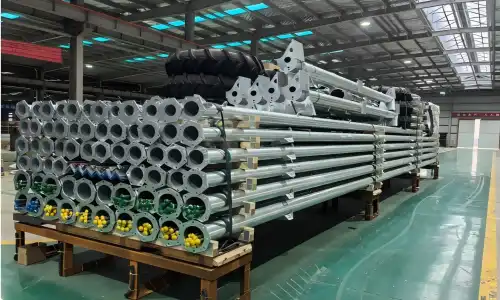
The system is made up of a main structural span that can be 37.5 m, 43.3 m, 49.1 m, or 54.9 m long and is placed on self-moving drive poles. A drag hose connected to hydrants placed around the field's edge lets water in. The main pipe has a diameter of 168 mm or 219 mm, and the longest machine length is 973 m, which can cover up to 240 hectares per unit.
How Drag Hose Water Supply Works
Moving along a 3,000-meter path, the machine leaves behind a flexible drag hose that connects at each hydrant point. The water pressure stays the same from the first span to the last thanks to this closed-circuit delivery. The hose pathway doesn't need to be dug up like open ditches do, so the soil structure is kept the same across the whole field.
Guidance Technology Options
There are three types of guidance that HUAYUAN SAIT lateral move systems can use: furrow guidance, cable guidance, and BDS/GPS dual-mode satellite guidance. For satellite-guided units, steering accuracy is within very small ranges. This means that skilled workers don't have to realign the machine by hand after every pass, which is a common task that costs a lot of money in canal-fed systems.
Key Advantages of Hose-Fed Linear Irrigation Systems
Canal-fed lateral move machines need an open path that is ready to go the whole length of the field. That channel takes up useful land, needs to be cleaned up often, and causes water to leak out before it even gets to the crop canopy. With a hose feed linear setup, you get these main benefits instead.
- Water conservation: Open irrigation pathways let water evaporate on the surface and seep into the ground. Closed hose supply stops these problems. The Food and Agriculture Organization says that 30 to 40 percent of all the water that is moved can be lost in unlined earthen ditches. These losses are almost zero when you use a compressed drag hose device.
- Higher field utilization: Every row can still be planted because there is no fixed channel that cuts the area in half. The system can water more than 98% of fields with a length-to-width ratio of more than 2:1. This is a lot more than a center pivot can do for square or rectangular plots.
- Relocation flexibility: Businesses that farm on leased land need to be able to move their assets. A drag hose machine can be moved from one field to another during the growing season because it can rejoin at regular hydrant intervals. This is not possible with a set canal system.
- Fertigation compatibility: The pressure supply line lets soluble fertilizers or crop protection agents be injected directly, which allows for fully automated fertigation that doesn't need any extra tools. This feature works the same way for nurseries, orchards, vegetables, grains, and sugarcane.
These benefits fix real problems with cost and productivity that canal-fed systems cause, especially for people who are in charge of several rectangular parcels next to each other or who are developing new farmland and don't have a lot of money to spend on excavation.
Comparing Hose-Fed Linear Systems with Canal-Fed Systems
When you compare field-level performance data and total ownership cost, it's easy to see the difference between the two ways of getting water to people.
Coverage and Land Use Efficiency
For a canal-fed lateral move to work, a path about 0.5 to 1 m wide must be made and run the whole length of the move. On a 3,000-meter field, that waterway forever cuts off a useful strip of working land. The hose feed linear setup lets you crop the whole area and gets the same travel distance without giving up any land permanently.
Installation Timeline and Civil Works
Moving dirt, lining, and designing drainage systems for canals can take weeks before the first irrigation pass happens. Setting up a drag hose system is as easy as placing hydrant manifolds along the field line, which a skilled crew can do in days. HUAYUAN SAIT oversees the installation and trains operators on-site to make sure that completion stays on schedule.
Maintenance and Operational Reliability
A hose-fed irrigator avoids the issues of open channels, which collect silt, algae, and other debris that block flow and need to be cleaned out every so often. A sealed hose and pipe system with a main pipe width of 168 mm or 219 mm keeps the pressure steady without these breaks. The electronic control system, which comes in either a normal panel or a full remote control unit, constantly checks how things are running and reports any problems before they cause downtime.
Procurement Considerations for Hose-Fed Linear Systems
When looking for the right hose feed linear irrigator, you need to look at more than just the unit price. Buyers who are in charge of multi-parcel groups or government cleanup projects need to think about how much the whole project will cost, how well the supplier can do the job, and how long parts will be available.
Span Configuration and Field Matching
Span lengths from 37.5 m to 54.9 m and overhang lengths from 2.7 m to 25 m make it possible to precisely cover irregular field edges without wasting water on areas that aren't growing crops. Wheels come in sizes 11.2-24, 14.9-24, and 16.9-24, and can be tubed or tubeless. Buyers can choose the ground pressure that is right for their soil's carrying ability.
Power Supply Flexibility
Using the pulled wire option, remote fields that aren't connected to the grid can run on generator power. The standard towed cable supply is used at grid-connected sites. This dual power availability is especially useful for operations in the CIS or Sub-Saharan Africa, where the grid infrastructure isn't always reliable.
Supplier Evaluation Criteria
A trustworthy hose feed linear provider should give direct factory supply with no markups added by middlemen, OEM and ODM customization, and an after-sales program that can be checked out. Every unit comes with a full warranty for one year, low-cost maintenance and part replacement for three years, and spare parts for life at the factory cost price. This is because HUAYUAN SAIT has been making machines for 20 years and has over 130 patents, including 35 invention patents.
Best Practices and Safety Guidelines for Hose-Fed Linear Irrigation
A hose feed linear system that is put correctly will work well for at least 15 years. Cutting corners during commissioning or skipping regular checks leads to changes in pressure that lower the uniformity of irrigation below what is acceptable.
Field Preparation Before Installation
For standard-height gaps, the ground must be level. Taller crops, like corn or sugarcane, can be grown on high-clearance span designs. Before the machine gets there, the user should make sure that the field surface gradient doesn't go over the slope tolerance set by the drive unit and that the distance between the hydrants fits the distance between the drag hose connections.
Routine Inspection Protocol
At the start of each irrigation run, check the span alignment, hose connections, and tire pressure at the wheels. Every three months, make sure the guidance system is calibrated for both cable and furrow modes. For BDS/GPS dual-mode units, the firmware needs to be checked after any control panel updates. Hot-dip galvanized structural members with a coating thicker than 80 μm don't rust, but it's still a good idea to look for surface damage after being in an abrasive field.
Operator Training and Safety Compliance
All operators should finish the training that was given for their specific system during commissioning. The choice of a remote control system lets workers watch over and stop the machine from a safe distance, like when the weather is bad. As part of the normal support package, HUAYUAN SAIT sends installation guides and training for operators in the buyer's language.
Conclusion
When it comes to saving water, field use, installation speed, and long-term flexibility, hose feed linear irrigation systems are better than canal-fed options. The drag hose water supply configuration gives a clear return on investment that open-channel systems can't match for people who work in rectangular fields, cooperatives that manage adjacent parcels, and contract farming companies that need assets that can be moved. This method is the best for large-scale farming that saves water because it uses exact guidance technology, flexible span setups, and pressurized closed delivery.
FAQ
Q1: What is the main difference between a drag hose and a canal water supply?
A pressurized flexible hose is pulled across the field by a drag hose and connected to different hydrant points along the way. For a canal supply, an open channel needs to be cut through the field and ready to go. With the hose method, plantable land is kept, water loss is cut down, and the system is set up faster without having to do any civil excavation work.
Q2: Can a hose-fed lateral move system handle fertigation?
Yes. Because the feed line is under pressure, direct fertilizer injection is possible. This means that fertigation can be used with the device. This can be used on grains, veggies, sugarcane, orchards, and gardens without the need for extra tools.
Q3: What guidance options are available?
The HUAYUAN SAIT systems can guide in furrows, along cables, or using both BDS and GPS to guide them. For large fields where installing furrows or cables would not work, satellite guidance is the best option.
Q4: How large a field can one unit cover?
One unit can move up to 3,000 m and reach a maximum length of 973 m. Depending on the span and overhang design, each unit can cover up to 240 hectares.
Get a Custom Quote from HUAYUAN SAIT — Leading Hose Feed Linear Manufacturer
The company HUAYUAN SAIT has been making lateral move irrigation systems for 20 years, has over 130 patents, and can make 1,800 units a year. As a maker of direct hose feed linears, we can make OEM and ODM designs that fit your field shape, power source, and guidance needs. Get in touch with our team right away for a field-specific coverage study and prices that beat the competition. To get a price on your unique project, email us at kevin@showyirrigation.com.
References
1. Food and Agriculture Organization of the United Nations. Irrigation Water Management: Irrigation Methods. FAO, 2020.
2. Postel, S. L., et al. "Drip and Sprinkler Irrigation Efficiency in Large-Scale Crop Production." Agricultural Water Management, Vol. 218, 2019.
3. Evans, R. G., & Sadler, E. J. "Methods and Technologies to Improve Efficiency of Water Use." Water Resources Research, Vol. 44, 2008.
4. Camp, C. R., Sadler, E. J., & Yoder, R. E. Evapotranspiration and Irrigation Scheduling. American Society of Agricultural Engineers, 1996.
5. Narayanamoorthy, A. "Drip and Sprinkler Irrigation in India: Adoption, Impact and Future Directions." Irrigation and Drainage, Vol. 66, No. 2, 2017.
6. Daccache, A., et al. "Resources and Greenhouse Gas Impacts of Water Pumping in Irrigated Agriculture." Biosystems Engineering, Vol. 114, No. 2, 2013.
Get a tailored irrigation solution for your project — our engineering team is ready to support you from design to installation.