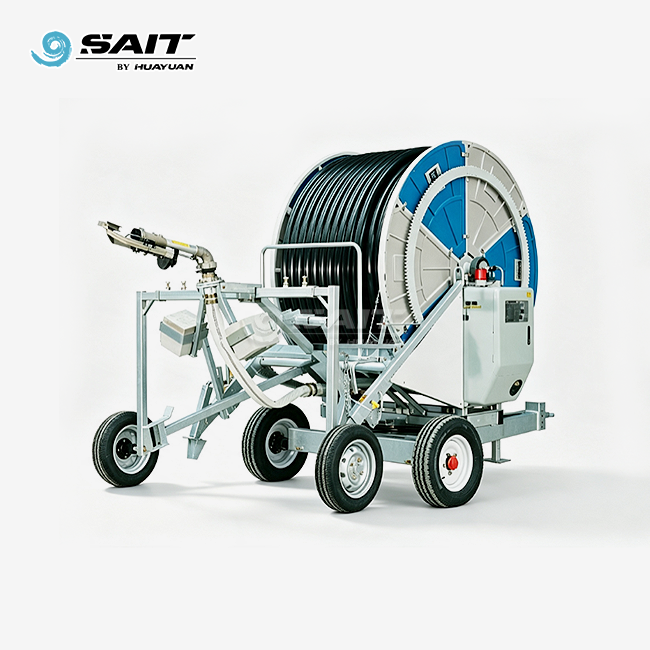
Skid pivot for sandy soils: how to anchor a skid pivot?
To properly anchor a skid pivot in sandy soil, you need to stabilise the soil and use hardware that was made just for that purpose. Because sand doesn't stick together, a skid-mounted pivot system needs helical anchors, deep-driven piles, or reinforced concrete pads to spread the weight of the system's rotational and vertical loads over a larger bearing area. Putting geotextile fabric under the skid base stops sand from moving even more when the load changes. When combined with proper compaction and moisture management, these steps keep the pivot point in place and shield the frame and engine from building up stress from misalignment.
Understanding the Challenges of Anchoring Skid Pivots on Sandy Soils


Sandy soils cover an estimated 900 million hectares of global farmland, according to the FAO, and they present a distinct engineering problem for any pivot-based irrigation structure. Grain sizes above 0.05 mm produce high internal drainage rates, stripping away the capillary tension that gives finer soils their load-bearing capacity. The result is a substrate that migrates under repeated mechanical stress — exactly the condition a rotating center pivot generates season after season.
Why Sandy Soil Undermines Conventional Anchoring
When pivot tower wheels travel over a loose, sandy bed, they compact the surface unevenly. Over multiple irrigation cycles, the pivot center shifts laterally, causing pipeline misalignment and uneven water application. Anchor bolts set in unreinforced sandy fill tend to "walk" upward through a phenomenon called frost heave analog in warm climates — cyclic wetting and drying loosen the surrounding matrix, reducing pull-out resistance by as much as 40% compared to clay-dominant soils (ASABE Standard S376.4).
Structural Risks That Compound Over Time
Pivot misalignment is not merely an inconvenience. A lateral displacement of even 50 mm at the center point can translate to several meters of tracking error at the far end of an 800-meter radius system, driving up wear on wheel gearboxes and increasing motor load. Hot-dip galvanized steel with an 80 μm zinc coating thickness resists corrosion admirably, but abrasion from sand particles lodging between moving components accelerates mechanical wear far beyond what corrosion alone would produce.
Key Principles and Techniques for Anchoring Skid Pivots on Sandy Soils
Effective anchoring is not a single action — it is a layered strategy that addresses soil behavior at multiple depths and load directions. Here are the core engineering principles that underpin a reliable installation for a skid pivot:
- Helical anchor arrays: Driven to a minimum depth of 1.5 meters, helical anchors develop bearing capacity in undisturbed sand layers below the wind-disturbed zone. Torque readings during installation serve as real-time load capacity indicators, removing the guesswork from sandy-site engineering.
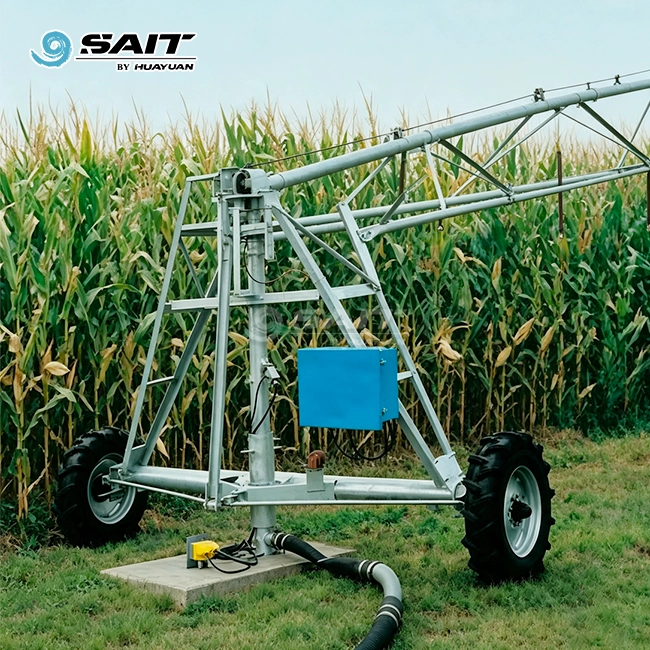
- Reinforced concrete grade beams: A continuous concrete pad (minimum 200 mm thick, reinforced with deformed rebar at 150 mm centers) distributes the pivot's vertical load across a footprint large enough to stay below the bearing capacity limit of the sandy stratum. This approach is particularly effective for HUAYUAN SAIT systems using 8-5/8" (219 mm) main pipeline configurations where dead loads are highest.
- Geotextile separation layer: A woven polypropylene geotextile placed beneath the skid base prevents fine sand particles from pumping upward into the gravel sub-base under cyclic irrigation loading. This single step can extend foundation service life by four to six years in field trials conducted on Nebraska Sandhills pivot installations.
- Compaction grouting: Injected grout columns stiffen loose sand around existing anchor shafts, recovering pull-out capacity without excavation. This technique suits retrofits where a pivot pad has already settled.
These measures work together to create a composite foundation. Relying on any single method in isolation leaves residual vulnerability — helical anchors resist uplift well but offer limited lateral restraint without a concrete collar connecting them to the skid base.
Step-by-Step Installation Guide for Skid Pivot Anchors in Sandy Soils
A structured installation sequence eliminates improvisation errors that account for the majority of premature pivot failures on sandy sites.
Phase 1 — Site Assessment and Soil Testing
Collect undisturbed core samples at 0.5 m, 1.0 m, and 1.5 m depths. Measure dry density, grain size distribution, and in-situ moisture content. USCS classification of SP (poorly graded sand) or SM (silty sand) triggers the highest-tier anchoring protocol. Record the groundwater table depth; saturated sands below the pivot pad dramatically reduce bearing capacity and may require dewatering during concrete placement.
Phase 2 — Anchor Installation and Alignment
Position the skid pivot base on a compacted gravel sub-base (150 mm minimum, CBR ≥ 30). Drive helical anchors at the four corners of the pad and at mid-span anchor points designated in the site-specific engineering drawing. Torque each anchor to the manufacturer's minimum installation torque — typically 3,400 N·m for a 76 mm shaft helix in medium-dense sand. Connect anchor shafts to the concrete grade beam rebar cage before pouring. Verify that the pivot center vertical axis is plumb to within ±2 mm before the concrete sets.
Phase 3 — Post-Installation Monitoring
After the first three irrigation cycles, inspect anchor head exposure and pad level with a precision digital level. Re-torque any anchor head nuts that have relaxed. SAIT Smart Control System telemetry can flag abnormal motor current draw — an early indicator of increased rolling resistance caused by pivot path deviation — allowing corrective action before structural damage accumulates.
Comparative Analysis: Skid Pivot Anchoring Solutions vs. Traditional Fixed-Base Systems
Traditional fixed-base center pivot installations pour a single large concrete monolith, which performs acceptably on cohesive soils but behaves poorly on sandy ground. The monolith's narrow bearing area concentrates load, and differential settlement between the pad and the surrounding loose fill creates a tilting moment that few designs account for. Repairing a settled monolith requires excavation, shimming, and often full replacement — a project that can idle irrigation for an entire growing season.
A skid-mounted pivot system distributes its load through a broader, configurable footprint and allows the base to be repositioned without demolition. For large-scale operations managing 500 hectares or more, this mobility translates directly into reduced infrastructure cost per hectare when rotating the pivot between fields. The initial engineering investment in a properly anchored skid system is recovered within two to three seasons through lower maintenance frequency and uninterrupted irrigation scheduling.

Maintenance and Troubleshooting for Skid Pivot Anchors on Sandy Soils
Quarterly inspections form the backbone of any anchoring maintenance program. Inspectors should probe the perimeter of the pad with a steel rod to detect subsurface voids — cavities as shallow as 100 mm beneath the edge of a concrete grade beam can initiate progressive failure under irrigation loading.
Common Warning Signs and Remediation
Pivot misalignment showing as a repeating arc deviation on SAIT telemetry maps warrants immediate pad-level verification. Anchor corrosion visible above the grade beam surface signals that the zinc coating has been compromised by aggressive soil chemistry — likely where soil pH drops below 5.5 or rises above 9.0. Replacing exposed anchor sections with hot-dip galvanized (80 μm+) replacements from a confirmed skid pivot supplier restores the protection barrier without full system removal.
Scheduled Preventive Actions
Repack bearing surfaces on wheel gearboxes (50:1 and 52:1 ratios) every 500 operating hours in sandy conditions versus the standard 1,000-hour interval. Inspect UL-listed armored cable conduit entry points for sand infiltration, which abrades insulation over time. Keeping the sub-base clean of windblown sand accumulation prevents the gravel drainage layer from blinding, maintaining the drainage function that stabilizes soil moisture and, by extension, bearing capacity beneath the pad.
Conclusion
Anchoring a skid pivot on sandy soils is solvable — but it demands engineering depth that goes well beyond driving a few ground anchors. Layered foundation design, disciplined installation sequencing, and a consistent maintenance schedule protect the full service life potential of a center pivot system that, when properly anchored, can irrigate up to 200 hectares per cycle while saving more than 70% of the water that flood irrigation would consume. Getting the foundation right is what separates a 20-year asset from a costly early replacement.
FAQ
Q1: What anchor depth is typically required for skid pivots on sandy soils?
Helical anchors should penetrate at least 1.5 meters into undisturbed sand. Depth increases if the upper soil profile is loose fill or if dynamic loads from larger pipeline configurations (8-5/8"/219 mm) exceed standard pull-out ratings.
Q2: Can a skid pivot be relocated after anchoring on sandy ground?
Yes. The skid-mounted design allows repositioning. After removing anchor hardware and breaking the concrete collar connection, the base assembly can be transported and re-anchored at a new field position — a key advantage over fixed monolith systems.
Q3: How does the SAIT control system help detect anchor issues?
SAIT telemetry monitors motor current, travel speed consistency, and deviation from the programmed arc path. Anomalies in these parameters often surface before visible physical damage occurs, enabling proactive maintenance.
Q4: What maintenance interval applies to anchors in sandy soils?
Inspect anchor torque and pad level every 90 days during the irrigation season. Annual non-destructive inspection of welds connecting anchor shafts to the grade beam is advisable where soil pH is outside the neutral range.
Partner with HUAYUAN SAIT — Trusted Skid Pivot Manufacturer for Demanding Terrain
HUAYUAN SAIT brings 20 years of manufacturing experience to every pivot project. Our skid pivot systems ship within one week from our Suzhou facility, backed by hot-dip galvanized construction at 80 μm+ zinc coating, a 20-year design life, and a full after-sales package including free installation, a 1-year warranty, and lifetime spare parts supply at cost price. Reach our technical team directly at kevin@showyirrigation.com to discuss your sandy-soil project specifications today.
References
1. American Society of Agricultural and Biological Engineers (ASABE). ASABE Standard S376.4: Design, Installation, and Performance of Underground, Subsurface Drip Irrigation Systems. ASABE, 2017.
2. Food and Agriculture Organization of the United Nations. Irrigation Water Management: Irrigation Methods. FAO, 2019.
3. Keller, J., & Bliesner, R. D. Sprinkle and Trickle Irrigation. Van Nostrand Reinhold, 1990.
4. Burt, C. M., et al. "Irrigation Performance Measures: Efficiency and Uniformity." Journal of Irrigation and Drainage Engineering, ASCE, 1997.
5. Hanson, B., Orloff, S., & Peters, D. Monitoring Soil Moisture for Irrigation Water Management. University of California Division of Agriculture and Natural Resources, Publication 21635, 2000.
6. Nebraska Extension. Center Pivot Irrigation Handbook. University of Nebraska–Lincoln, EC3002, 2016.
Get a tailored irrigation solution for your project — our engineering team is ready to support you from design to installation.