How to set sector control on a pivot? How does it work with obstacles?
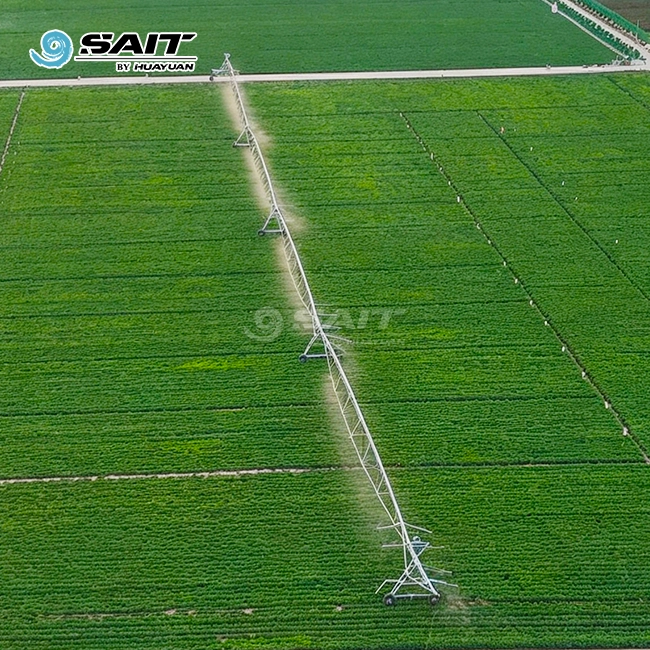
When a pivot needs to irrigate only part of a field — skipping a road, a power line, or a building — sector control makes that possible. Sector control is a programmable function within a center pivot's control panel that defines specific arc boundaries, instructing the machine to irrigate within a set angular range rather than completing a full 360° rotation. The system monitors the pivot's real-time position using angle sensors or GPS-based positioning, automatically pausing or shutting off water flow when the machine enters a designated exclusion zone tied to an obstacle.
Understanding Sector Control on a Pivot
It's not always true that a center hinge works in a wide, open field. There are often access roads that go through irrigated land, drainage ditches, utility lines, or buildings that are in the pivot's sweep radius on industrial fields. Without automated zone management, farmers have to either waste water on areas that aren't growing crops or do it by hand, which is expensive on a large scale.
The control system of the pivot breaks the full rotation arc into angular segments that can be programmed. Each segment has its own irrigation instructions, such as "run at full flow," "run at a lower application rate," or "shut off completely." The controller knows exactly where each tower is in the turn thanks to position feedback, which usually comes from a resolver or Hall-effect sensor placed at the pivot point. If the system sees that the pivot moves into a certain exclusion zone, it turns off the water pump or closes the line valve until the pivot moves out of the zone.
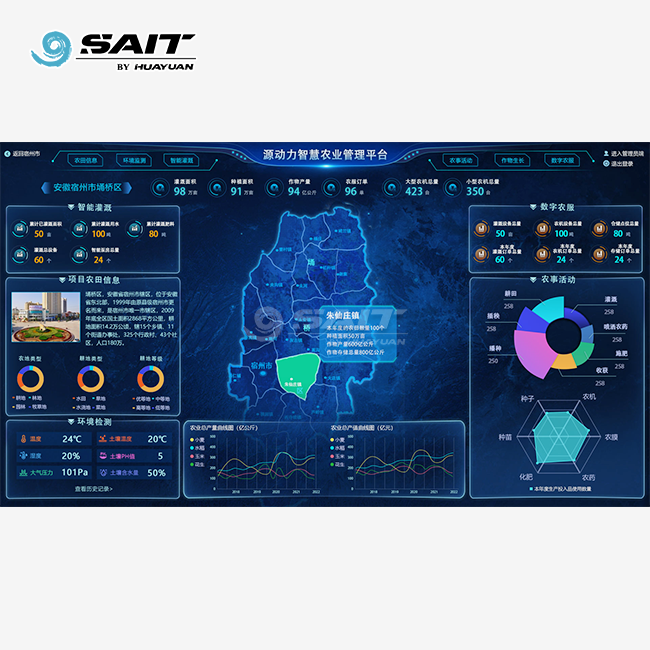
This is one step further with the SAIT Smart Control System. It uses Internet of Things (IoT) connections and big data models to support Variable Rate Irrigation (VRI) across specific zones. With VRI, water is applied based on how well the soil absorbs it, rather than being applied at the same rate across the whole arc. It has performance standards that set it apart from normal catalog systems, like uniformity of irrigation that is over 90% and missed watering rates that stay below 5%.
Step-by-Step Guide to Setting Sector Control on a Pivot
To get sector control set up properly, you need to do more than just turn on a feature. On a HUAYUAN SAIT pivot with the SAIT control platform, this is how the process works in real life.


Defining Arc Boundaries and Entering Control Parameters
Walk around the field and write down where each obstacle is in relation to the pivot point in terms of angle. To turn a real place into a degree value, use a compass bearing or the system's built-in GPS positioning. In the control panel, type in the start and stop angles for each exclusion zone. The SAIT system can handle more than one separate zone per spin. This means that a field with a road on one side and a building on the other can have both programmed at the same time without any problems.
Calibrating Sensors and Running Field Tests
After setting up the zone parameters, slowly turn the pivot around at least once while keeping an eye on the position display on the control panel. Make sure that the system's angle tracking is within ±1° of where it is in real life. If necessary, change the sensitivity thresholds. To test the exclusion zone reaction, temporarily mark a test arc and make sure that the water supply stops and starts at the right degree marks. The system shouldn't go into the normal production schedule until a dry run has been checked and approved.
The SAIT platform allows for remote tracking through a mobile or desktop interface. This means that operators with 500 ha or more of land can check zone behavior during tests without being at the pivot point in person.
Overcoming Challenges When Using Sector Control with Obstacles
Even systems that are well set up have problems that make them less useful. Sensor drift is the most common problem on large commercial farms during long seasons. This is when the pivot's angle encoder loses its calibration because of vibrations or electrical interference from other equipment nearby. Arc limits stay correct with regular recalibration, at least once a growing season.
For optimized sector watering, systems that use proximity sensors instead of angle encoders sometimes find obstacles when they shouldn't. Software-based noise filtering and strategically placing sensors away from metal structures both help cut down on false stops. When using SAIT with third-party SCADA platforms, making sure the protocols are compatible before installing it keeps the connection between the pivot controller and the farm management system from being held up.
One interesting real-life example is a 1,200 ha row crop operation in Kazakhstan that used multiple pivots across fields with seasonal access roads. They saw a 22% drop in unproductive pivot stops after switching from a PLC-based manual exclusion system to an IoT-integrated angular control platform. During the spring planting season, when every irrigation run is important, the operating stability got a lot better.
Comparing Sector Control Technologies and Solutions
Traditional PLC-based systems use hard-coded relay logic to handle barrier elimination. This works, but it needs to be reprogrammed on-site whenever conditions change in the field. SCADA platforms give you more options, but they are more expensive and make your infrastructure more complicated, which is hard for smaller businesses to justify.
This hole is filled by new smart control tools like SAIT. It uses both BeiDou satellite navigation and Internet of Things (IoT) sensor networks to give accurate real-time location information without all the extra hardware needed for full SCADA operation. The end result is a solution that can be used on both a 50-hectare pilot field and a 5,000-hectare state farm.
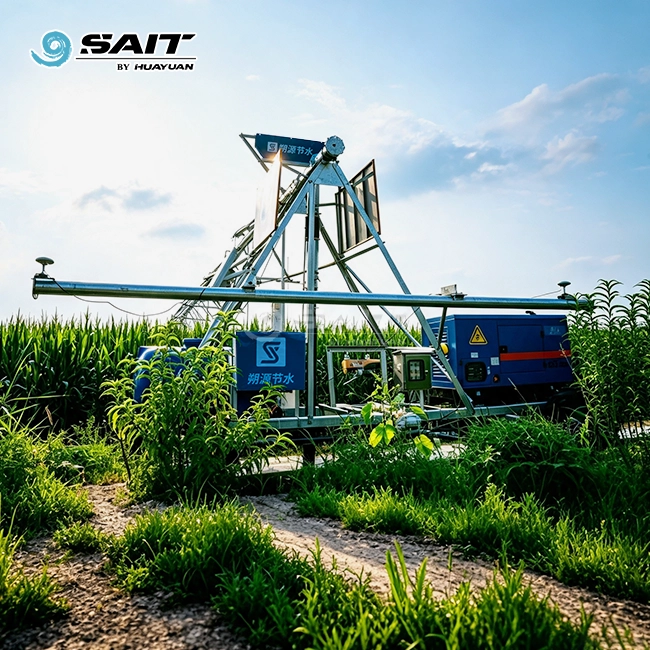
At the hardware level, the HUAYUAN SAIT center pivot provides this information. In the field, precision sector control is effective because of the following strengths:
- Hot-dip galvanized construction with 80μm+ zinc coating protects against rust in hot, warm, and temperate conditions, and it's meant to last more than 20 years.
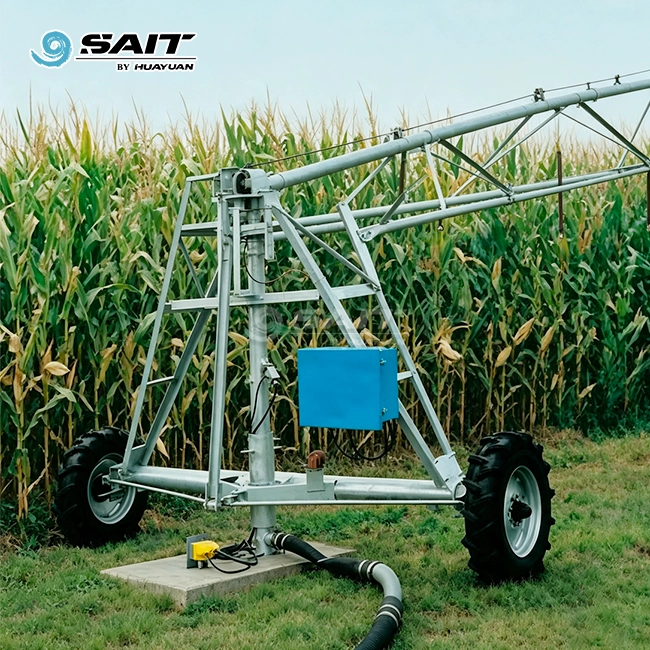
- Truss rod and angle structural design fairly spreads weight across each span, which ranges from 37.5 m to 66.5 m. This keeps the geometry stable, which is necessary for precise arc placement.
- Standard, low, high, and ultra-high profile configurations (span heights of 2.1 m to 4.5 m) can be used for row crops, high-clearance sugar cane fields, and biofuel plantings without the need for different machine platforms.
- A maximum radius of 800 meters allows each unit to cover up to 200 hectares. Pipelines come in widths of 5" (127 mm), 6-5/8" (168 mm), and 8-5/8" (219 mm), which can be adjusted to fit the size of the field.
- Corner Arm System makes it possible to water square and irregularly shaped fields more effectively, watering up to 15% more land than with standard circular sweeps.
These benefits directly solve the problem of putting in place reliable sector watering in fields with different shapes and in harsh conditions. It saves more than 70% of the water used in standard flood irrigation, and the fact that it also fertilizes the soil at the same time makes it the most agriculturally efficient per irrigation cycle.
Procurement Considerations for Sector Control Systems
When looking at a sector control provider, B2B buyers often feel torn between the unit cost and the total cost of ownership. A system with a lower purchase price but limited after-sales support, hard-to-reach spare parts, or limited customization options will cost more over its lifetime than the invoice suggests.
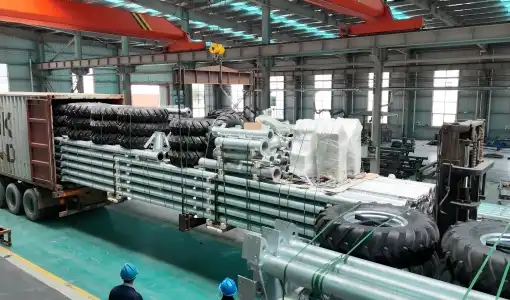
HUAYUAN SAIT talks about this straight out. The company has more than 130 patents, including 35 idea patents and 15 foreign patents. These patents were created with the help of China Agricultural University and are based on engineering studies done in the province. The company has been making things for 20 years and can make 1,800 pivot and linear systems every year, which makes sure that shipping dates are always met. Standard delivery takes about a week from the time the order is approved. For fast export dispatch, goods are sent through the Xuzhou hub network.
After the sale, there is a full warranty for one year, low-cost maintenance and part replacement for three years, and spare parts for life at the factory cost price. OEM and ODM services include private-label documentation, control panel localization, and custom branding. These are useful for distributors entering new regional markets or contractors responding to government tender specifications.
Conclusion
A center pivot is transformed into a precise watering tool by sector control, which allows it to operate independently in difficult field conditions. If the system is correctly set up, with correct arc border entry, sensor calibration, and confirmed field testing, it will either work consistently or cause problems that need to be fixed over and over again. The HUAYUAN SAIT platform combines positioning with BeiDou, remote management through the Internet of Things (IoT), and strong hot-dip galvanized hardware to support reliable zone-based irrigation in both commercial and government operations that are very demanding.
FAQ
Q1: What is the minimum angular resolution for sector exclusion zones?
With arc border programming that can be done in one-degree steps, the SAIT control system gives users exact control over exclusion zones that are tied to narrow obstacles like utility poles or fence lines.
Q2: Can sector control operate independently without internet connectivity?
The onboard controller stores all zone parameters locally and can run irrigation schedules even when the internet isn't connected. For remote tracking and adjustments to work, you need to be connected, but the logic in the core zone runs on its own.
Q3: How does the system handle overlapping exclusion zones?
When any active zone condition is met, the control logic gives the exclusion instruction the most weight. When zones overlap, they don't cause problems; the system stays in the off state until the pivot clears all current exclusion loops.
Q4: Is SAIT compatible with third-party farm management platforms?
Through standard transmission protocols, the SAIT platform can connect to third-party SCADA and farm management tools. For OEM clients, NDA protection is available for secret system configurations.
Partner with HUAYUAN SAIT — Your Trusted Sector Control Supplier
Engineered pivot irrigation systems made for commercial-scale accuracy are what HUAYUAN SAIT sells. We can help with every step of your project, from planning the field layout to making sure you always have parts and implementing sector control. We have over 130 patents and 20 years of experience making things. Get in touch with our technical team right away to talk about how your field is set up, ask for a product sample, or get a reasonable quote. To start your question, email us at kevin@showyirrigation.com.
References
1. Evans, R.G. & Sadler, E.J. — Precision Irrigation Management: A Review of Current Research and Trends, Computers and Electronics in Agriculture, 2008.
2. Hedley, C.B. & Yule, I.J. — Soil Water Status Mapping and Two Variable-Rate Irrigation Scenarios, Precision Agriculture, 2009.
3. O'Shaughnessy, S.A. et al. — Site-Specific Variable-Rate Irrigation as a Means to Enhance Water Use Efficiency, Irrigation Science, 2013.
4. Camp, C.R. & Sadler, E.J. — Evaluation of Uniformity for Fixed and Variable Rate Center Pivot Irrigation Systems, Transactions of the ASABE, 2006.
5. Sui, R. & Fisher, D.K. — Field Test of a Center Pivot Irrigation System with Precision Application Capabilities, Agricultural Water Management, 2015.
6. Lyle, W.M. & Bordovsky, J.P. — Low Energy Precision Application (LEPA) Irrigation System, Transactions of the ASAE, 1981.
Get a tailored irrigation solution for your project — our engineering team is ready to support you from design to installation.