How Does an Electric Drive Irrigation System Work?
An electric drive irrigation system uses electric motors, variable-frequency drives, pumps, sensors, and smart controllers to deliver water with measurable precision across large agricultural fields. Unlike flood irrigation or pressure-turbine alternatives, the system decouples water delivery from mechanical drag, allowing operators to regulate flow rate, coverage zone, and application depth independently. The HUAYUAN SAIT center pivot platform exemplifies this approach — integrating the SAIT Smart Control System with BeiDou navigation and IoT connectivity to achieve irrigation uniformity above 90% and a missed-irrigation rate below 5% across fields up to 200 hectares.
Understanding How an Electric Drive Irrigation System Actually Operates
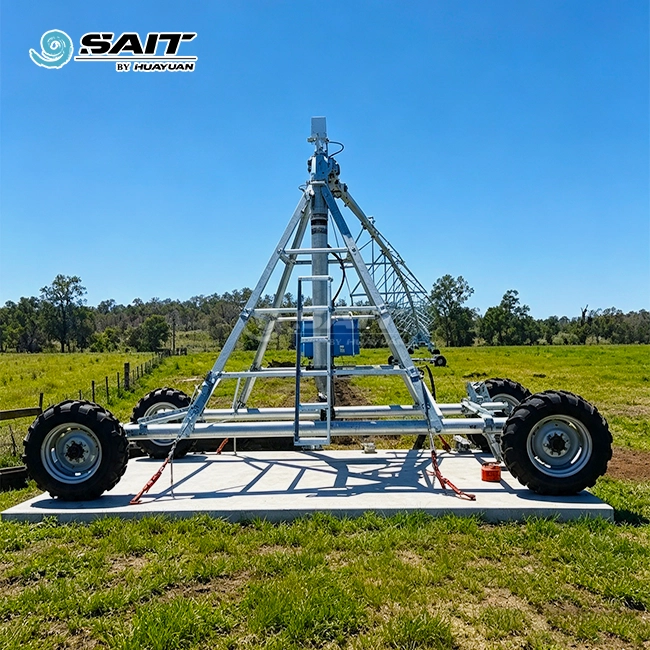
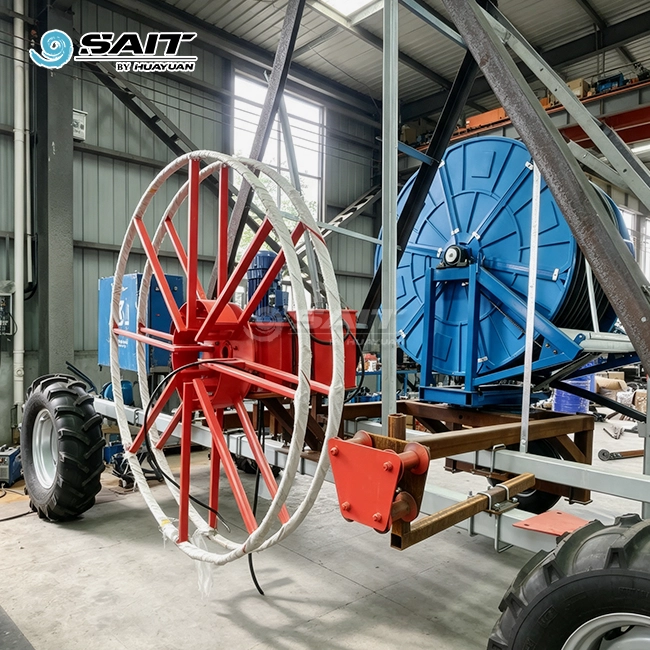
At its core, this technology turns electrical energy into controlled circular motion that turns the wheels on both the pump and the pivot tower at the same time. The water comes from the supply source and goes through the main tunnel, which has diameters of 5" (127mm), 6-5/8" (168mm), or 8-5/8" (219mm). The water then moves out along the span structure as the towers rotate in a planned arc.
The Role of the Gearmotor and Wheel Gearbox


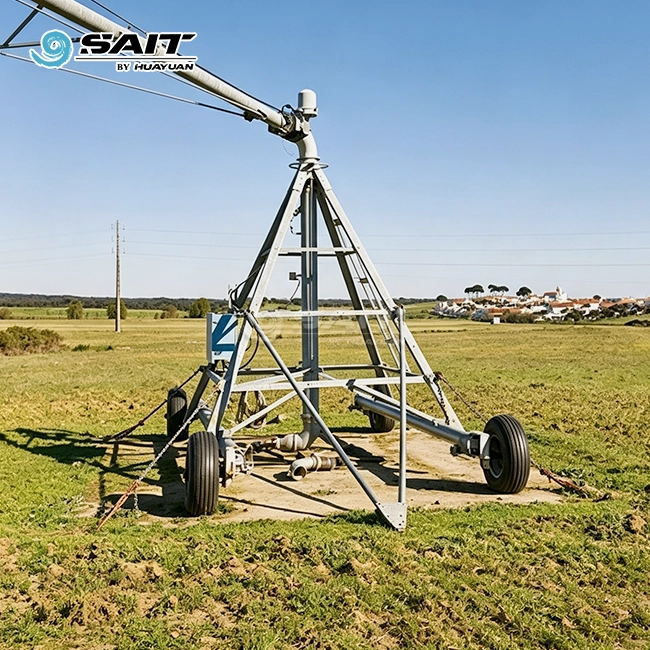
The gearmotor has a ratio of 25.5:1 at 1.5hp and 40:1 at 0.75hp. Each tower has a wheel gearbox with a ratio of 50:1 or 52:1. This mixture makes a lot of power at a low rotational speed. This keeps the pivot going slowly and evenly over rough ground or compacted clay soils. The truss rod design, which uses 20mm or 22mm rods with precise angle geometry, spreads span loading evenly. This stops the structure from bowing and keeps the outlet spacing the same at 1.9m or 2.9m for every run.
SAIT Smart Control and Variable Rate Irrigation
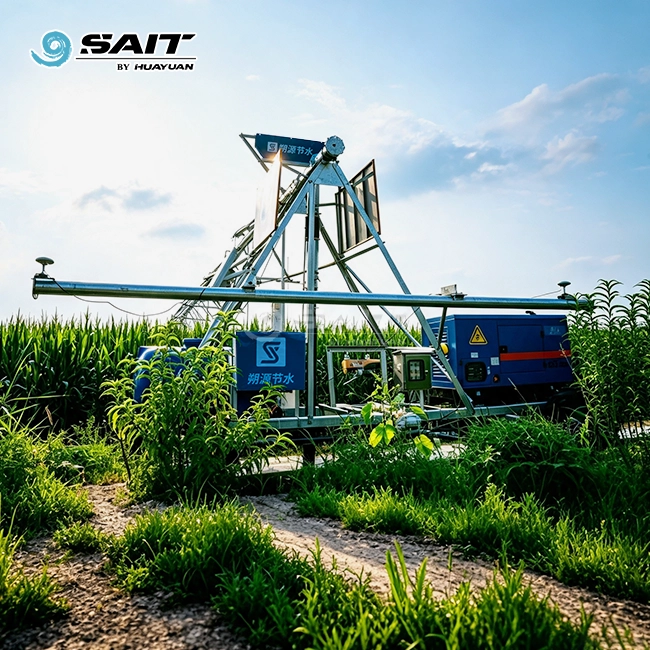
The automated irrigation SAIT control system matches how much water is applied to how the dirt is infiltrating in real time. It figures out variable rate irrigation (VRI) plans on its own using big data models and IoT sensor inputs. Through GSM connectivity, operators can start or stop the machine remotely, change its speed, or switch between irrigation zones all from their phones, without having to go to the field in person.
How does electric drive compare to Hydraulic and Diesel Alternatives?
Picking the right drive technology is very important for keeping costs down on a 500-hectare row crop farm. When you use hydraulic drive systems, the pressure drop can change, which can make the water distribution less even over longer distances (below 80%). Diesel-powered pumping units use a lot more fuel per hectare-meter of water supplied, and they need to be serviced more often, which raises the total cost of ownership over 10 years.
Both problems are solved by the electric drive method. Benchmarking data from the USDA ARS shows that electrically driven center pivots regularly achieve 85–95% distribution regularity, while gravity-fed surface watering only achieves 70–80%. The HUAYUAN SAIT system goes even further, with closed-loop motor speed correction achieving more than 90% uniformity. This is a clear practical benefit for growers of corn, soybeans, wheat, and cotton who are handling moisture-sensitive yield windows.
Core Components, Automation Features, and Configuration Options
Modern center pivot platforms have many parts that work together. Knowing how they work together helps procurement engineers choose the best setup for a field's plan and crop needs.
Here are the main technical parts that determine how well a system works:
- Pipeline and span structure: Six selectable span lengths (37.5m to 66.5m) accommodate fields from 4 hectares up to 200 hectares. Four profile heights — 2.1m, 2.9m, 3.8m, and 4.5m — enable clearance for standing crops including sugarcane and biofuel species. The maximum pivot radius reaches 800 meters.
- Drive and wheel assembly: UL-listed armored cable supplies power to each tower gearmotor. Wheel sizes (11.2-24, 14.8-24, or 16.9-24) are available in tube or tubeless configurations suited to sandy, loam, or heavy clay profiles. This range prevents wheel slip that would disrupt arc synchronization.
- Sprinkler and fertigation package: Multiple sprinkler options match different soil intake rates and canopy architectures. The integrated water-fertilizer module delivers nutrient solution simultaneously with irrigation water, cutting labor input and improving nutrient uptake timing.
- SAIT Smart Control System: BeiDou-enabled positioning eliminates corner-missed irrigation — a persistent pain point with standard pivot geometry. The corner arm system extends effective coverage by 15% over standard circular coverage, recovering previously unirrigated square-field corners.
The electric drive irrigation system's parts work together to solve the production problems that big operators often have, like water depths that change, dead zones in corners, and a lot of work that needs to be done by hand to make the schedule. Before it is shipped, the factory can change each configuration element to match engineering drawings specific to the site.
Maintenance Requirements, Durability, and Environmental Footprint
One of the best reasons to use an electricity-driven pivot is that it cuts down on the number of times that upkeep needs to be done. Turbine-driven and hydraulic systems need to have their gearbox oil changed, seals replaced, and pressure-line inspections done regularly. This means that the equipment has to be taken offline during important irrigation windows. The electric drive design cuts down on those touchpoints by a large amount. The main planned maintenance tasks are regularly checking the battery health and lubricating the gearmotor chain.
Structural Longevity Through Hot-Dip Galvanizing
All structural steel parts are hot-dip galvanized until the zinc coating is at least 80µm thick. This method embeds zinc into the steel instead of just covering it with a layer. This makes the finish much more resistant to rust than regular electroplated finishes. Independent salt-spray testing shows protection lasts longer than 20 years in outdoor farming settings. This is important for operators in coastal, arid, or high-humidity areas where steel breaks down in 5–7 years without protection.
Water Conservation and Carbon Impact
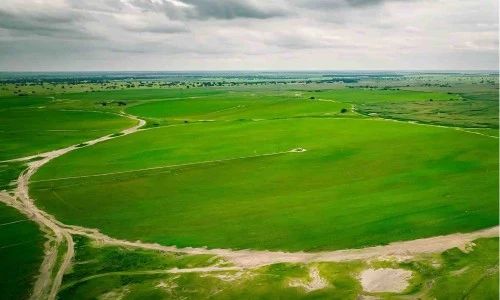
According to data from the Food and Agriculture Organization, automated irrigation precision pivots that are powered by electricity use over 70% less water per hectare than traditional flood irrigation. That difference means that hundreds of thousands of cubic meters of groundwater are saved every year in a 100-hectare corn field with a 120-day growing season. Less pumping time and better planning also use fewer kilowatt-hours per irrigation cycle, which lowers the amount of carbon that each harvest produces.
Procurement Considerations for B2B Clients
Purchasing managers who are looking at center pivot suppliers compare the unit price to the total cost over the lifecycle, the length of the warranty, and the reliability of the supply chain. Every concern is directly addressed by HUAYUAN SAIT.
With 20 years of experience making things, the company can make 1,800 pivot and linear systems every year. Its factory is close to Xuzhou, which is a hub-level logistics node in the Huaihai Economic Zone, making exporting faster and cheaper than for manufacturers in mainland China. For custom combinations, pilot sales begin at one unit. For normal wholesale orders, 5–20 units across the three pipe diameter classes can be ordered at a time.
After the sale, there is on-site fitting help, a full guarantee for one year, low-cost part replacement for three years, and spare parts for life at the factory cost price. As long as wholesalers and regional irrigation brands sign NDA agreements, OEM and ODM customization is allowed. This includes branded control panels, private-label truss marks, and localized UI languages.
Conclusion
An electric drive irrigation system is a developed and measured step up from manual, diesel, and hydraulic systems for watering plants. Its value doesn't come from any one part, but from how well it works with intelligent scheduling, precision motor control, long-lasting structures, and the ability to respond to agronomic data. The technology improves water efficiency, crop uniformity, and running costs for business farms, government agencies that buy things, and engineering companies that work in a variety of field situations. The HUAYUAN SAIT platform, which has an 80¼m galvanized structure, the SAIT Smart Control System, and flexible span configurations, offers a technically sound and commercially viable way to achieve large-scale automated precision irrigation.
FAQ
Q1: How much water does an electric center pivot system save compared to flood irrigation?
Independent figures from the FAO and USDA show that center pivot systems use more than 70% less water per hectare than standard flood irrigation. The HUAYUAN SAIT system makes this even better by using closed-loop VRI scheduling to match the rate of application to real-time data on how much water is infiltrating the soil. This stops runoff and deep percolation losses.
Q2: Can the SAIT control system integrate with existing farm management platforms?
The SAIT Smart Control System can connect to third-party SCADA and farm management platforms. With IoT connections and API APIs that can be changed, OEM distributors and procurement clients can add the control layer to their current digital farm infrastructure.
Q3: What protection does the system have against lightning and power surges?
Each tower assembly has armored wire that is listed by UL, and surge protection and grounding features to keep the PLC, sensors, and motor controls safe during electrical storms.
Q4: What is the minimum order for a custom configuration?
HUAYUAN SAIT takes pilot orders for one unit of custom configurations, such as span lengths that aren't standard, different profile heights, and private-label branding packages.
Partner With HUAYUAN SAIT — Your Trusted Electric Drive Irrigation System Supplier
HUAYUAN SAIT offers factory-direct prices, 20 years of engineering experience, and a tried-and-true electric drive irrigation system made to work on a large scale. Our team can help you with everything from layout planning to on-site commissioning, whether you need 5–20 units for a government food security project or a single OEM pilot unit. To get a configuration quote right away, email us at kevin@showyirrigation.com.
References
1. Food and Agriculture Organization of the United Nations. Crop Evapotranspiration: Guidelines for Computing Crop Water Requirements. FAO Irrigation and Drainage Paper No. 56, 1998.
2. USDA Agricultural Research Service. Center Pivot Irrigation System Performance and Water Use Efficiency. ARS Technical Report, 2017.
3. American Society of Agricultural and Biological Engineers. ASABE Standard S436.1: Test Procedure for Determining the Uniformity of Water Distribution of Center Pivot and Lateral Move Irrigation Machines. ASABE, 2016.
4. Howell, T.A. Irrigation Efficiency. Encyclopedia of Water Science, Marcel Dekker, 2003.
5. Camp, C.R., Sadler, E.J., & Yoder, R.E. Evapotranspiration and Irrigation Water Requirements. ASCE Manuals and Reports on Engineering Practice No. 70, American Society of Civil Engineers, 1996.
6. Phocaides, A. Handbook on Pressurized Irrigation Techniques. Food and Agriculture Organization of the United Nations, 2007.
Get a tailored irrigation solution for your project — our engineering team is ready to support you from design to installation.