How to Install Steel Cable Guidance for Reliable Operation
Installing steel cable guidance correctly is the single most important step in getting a linear irrigation system to travel straight, season after season. When the wire rope anchor points are off, or tension is uneven, the entire machine drifts — wasting water, damaging crops, and triggering costly service calls. This guide walks through each phase of steel cable guidance installation for lateral move irrigation systems, from site prep to post-run verification, so operators and distributors can protect their investment from day one.
Understanding Steel Cable Guidance in Linear Irrigation Systems


Before you take out a wrench, it's helpful to know what the cable is for and why it's so important to install it correctly in the field.
What Steel Cable Guidance Actually Does
Along the edge of the field, a steel cable guiding device lays a wire rope that is tightened. Each drive unit has sensor wheels or feeler arms that follow the cable and send correction signals to the steering motors. This keeps the machine moving in a straight line parallel to the mainline pipe. If the cables aren't placed exactly, the machine will move around. And since the machine moves side to side 3,000 meters, even a small error in angle can cause a lot of damage to the crops.
Why Linear Systems Demand Higher Precision Than Pivots
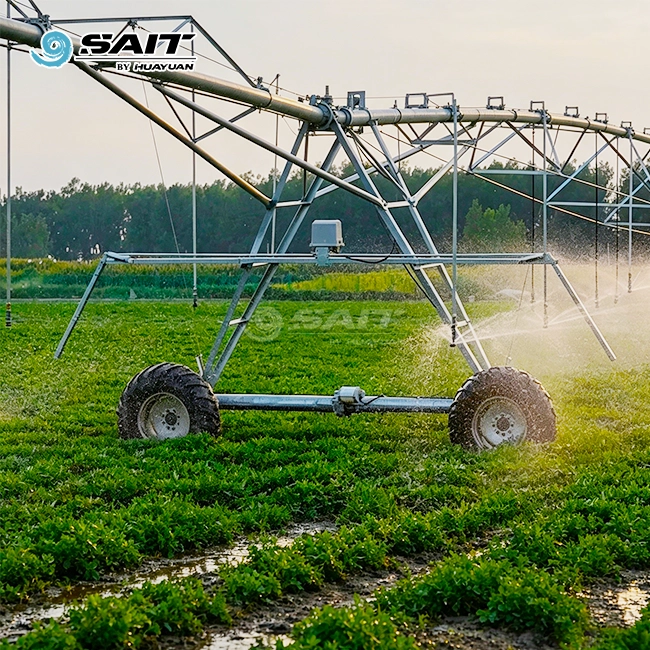
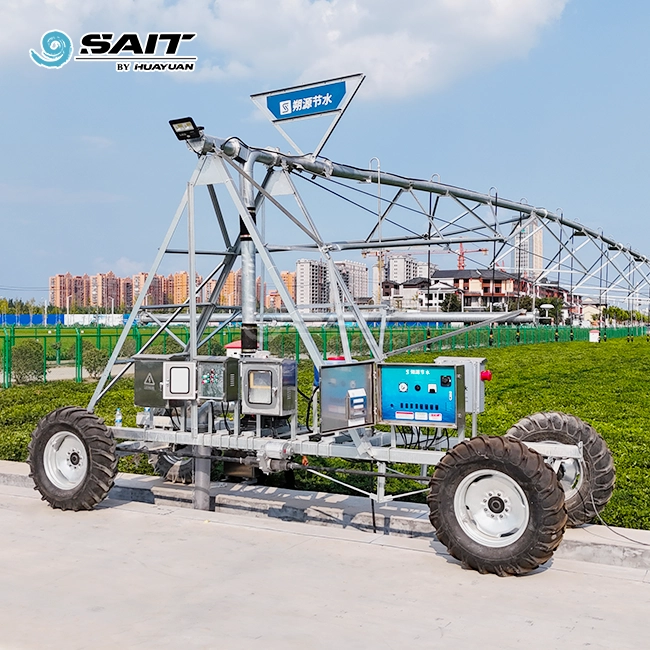
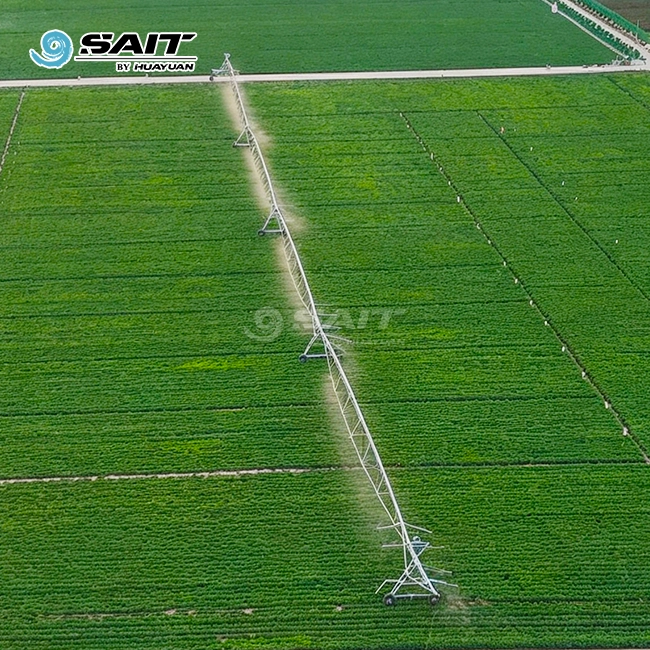
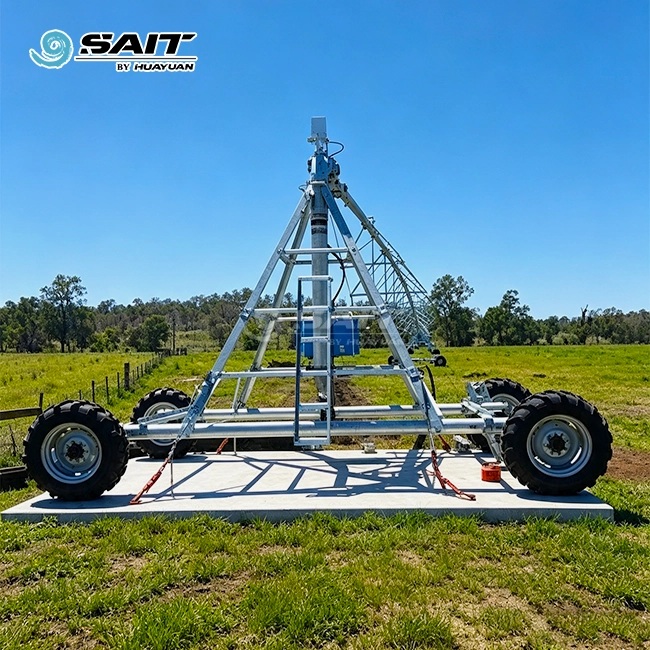
Center pivot machines set themselves around a given point. There is no such base in a linear watering system. Each drive unit has to keep the whole machine in line on its own, and the length of the machine can go up to 800 meters. HUAYUAN SAIT's four-wheel and two-wheel horizontal configurations both use the cable reference line as their main source of direction information. This means that the accuracy of the whole system depends on how well that single wire rope is installed.
Common Installation Errors That Cause Field Problems
Most steel cable guidance mistakes happen when the cable tension isn't the same along the run, anchor stakes are driven at an angle instead of straight up and down, or the cable is routed too far away from the machine's wheel path. Each mistake adds a horizontal force that the steering system has to fight all the time. This wears out parts faster and makes the watering less even. Studies on wire rope guidance systems show that most steering drift issues can be stopped by keeping the right fleet angle (0.5°–1.5°) and anchor spacing.
Preparing for Steel Cable Installation: Best Practices
Being well-prepared cuts installation time in half and stops the extra work that makes operators and sellers mad.
Selecting the Right Cable Specification
For HUAYUAN SAIT linear systems to work, the wire rope diameters must be the same as the sensing wheel groove on the drive unit. To keep the groove radius from pinching and still make a good connection, it should be 5–10% bigger than the nominal wire width. Galvanized wire rope with a hot-dip coating thicker than 80 μm is good for fields that are humid or near the coast because it doesn't rust and can be used all year. A polymer-jacketed rope protects the guide contact points from the rough sand that is typical in Middle Eastern restoration projects.
Tools and Hardware Checklist
A one-day job takes three days if you show up without the right tools. This is what a full work crew needs:
- Steel cable (correct diameter and rated breaking strength for span length): Confirm specification against machine documentation before leaving the warehouse.
- Ground anchors or concrete deadman anchors: Anchor pull-out strength must exceed 1.5× the maximum cable tension calculated for your field length.
- Wire rope clamps, thimbles, and turnbuckles: Use clamps rated to ISO 4308-1 load classes to avoid compression failures.
- Tension meter or dynamometer: Calibrate cable tension to the manufacturer's specified range — typically 200–400 N for standard lateral lengths.
- Survey stakes and measuring tape: Mark the cable centerline before driving a single anchor.
Any skilled assembly crew should have these things. If you don't have even one, especially the tension meter, you have to guess, which shows up as guiding mistakes in the first irrigation cycle.
Site Survey and Centerline Layout
Use a laser level or theodolite to walk the whole length of the field before stretching the wire. Write down any change in elevation that is greater than 1%, as slope affects how the stress is spread along the run. The usual span sizes for HUAYUAN SAIT's anchored cable are 37.5 m, 43.3 m, 49.1 m, and 54.9 m. They are designed to work best on flat ground, where wire guidance works best. When installing on slopes, the team must change the anchor depth and cable pre-tension to fit the situation. Put a stake in the ground every 50 meters along the centerline of the cable before you start installing it.
Step-by-Step Steel Cable Installation Process
The crew, the machine, and the wire are all safe with a strict order.
Step 1 — Drive and Test Anchors
First, put terminal anchors on both ends of the cable run. Drive roots so that they are 90° to the ground. Stakes that are driven at an angle lose 30% to 40% of their rated pull-out strength. Before connecting the cable, put a test load on it that is equal to the design tension. Every 100 to 150 meters, there are anchors in the middle that keep the wire from sagging, which would cause the sensing wheel to lose touch on the return pass.
Step 2 — Lay and Connect the Cable
Draw a line down the middle of the wire rope and unroll it along that line. Do not let it kink. Kinks make permanent weak spots and bend the local cable path, which means that every time the sensor passes, the steering needs to be corrected for a short time. Use a thimble and two wire rope clamps that are torqued to the manufacturer's value to connect the first lead end. At the second pin, thread the other end through a turnbuckle. At this point, leave the turnbuckle fully open.
Step 3 — Tension, Verify, and Secure
Use the dynamometer to tighten the cable to the right level while someone else checks the midpoint for sag. At any point in the middle, the target tension should keep the cable within 25 mm of the surveyed centerline. Install all the intermediate guide stakes and lock the turnbuckle with a jam nut once the tension is set. Take a picture of the final wire path so that you can use it as a guide for future repair.
Maintaining Steel Cable for Long-Term Reliable Operation
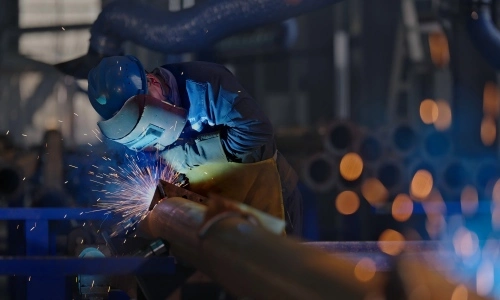
Setting up only needs to be done once. Taking care of the machine is what keeps it running well for years.
Seasonal Inspection Protocol
Before each watering season, check the whole cable run for rust pits, broken strands, and anchors that have moved. The DIN 15020 inspection standard says that wire rope should be replaced when there are more than 10% broken wires in any six-meter length. If your HUAYUAN SAIT systems are in sandy or salty soils, you should check them more often—every month during peak season is fine.
Lubrication and Cleaning
To avoid galling, steel cable guidance parts, especially the sense wheel bearings and guide rollers, need to be lubricated regularly. Every 200 hours of use, grease the wheel bearings with food-grade grease. At the start of each season, clean the cable surface of sand and crop residue. Abrasive particles stuck between the cable and roller groove speed up wear on both surfaces.
When to Replace Cable and Components
If you see corrugation (rope marks) in the guide wheel gap or if the rope is kinked, crushed, or has lost its color due to heat, you should replace the wire rope. When the depth of the groove wears past 1 mm, the sensing wheel rollers need to be replaced because the worn groove changes the contact geometry and causes steering lag. HUAYUAN SAIT offers extra parts for life at the price of the plant, so getting replacements doesn't take a long time.
Conclusion
Installing steel cable guidance correctly isn't hard, but it does take discipline—accurate centerline surveying, the right size anchors, calibrated tension, and written verification after installation. Each step has a direct effect on how straight the machine moves, how evenly water is applied, and how long the parts that guide it last. It is possible for HUAYUAN SAIT lateral move systems to cover more than 98% of rectangular fields up to 240 hectares, but only if the cables are installed correctly the first time. If you follow this guide, your system will work reliably from the first time it is used for watering and for many years to come.
FAQ
Q1: How long does steel cable guidance installation take for a standard lateral system?
A two-person crew with the correct tools can complete cable installation for a 400-meter field run in one working day. Longer runs or fields with significant grade changes require an additional half-day for re-tensioning and verification.
Q2: Can I switch from cable guidance to GNSS guidance later?
Yes. HUAYUAN SAIT's linear irrigation machines use a modular drive unit platform. The guidance method — cable, furrow, or BDS/GPS dual-mode satellite — can be swapped without replacing the drive unit chassis. This protects your initial investment if field conditions change.
Q3: What cable diameter should I specify for a 54.9-meter span configuration?
Consult the HUAYUAN SAIT installation manual for your specific machine configuration. Span length and machine weight determine the required cable breaking strength. Never downsize the cable to reduce cost; the guidance system's tension sensor is calibrated to a specific load range.
Q4: Does cable guidance work in sandy desert soils?
Cable guidance functions correctly in sandy soils provided anchors are sized for the lower soil bearing capacity. Concrete deadman anchors or screw-type ground anchors are preferred over driven stakes in loose sand. HUAYUAN SAIT systems have operated successfully in Middle East desert reclamation projects.
Get Your Linear Irrigation System Running Straight — Contact HUAYUAN SAIT
HUAYUAN SAIT has been making linear watering systems for 20 years, has over 130 patents, and can make 1,800 units a year. From our factory in Suzhou, our steel wire guide systems are shipped within a week. We are a direct factory that supplies steel cable guidance. We offer OEM and ODM services, a free warranty for one year, low-cost maintenance for three years, and parts for life. To get a price for your project right away, email kevin@showyirrigation.com with the size of your field and the type of food you want to plant.
References
1. FAO Irrigation and Drainage Paper No. 56 — Crop Evapotranspiration: Guidelines for Computing Crop Water Requirements, Food and Agriculture Organization, 1998.
2. ASABE Standards EP405.1 — Design and Installation of Microirrigation Systems, American Society of Agricultural and Biological Engineers, 2012.
3. ISO 4308-1 — Cranes and Lifting Appliances: Selection of Wire Ropes, Part 1: General, International Organization for Standardization, 2003.
4. DIN 15020-1 — Lifting Appliances: Principles for Wire Rope Drives, Deutsches Institut für Normung, 1974.
5. Irrigation of Agricultural Crops (2nd ed.), Agronomy Monograph 30, American Society of Agronomy, 2007.
6. Wire Rope Users Manual (4th ed.), Wire Rope Technical Board, 2005.
Get a tailored irrigation solution for your project — our engineering team is ready to support you from design to installation.