Best water-saving solutions for arid regions?
When farming dry land, water is your most scarce resource, and losing it to improper irrigation is a cost no enterprise can afford. Precision delivery hardware, automatic scheduling, and sturdy design engineered for tough situations make this the greatest water saving irrigation solution for dry areas. HUAYUAN SAIT centre pivot irrigation systems save over 70% water compared with flood irrigation, and can irrigate 4-200 hectares each time with fertigation and intelligent control integrated. This guide takes procurement managers, EPC contractors and large-scale farm operators through all the steps of selecting and implementing the correct solution.
Understanding Water-Saving Irrigation Solutions for Arid Regions
The UN Food and Agriculture Organisation reports that almost 70% of global freshwater withdrawals are for agriculture. In arid countries, pressure increases quite fast. In typical flood irrigation, as much as half the water evaporates or runs off before it gets to the plants. Precision watering systems modify this equation entirely by delivering water directly to the roots and changing the amount of water given to the soil’s ability to absorb it.
What Separates Precision Irrigation from Conventional Methods
Precision watering devices control how much water is used, when it’s administered, and where it goes – all at the same time. For example, the SAIT system aligns the rate of delivery with the ability of the soil to absorb water so there are no surface pools or deep percolation losses. The precision level keeps water budgets and soil structure safe over time.
Automation and Smart Technology Integration
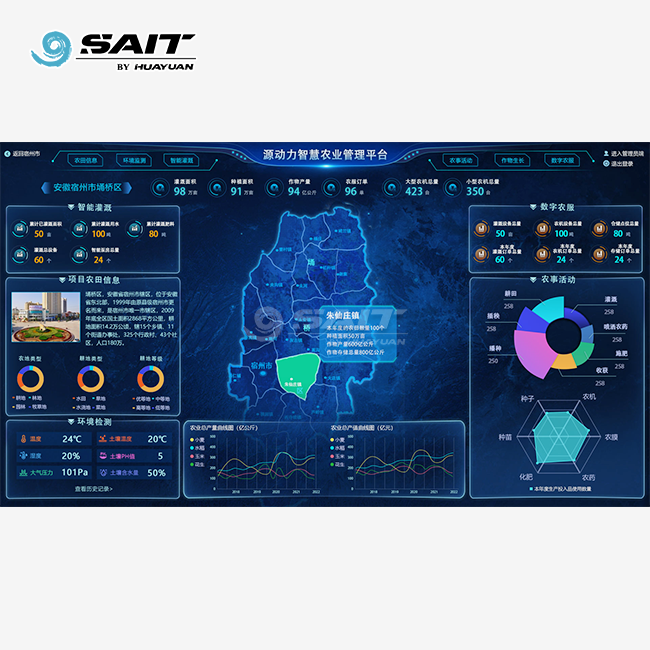
Modern systems are armed with IoT sensors, real-time weather data, and computational scheduling rather than guessing. You may control your farm remotely, establish different rates for different zones, and regulate the system using big data models, all with HUAYUAN SAIT's SAIT Smart Control System. You can see it all from your phone or a central administration tool for your farm.
Documented Impacts on Yield and Sustainability
A 2022 study published in Agricultural Water Management revealed that water-efficient irrigation, specifically center pivot irrigation with variable rate control, increased corn yields by 18-22% and reduced the amount of water used by 30-35% compared with surface irrigation in mostly dry test plots. These results speak for themselves, and the rationale for investment is simple for buyers on a business scale.
Top Water-Saving Irrigation Systems Suitable for Arid Climates
Which technology to use depends on the size of the field, the type of crop, the amount of energy available, and your budget. The market has a number of tried-and-true choices, and buying teams can save a lot of time and money by learning about the pros and cons of each one.
Drip Irrigation for Precision Row Crop Applications
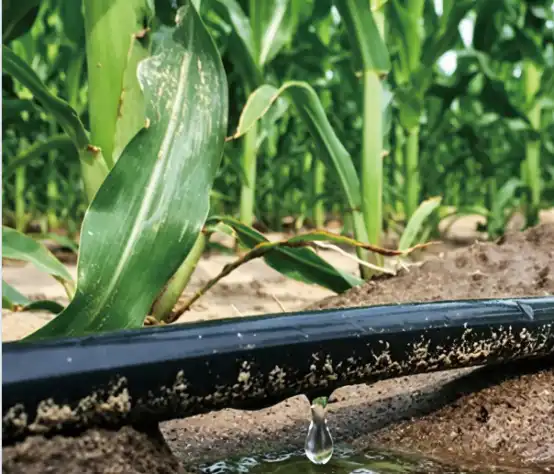
Subsurface drip irrigation (SDI) gets water to the roots more efficiently than surface methods, cutting water loss by up to 40%. When used on a moderately sized field, it works well for orchards, vineyards, and row crops. Disk or screen filters that don't get clogged and have self-flushing turbulent flow paths can handle modest sediment loads consistently.
Center Pivot Sprinkler Systems for Large-Scale Arid Farming
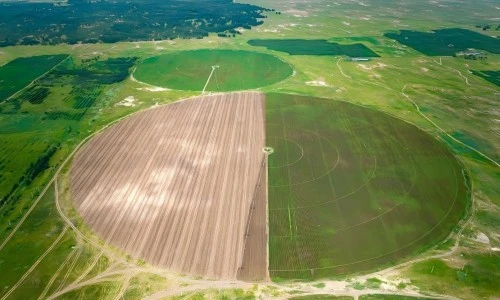
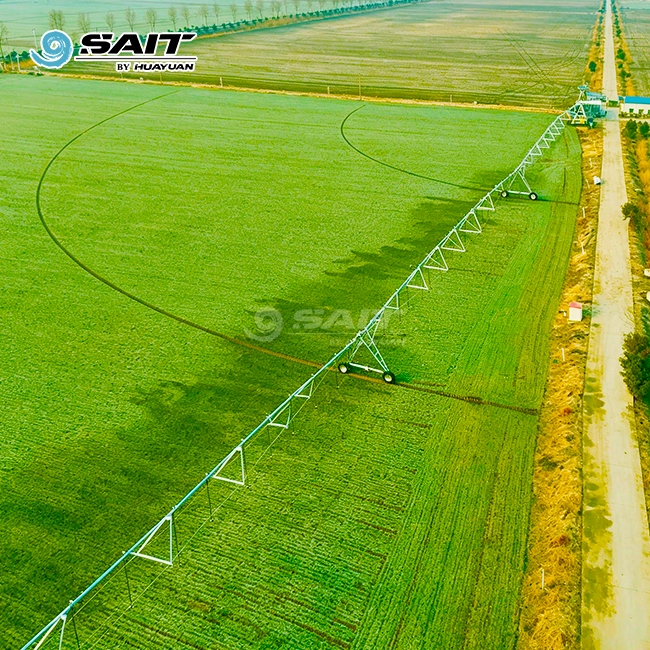
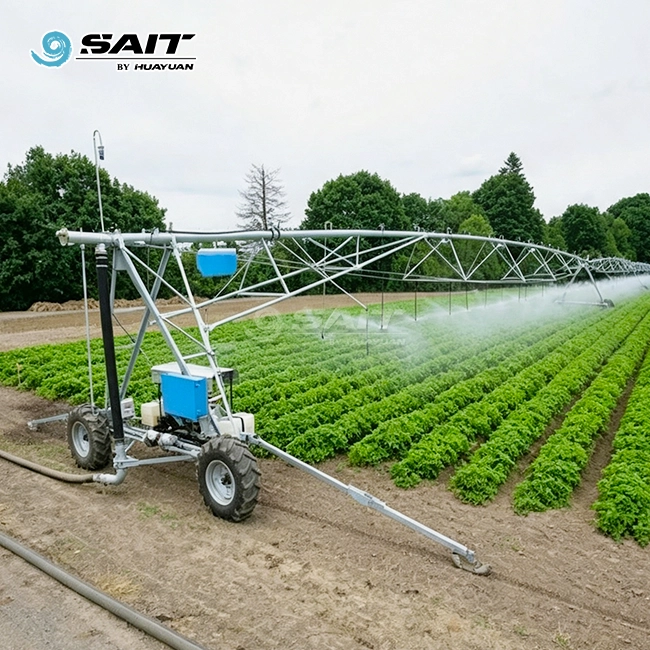
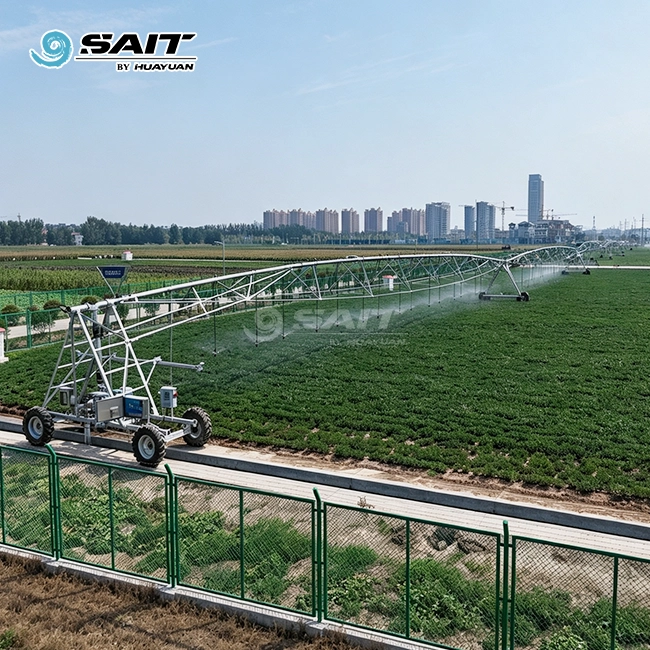
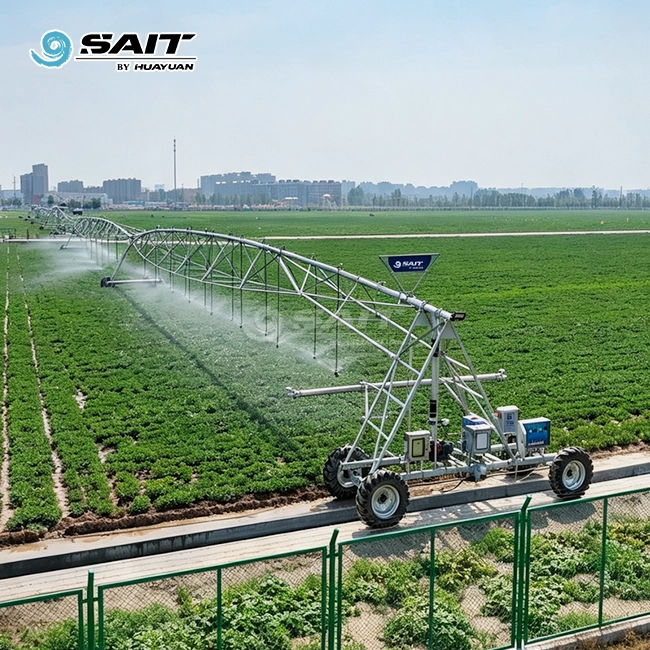
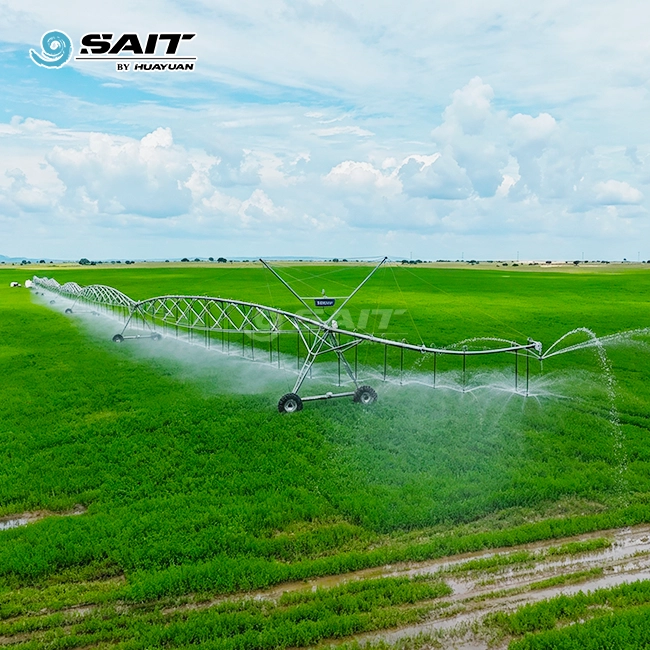
Center pivot systems cover the most land, are easiest to use, and use the least amount of water for operations that cover more than 100 hectares. The HUAYUAN SAIT center pivot can turn in a circle up to 800 meters across, which is equal to 200 hectares. There are three main sizes for pipeline options: 5" (127mm), 6-5/8" (168mm), and 8-5/8" (219mm). The span lengths range from 37.5m to 66.5m, so they can fit a lot of different field shapes.
Solar-Powered and Off-Grid Irrigation Options
Unreliable grid power is common in parts of Central Asia and sub-Saharan Africa. To get around this, automatic controls and solar-powered pump systems can be used. On a long-term basis, this combination gets rid of the need for diesel generators and meets the needs of World Bank and FAO projects that focus on building sustainable infrastructure. You can get big efficiency gains from adding pressure-compensating emitters, better filtration units, and smart controls to pipe networks that are already in place without having to replace the whole system. This method lowers the cost of capital while increasing the useful life of assets that have already been placed.
Retrofitting Legacy Infrastructure
Not every operation starts from scratch. Pressure-compensating emitters, upgraded filtration modules, and smart controllers can be added to existing pipe networks to recover significant efficiency gains without replacing the entire system. This approach keeps capital costs lower while extending the productive life of installed assets.
Designing and Implementing Water-Efficient Irrigation in Arid Regions
Most problems in the field can be avoided before they happen if the system is well designed. People in charge of procurement often make the costly mistake of skipping the research step.
Pre-Implementation Soil and Crop Water Analysis
First, check the structure and infiltration rate of the dirt as part of a water saving irrigation solution. Sandy soils in dry areas drain quickly, so they need to be watered less often but more often. Clay-rich soils hold water for longer, but they pack down quickly when a lot of it is applied. HUAYUAN SAIT offers 1.9m and 2.9m spacing, and custom configurations are also possible. Whether water reaches roots or drains past them depends on the type of soil.
Installation Best Practices and Span Configuration
In order for a structure to be safe, it must be strong at the span level. The truss rod design by HUAYUAN SAIT (20mm or 22mm rod diameters) keeps the structure's shape even when loads are applied from different angles. There are four span height options: 2.1m, 2.9m, 3.8m, and 4.5m. These can be used for row crops, high-clearance sugar cane plantations, and biofuel plantations. Direct supervision of the installation can be arranged from the factory team.
Scheduling, Maintenance, and Troubleshooting
Once the system is up and running, the SAIT Smart Control platform automatically sets the timing of watering cycles based on the stage of crop growth and real-time data on soil wetness. As part of seasonal maintenance, the system is flushed, emitters are checked for mineral scale buildup, and the stability of the cables is checked. The armored UL-listed wire standard lowers the chance of an electrical failure happening outside. HUAYUAN SAIT backs up every system with a full guarantee for one year, low-cost maintenance support for three years, and factory-cost extra parts for life.
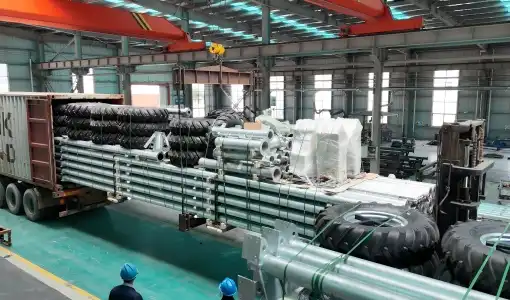
Comparing Water-Saving Irrigation Solutions for Procurement Decisions
A clear framework is needed for procurement managers to compare different systems. Price alone doesn't always tell you what the total cost of ownership will be over 20 years.
For B2B buyers, these are the most important things to look at when comparing:
- Water efficiency: HUAYUAN SAIT center pivots save over 70% more water than flood irrigation, with irrigation uniformity exceeding 90% — above the industry average achieved by BeiDou-integrated corner arm systems that reduce missed irrigation rates to below 5%.
- Durability and corrosion resistance: Hot-dip galvanizing at a minimum 80μm zinc coating thickness protects structural steel against rust in desert, tropical, and temperate continental environments, with a designed service life exceeding 20 years.
- Scalability: With span lengths from 37.5m to 66.5m and overhang options up to 25m, the system scales from 4-hectare pilot plots to 200-hectare commercial fields without changing the core platform.
- Supplier qualifications: Look for ISO 9001 certification, ASABE standards compliance, and verifiable export documentation. HUAYUAN SAIT holds over 130 patents — including 35 invention patents and 15 international patents — backed by co-developed R&D platforms with China Agricultural University.
Durability and resistance to corrosion: Hot-dip galvanizing with a zinc coating of at least 80μm protects structural steel from rust in desert, tropical, and temperate continental environments, and is meant to last for more than 20 years.
Scalability: The system can be used on anywhere from a 4-hectare test plot to a 200-hectare commercial field without changing the core platform. Its span lengths range from 37.5m to 66.5m, and it can extend up to 25m.
Future Trends and Technological Advances in Water-Saving Irrigation
The irrigation business is switching from watering on a set plan to managing based on demand; water-efficient irrigation is now the focus, with real-time monitors that measure soil moisture, scheduling systems that are run by AI, and satellite maps of fields all changing what precision agriculture really means.
IoT and Sensor-Driven Irrigation Management
Sensor networks that send real-time data to cloud-based controllers let farms react to real crop stress instead of set schedules. This demand-based method stops both water stress and overwatering, which are both bad for the health of the crop.
AI-Driven Variable Rate Irrigation
The SAIT Smart Control System from HUAYUAN SAIT already has big data models for Variable Rate Irrigation, which changes the rates of application in different zones during a single pivot cycle. With more field data, AI models will get more accurate, and this feature will help cut down on water waste even more.
Climate Adaptation and Regulatory Alignment
As rules on water use get stricter in the US, EU, and Middle East, farms have to keep track of and report the amount of water they use for irrigation. Smart systems that keep track of every application event automatically meet legal standards and gather information for making decisions about farming.
Conclusion
Farmers in dry areas have a clear problem to solve: they need to grow more food with less water. This water saving irrigation solution combines high-efficiency spray or drip gear with smart control systems and materials that are made to last for decades outside. These needs are met directly by HUAYUAN SAIT's center pivot platform, which is made of 80¼m+ galvanized steel, covers 4 to 200 hectares per unit, and is controlled by the SAIT Smart Control System. It is a good choice for business farms, government projects, and engineering firms that work in dry areas because it has been made for 20 years and comes in a variety of OEM/ODM configurations.
FAQ
Q1: How much water does a center pivot system actually save compared to flood irrigation?
A center pivot that is set up correctly and has variable rate control saves more than 70% more water than standard flood irrigation. If the regularity of the irrigation is above 90%, water gets to the crop instead of flooding the paths or disappearing from the bare soil.
Q2: What is the typical ROI timeline for upgrading to precision irrigation?
In 18 to 36 months, most B2B clients see a return on their investment. The payback period depends on the crop value and the price of water in the area. It is driven by lower water costs, average 18–22% increases in yield, and less work that needs to be done.
Q3: Can the SAIT Smart Control System integrate with existing farm management software?
Yes. The SAIT platform can connect to third-party SCADA systems and major agricultural management platforms through LoRaWAN and 4G/5G networks using APIs. This lets data flow smoothly without having to replace software infrastructure that is already in place.
Q4: What certifications does HUAYUAN SAIT hold for US procurement?
HUAYUAN SAIT products are made according to ISO 9001 quality management standards, using ASABE-compatible parts and UL-listed armored wire specs. These meet the standards for business and government purchases in North America.
Ready to Source a Proven Water-Saving Irrigation Solution? Contact HUAYUAN SAIT Today
For more than 20 years, HUAYUAN SAIT has provided industrial farms, government agencies, and EPC companies with water saving irrigation solution systems. We offer competitive unit prices, 60–90 day delivery windows, and lifetime support for spare parts because we are a direct water saving irrigation solution manufacturer without middlemen. To get a technical proposal that fits your project, email Kevin at kevin@showyirrigation.com with the details of your field.
References
1. Brouwer, C., Prins, K., & Heibloem, M. Irrigation Water Management: Irrigation Scheduling. FAO Training Manual No. 4. Food and Agriculture Organization of the United Nations, 1989.
2. Camp, C.R. "Subsurface Drip Irrigation: A Review." Transactions of the ASAE, Vol. 41, No. 5, 1998.
3. Evans, R.G., & Sadler, E.J. "Methods and Technologies to Improve Efficiency of Water Use." Water Resources Research, Vol. 44, 2008.
4. Howell, T.A. "Enhancing Water Use Efficiency in Irrigated Agriculture." Agronomy Journal, Vol. 93, No. 2, 2001.
5. Pereira, L.S., Oweis, T., & Zairi, A. "Irrigation Management Under Water Scarcity." Agricultural Water Management, Vol. 57, No. 3, 2002.
6. Vories, E.D., & Evett, S.R. "Irrigation Technology and Management for Arid and Semi-Arid Agriculture." Applied Engineering in Agriculture, Vol. 35, No. 1, 2019.
Get a tailored irrigation solution for your project — our engineering team is ready to support you from design to installation.