What Water Pressure Does Hose Reel Irrigation-Boom Spray Require?
A hose reel irrigation-boom spray system typically requires an inlet pressure of 0.3–1.2 MPa (approximately 43–174 PSI) depending on the model, pipe diameter, and field configuration. At the nozzle end, working pressure generally ranges from 0.25–0.6 MPa (36–87 PSI). These figures apply across turbine-driven traveler systems paired with boom carriages. Getting pressure right is not optional — it directly determines spray uniformity, droplet size, coverage width, and how efficiently your crops receive water without waste or mechanical strain.
Understanding Water Pressure Fundamentals in Hose Reel and Boom Spray Irrigation


Before you buy any watering equipment, you should know what pressure does in the system. This will save you a lot of money and trouble in the long run.
What Pressure Measurements Actually Mean
In irrigation, MPa, bar, or PSI are used to measure water pressure. About 14.5 PSI, or 0.1 MPa, is equal to one bar. The pressure coming into the reel unit from the pump or mainline is called the inlet pressure. The pressure that reaches the spray head after friction loss through the PE pipe is called the nozzle pressure. Both numbers are important on their own.
How Pressure Affects Spray Performance
When there isn't enough pressure at the nozzle, big, uneven droplets form on the surface of the soil and pack it down. When there is too much pressure, a fine mist forms that vanishes before it can reach the roots, especially when it is windy. The goal is for droplets to be of a controlled size so that they can reach deep into the sky without hurting weak plants or wasting water by drifting.
Hose Reel vs. Boom Spray Pressure Logic
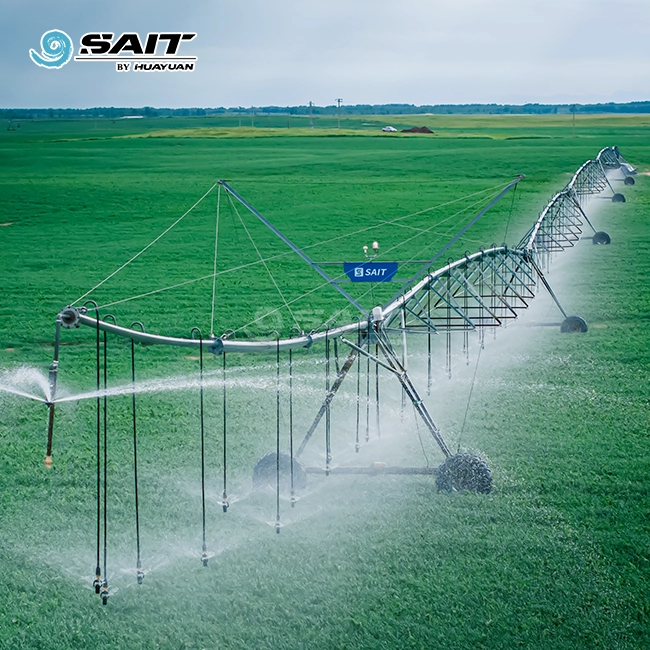
You need a higher tip pressure (often 0.4 to 0.7 MPa) for a single rain-gun spray on a hose reel traveler to get a wide throw radius. A hose reel irrigation-boom spray system uses a boom-type carriage that shares the same flow across several low-pressure nozzles. This means that each nozzle only works at 0.25–0.5 MPa, but the total watering width can be 43–78 meters. Compared to gun-style methods, this saves a lot of water and energy.
Key Factors Influencing Water Pressure Requirements
The exact amount of pressure your system needs depends on a number of factors. Knowing about them helps you choose the right gear from the start.
PE Pipe Diameter and Length
The friction loss goes up as the pipe gets longer and down as the diameter gets bigger. The JP-75/500 type has a 75mm PE pipe that goes for 500 meters. For the nozzle to work properly at the far end, the input pressure needs to be between 0.6 and 1.1 MPa. The JP-90/400, on the other hand, has a 90mm pipe that goes over 400 meters and can work with an inlet pressure as low as 0.3 MPa, which makes the pump's job much easier.
Nozzle Type and Configuration
The width of the nozzle directly affects the throw distance and flow rate. The sprinkler flow rate for the JP-90/400 model is 10–50 m³/h, and the spray range is 25–46 meters. It can use nozzles with diameters between 14 and 28 mm. For the same pressure, a wider nozzle opening needs a higher flow. By matching the nozzle size to the crop and field width, you can avoid both under-application and pressure waste.
Field Conditions and Terrain
In order to make up for slope gain, elevated fields need more pump head pressure. Soils that are sandy and drain quickly can handle a little more material (>7–8 mm/h), but soils that are clay-based need slower movement speeds to keep water from running off. Spray patterns from gun sprinklers can be messed up by winds over 4 m/s. But boom-type carriages stay stable up to 7–9 m/s because the nozzles are close to the crop canopy.
Optimal Water Pressure Ranges for Efficient Operation
Here is a useful list of all the HUAYUAN SAIT JP-series types that can be bought by businesses right now:
The table below shows the pressures at the intake and tip for each model:
JP-75/300 and JP-75/400: Inlet pressure of 0.5 to 1.0 MPa; Nozzle pressure of 0.25 to 0.5 MPa; Flow rate of 15.5 to 34.3 m³/h; Coverage width of 47 to 74 m
- JP-75/300 & JP-75/400: Inlet 0.5–1.0 MPa | Nozzle 0.25–0.5 MPa | Flow 15.5–34.3 m³/h | Coverage width 47–74 m
- JP-75/500: Inlet 0.6–1.1 MPa | Nozzle 0.25–0.5 MPa | Flow 15.5–34.3 m³/h | Coverage width 47–74 m
- JP-90/300: Inlet 0.5–1.0 MPa | Nozzle 0.4–0.6 MPa | Flow 17.2–48.4 m³/h | Coverage width 43–78 m
- JP-90/400: Inlet 0.3–1.2 MPa | Nozzle 0.25–0.5 MPa | Flow 10–50 m³/h | Coverage width 43–78 m
These ranges are not made up on the spot; they show the performance envelopes that have been tested in the field for the hose reel irrigation-boom spray system. Working within these ranges makes sure that the turbine drive pulls back the hose at a speed of 8–80 m/h, which gives a consistent application depth of more than 7–8 mm/h no matter what kind of crop is being used.
Real-time readings from a glycerin-filled pressure gauge at the entry port and a second gauge near the boom feed pipe let you check things on-site. During busy watering times, calibrate once a month.
Troubleshooting and Maintaining Proper Water Pressure
Pressure problems are the most common cause of poor irrigation results. Catching them early prevents crop stress and equipment damage.
Diagnosing Low Nozzle Pressure
Low nozzle pressure usually traces back to three sources: a pump delivering below rated flow, partial blockage inside the PE pipe (scale, sediment, or a collapsed inner wall), or a nozzle worn beyond its specified diameter. Check inlet pressure first. If inlet reads normal but nozzle pressure is low, the problem is inside the pipe or boom manifold. Flush the system before each season to clear debris.
Addressing Pressure Spikes and Surges
Sudden pressure surges — called water hammer — occur when the turbine drive stalls or a valve closes too quickly. Repeated surges crack PE pipe joints and damage turbine seals. Installing a pressure relief valve set at 10% above the maximum rated inlet pressure (e.g., 1.1 MPa for JP-75 models) protects the system. HUAYUAN SAIT supplies matching pressure relief components as part of its spare parts catalog.
Scheduled Maintenance to Prevent Failures
PE pipe failure is the leading warranty issue across the traveler irrigation industry. HUAYUAN SAIT uses self-produced virgin-material PE pipe — no recycled content — with wall thickness exceeding standard market peers. With proper winding tension and UV stabilization, pipe service life exceeds 15 years. A maintenance schedule should include quarterly inspections of hose winding uniformity, turbine gearbox lubrication, and nozzle wear measurement.
Making the Right Procurement Decision: Hose Reel vs. Boom Spray Based on Pressure Needs

The equipment to choose should be based on the pressure requirements you have, not the other way around.
Matching System Type to Available Pressure
No matter what kind of gun or boom you use, as long as your pump consistently delivers 0.5 to 0.8 MPa at the field connection point, it will work. The JP-90/400's wide inlet range (0.3–1.2 MPa) gives you the most options if your water source pressure is low. This is common in gravity-fed systems or off-grid farms with turbine-driven units. A hose reel irrigation-boom spray system works especially well in low-pressure situations because it spreads the flow across many nozzles instead of forcing it through one big hole.
Efficiency and Cost Comparison
Boom spray systems use 30–50% less nozzle pressure than gun showers of the same type, which means they use less pumping energy per cubic meter of water sprayed. One HUAYUAN SAIT hose reel irrigator watered more than 1.33 hectares in one cycle, and the system saved more than 50% of water compared to flood or traditional gun irrigation. These results come from field tests done with the help of China Agricultural University as part of national key R&D projects.
Selection Criteria for B2B Buyers
Aside from price, the most important things to look at when choosing a seller are the length of the PE pipe guarantee, the consistency of the turbine's efficiency, and the availability of parts after the sale. The equipment made by HUAYUAN SAIT comes with a full warranty for one year, a low-cost maintenance program for three years, and spare parts that are supplied at factory cost for life. With more than 130 patents, including 35 idea patents, and 20 years of experience making things, each unit has a strong technical base.
Conclusion
It's a technical choice that has direct financial effects on getting the water flow right in a hose reel irrigation-boom spray system. If it's too low, crops don't get enough water. If it's too high, you waste energy, hurt the nozzles, and shorten the life of the PE pipe. The HUAYUAN SAIT JP-series models work in a pressure range that has been tested and proven to work: 0.3–1.2 MPa at the inlet and 0.25–0.6 MPa at the nozzle. This covers most field situations, from short 300-meter runs to long 500-meter deployments. To get effective and long-lasting irrigation, you should first make sure that the model you choose fits your pump's capacity, pipe length, and crop type.
FAQ
Q1: What is the minimum inlet pressure needed to run a boom spray traveler?
The JP-90/400 model can handle inlet pressures as low as 0.3 MPa, which is about 43 PSI. This means it can work with pump systems that don't have a high output or water sources that get their water from gravity.
Q2: Does nozzle diameter affect how much pressure I need?
Yes. When the pressure stays the same, bigger nozzle diameters move more water, but the throw distance gets shorter. You don't have to change the core unit of the JP-90/400 to change the flow rate or coverage area because it can handle nozzles from 14mm to 28mm.
Q3: Can I use the same pressure settings for grain crops and vegetables?
No, not really. To keep the leaves from getting hurt, vegetables and specialty crops need smaller drops and lower application rates. By lowering the pressure on the tip and slowing down the travel speed, this can be done on the same machine with no hardware changes.
Q4: How do I know if pressure is causing uneven crop coverage?
After the first pass, walk along the watered strip and look for dry bands or areas with a lot of water. Low boom pressure or worn nozzles can be seen in the form of dry bands between nozzle paths. If the edges are wet, it means that the travel speed is too slow compared to the flow rate.
Connect with HUAYUAN SAIT for a Pressure-Matched Irrigation Quote
The company HUAYUAN SAIT has been making direct hose reel irrigation-boom sprays for 20 years, has more than 130 patents, and can do OEM/ODM for custom configurations. From our factory in Suzhou, our JP-series units are sent out within a week. Send your field information, such as pump pressure, pipe length, and crop type, to kevin@showyirrigation.com.
References
1. Food and Agriculture Organization of the United Nations. Irrigation Water Management: Irrigation Methods. FAO Agricultural Services Bulletin, 1989.
2. Keller, J., & Bliesner, R. D. Sprinkle and Trickle Irrigation. Van Nostrand Reinhold, 1990.
3. American Society of Agricultural and Biological Engineers. ASABE Standards: Design and Installation of Microirrigation Systems. ASABE, 2007.
4. Phocaides, A. Handbook on Pressurized Irrigation Techniques. Food and Agriculture Organization of the United Nations, 2007.
5. International Organization for Standardization. ISO 8224-1: Traveller Irrigation Machines — Laboratory and Field Testing Methods. ISO, 2003.
6. Howell, T. A. "Irrigation Efficiency." Encyclopedia of Water Science, Marcel Dekker, 2003.
Get a tailored irrigation solution for your project — our engineering team is ready to support you from design to installation.